The sound of going Home
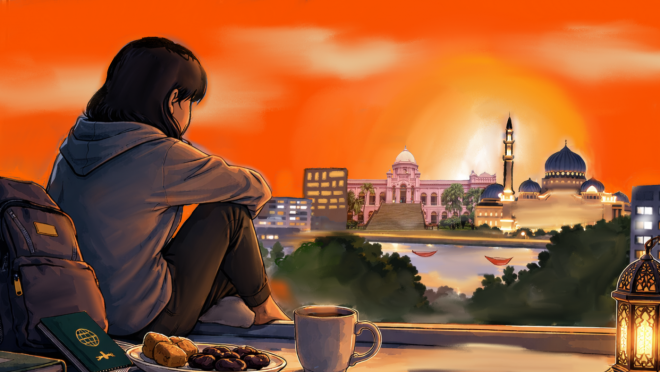
Writing from the quiet of Sydney, a Bangladeshi student captures the ache of distance and the longing for the vibrant chaos of home during Eid
The sound of going Home
Writing from the quiet of Sydney, a Bangladeshi student captures the ache of distance and the longing for the vibrant chaos of home during Eid
Essay
Tiana Samreen
Sf:
If you ask me, the most profound change when moving abroad isn’t the weather, the food, or even the language—it’s Eid.
For some, the loneliness starts at the first Iftar, but I didn’t truly feel the distance until Eid day. At home, Eid was effortless, like clockwork. It was the predictable rhythm of our three-person home—the aroma of Maa’s cooking filling the house while Baba fussed over the lighting, worried the living room wasn’t bright enough for our guests.
When I think of Eid at home, I go all the way back to the long traffic to reach the gates of Aarong in Tejgaon, and getting lost in the unnecessarily huge crowds before finding that one piece of clothing that is not available in the size I needed.
For the thousands of Bangladeshi students now carving out lives abroad, the “ordinary” they left behind has taken on a nostalgic glow.
They remember the frenetic energy of last-minute shopping after iftar and the sharp, vocal frustrations of drivers locked in rush-hour traffic—experiences that were once mere daily annoyances, but are now the vivid textures of a home they carry with them.
After iftar, the whole city would seem to pour into the streets. Roads that were already chaotic somehow became even more crowded. Shops stayed open late. At some point in that night, there was almost always a stop at Aarong.
It wasn’t something we planned. It just happened. Someone in the family would suddenly remember they still needed a panjabi or a shari, and we’d all end up there anyway.
Inside, it was the same scene every year. People trying on clothes in crowded fitting rooms. Someone complaining about the price. Someone else said, “let’s just check one more shop.”
But all that now feels distant. Because even if I went back today, I’m not sure those nights would exist in the same way.
Homecoming
For many Bangladeshis, Eid is the only time in the entire year when they can return home.
I have always been very fascinated by how every year just around the time of Eid, millions of people leave the capital and travel back to their hometowns and villages to celebrate with family, just like clockwork.
Every year, the days leading up to Eid triggers one of the largest internal migrations in the world. Dhaka, a city of more than 35 million people, slowly empties as workers, students, and families begin the journey home.
While the roads inside the city clear up, the highways leading out of the capital become packed, train stations overflow with passengers, and bus and ferry terminals operate around the clock.
And every eid, just like a habit, a familiar tune has also made its way through every Bangladeshi’s hearts, who have taken every medium, road, air, train or sea to come back to their loved ones.
‘Shopno Jabe Bari Amar ‘, created by Grameenphone has been re-released in multiple video versions over the last decade, with the same story: migrants, students, workers, and expatriates returning home for Eid.
Up until 2 years ago, my limited knowledge in marketing never really understood why the song kept coming back in different videos.
Now, I hear it every year, during Eid, and every year it hits me a little harder. And like me, workers who spend months in factories, offices, or construction sites in Dhaka, Chittagong, or Gazipur, expatriates living abroad, and especially students who have left to build a better life abroad, save money specifically for that one ticket that takes them home.
Somewhere between buying that ticket and reuniting with the familiar smell of Eid in Bangladesh, the song starts playing again.
Shopno jabe bari amar…
When you live abroad long enough, Eid ceases to be a given; it becomes something you earn. You wake in the quiet of the morning to pull on a new outfit sent across oceans by your parents, catching the earliest train to the nearest mosque.
There, you pray shoulder-to-shoulder with people from a dozen different nations. Afterward, the ‘Eid Mubarak’s are polite and the smiles are kind, but the crowd disperses quickly. Back in your room—which feels so much smaller than the vibrant, crowded scenes in the photos from Bangladesh.
You see your cousins dressed in their finery and your parents moving through a house that looks loud and full. But perhaps that is the beauty of it: knowing that no matter the distance, there is one day a year when the heart unfailingly turns back, a day when our hearts return home.