A few lines, a thousand wounds: Inside the mind of a poet
Poetry has the ability to hold entire worlds within a handful of words. A few syllables can carry longing, memory, love, grief, everything all at once. It does not explain; it evokes. It allows us to voice a thousand meanings and mean a thousand different things to different people at the same time.
A few lines, a thousand wounds: Inside the mind of a poet
Poetry has the ability to hold entire worlds within a handful of words. A few syllables can carry longing, memory, love, grief, everything all at once. It does not explain; it evokes. It allows us to voice a thousand meanings and mean a thousand different things to different people at the same time.
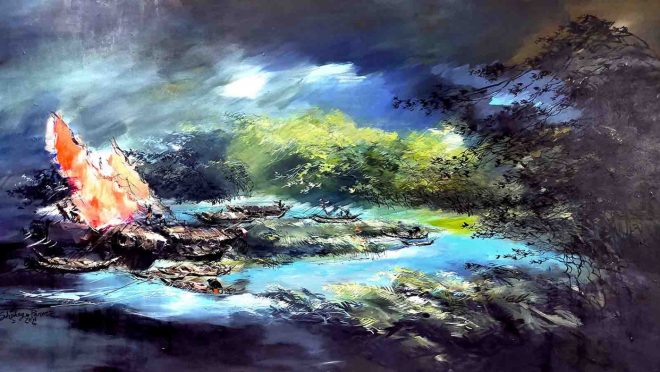
The initiated constantly appreciate the true beauty of poetry. It is an expression which is at once deeply personal and universally understood.
One of those initiated is Fairooz Zakir Pritha, a lecturer of English and a contemporary poet.
I chatted with Pritha to know what makes a poet in 2026, and how poetry began not as ambition but as survival for her.
In her words, “I started writing as a coping mechanism, which gradually developed into a passion and eventually became a lifestyle. Poetry saved me in ways I could not have imagined.”
And perhaps that is what makes poetry so extraordinary.
“Poets make vulnerability look easy when it is not. We express ourselves fearlessly when we have no reason to be fearless.”
In just a few lines, poetry becomes an act of courage. Yet poetry is not merely words. It is a craft. Beneath its apparent simplicity lies a complex architecture like rhythm, metre, form, symbolism, shape, and sound.
From the measured lines of a sonnet to the free-flowing lines of modern verse, poetry tells stories, sometimes directly, sometimes through fragments and metaphors. And the beauty is that poetry can convey whatever meaning the reader’s heart desires. For some, it can be a shield, and for others, it can hold power.
As Pritha insightfully notes, “All cultures and generations have their own monsters, and poetry is a weapon, a weapon of creation.” Even as language and style evolve, the essence of poetry remains unchanged.
“The messages remain timeless,” she says. We sometimes fail to notice the magnificent array of poetry. For example, a haiku can capture an entire moment in just a few syllables. On the other hand, an epic can contain thousands of lines to tell many stories.
There is concrete poetry, where the poet gives the poem the shape of the subject of the poem. In the world of poems, there is also lyric poetry, ballads, odes, elegies, blank verse, and sonnets. Meanwhile, confessional poetry, Pritha’s chosen form, dives deep into the personal by turning private pain into shared understanding.
Her own collection, Butterflies Feed on Blood (2024), explores childhood trauma and repressed emotions that continue to shape her behaviour as an adult.
According to Pritha, poetry can be a fascinating world in itself if somebody has the creative heart.
Historically, poetry predates prose. Long before novels or essays, human beings used to record their histories, beliefs, and myths through verses and rhymes.
Ancient epics like The Iliad, The Mahabharata, and Gilgamesh were not merely stories; they were vessels of culture, memory, and identity, all written in the form of poetry.
In many civilisations, poetry was oral long before it was written. It was recited, sung, and passed down through generations. Poetry was a way for people to remember long tales, history, genealogy, and even laws.
It served as both art and archive.
For Pritha, poetry is also a means of transformation. “When I write a poem, I am essentially rewriting those uncomfortable feelings,” she explains. “It is a bit like being an alchemist. I’m the initiator, and there lies my power.”
This notion of poetry as alchemy, turning pain into beauty, confusion into clarity, resonates deeply with many who write and read verse. At its core, poetry offers something increasingly rare in a fast-paced world.
“Poetry is nothing if not cathartic,” Pritha says. “It has given me a sense of purpose.”
While it may not solve the world’s problems, it can reshape how we see it.
However, poetry might often feel intimidating to those who wish to write their own. To them, Pritha offers a simple reassurance, “One poem is all you need to get into the habit of writing.” The first attempts may feel uncertain, imperfect even, but that is part of the journey.
“The mind of a poet ages like fine wine,” she says, suggesting that poetry, like life, deepens with time and experience.
In the end, poetry is not just something we read or write. It is something we live.