BRACU Duburi: How a student team transformed Bangladesh into a contender in global underwater robotics
Autonomous Underwater Vehicle (AUV) models have emerged as one of the most innovative technological advancements in the modern maritime and engineering world.
BRACU Duburi: How a student team transformed Bangladesh into a contender in global underwater robotics
Autonomous Underwater Vehicle (AUV) models have emerged as one of the most innovative technological advancements in the modern maritime and engineering world.
These unmanned robotic systems are designed to operate underwater without direct human control, contributing significantly to ocean exploration and mapping. With the rapid growth of AI, AUV models are now being developed by universities, research institutions, and governments across the globe to solve complex underwater challenges efficiently and sustainably.
BRACU Duburi from Bangladesh is such a project that has earned global attention as well as appreciation for Bangladesh.
To know more about this project, I spoke with Duburi’s Ashabur Rahman Shoummo, senior member of sensors and circuits.
Duburi’s journey began in 2017, during a time when underwater robotics was almost entirely unexplored in Bangladesh. While robotics itself was still gradually growing in the country, no one was truly working in the field of autonomous underwater systems.
“That reality felt surprising to us because Bangladesh is a nation shaped by water. We are surrounded by rivers, deeply connected to the Bay of Bengal, and heavily dependent on our waterways in everyday life. Yet very little technological development was happening in the underwater sector, especially in areas connected to marine research, underwater exploration, safety, and blue economy advancement,” Shoummo said.
At the same time, the country continued facing heartbreaking water-related incidents, launch accidents, drowning cases, and a lack of efficient underwater monitoring and inspection technologies. They began asking themselves a simple question: if countries around the world could use underwater robotics for research, safety, and exploration, why could Bangladesh not do the same?
That question became the beginning of BRACU Duburi.
What started as an ambitious idea gradually turned into a mission to pioneer underwater robotics research in Bangladesh and prove that advanced marine technology could also be developed locally.
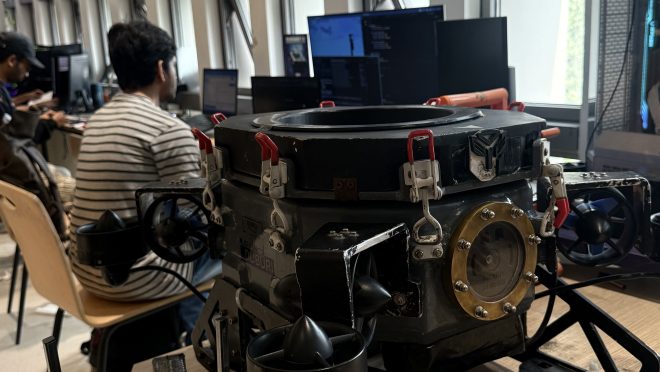
Today, BRACU Duburi stands as Bangladesh’s first and pioneering student-led AUV research team, and Duburi itself became the country’s first autonomous underwater vehicle.
Duburi means “diver” in Bangla, and the name perfectly captures its identity. It represents curiosity, exploration, courage, and the willingness to go deeper into challenges others avoid.
At the same time, the name keeps the roots connected to Bangladesh. Even though the team works with advanced robotics and AI, they wanted its identity to reflect local culture and national pride.
“As a delta nation with enormous dependence on water systems, we believe underwater robotics has significant long-term potential for Bangladesh,” Shoummo said.
The idea behind Duburi was never limited to building a robot for competitions. From the beginning, the vision was much larger.
“We wanted to create a platform where innovation, research, and engineering could come together to explore the possibilities of underwater technology in Bangladesh. Through robotics, AI, embedded systems, computer vision, and autonomous navigation, we hoped to push boundaries in a field that had barely been explored locally.”
One of Duburi’s biggest strengths is its highly student-driven engineering and integration process. Much of the robot, including mechanical systems, electronics integration, software architecture, testing infrastructure, and optimisation workflows, has been designed and adapted internally according to their own research goals and constraints.
What makes Duburi unique is not a single component alone, but the fact that a multidisciplinary student team built and continuously evolved an advanced underwater robotic system from the ground up in an environment where resources and access to underwater robotics technology are still limited.
BRACU Duburi stepped onto the international stage through prestigious underwater robotics competitions such as SAUVC and RoboSub, where the team represented Bangladesh among some of the world’s most established robotics teams.
One of the team’s biggest milestones came in 2023, when BRACU Duburi became the runner-up at RoboSub, placing Bangladesh among the world’s leading underwater robotics teams. In 2025, the team secured 8th place internationally while also earning awards including the Best Entrepreneurship Award.
BRAC University authorities played a major role in supporting Duburi by providing institutional guidance, workspace, research facilities, and opportunities for development.
Alongside university support, the team also relied on sponsorships, industry collaborations, technology partners, alumni support, and contributions from members to sustain prototyping, testing, and international participation. Because underwater robotics research is resource-intensive, every form of support, whether technical, financial, or mentorship-based, contributed significantly to the team’s growth.
Apart from BRAC University, Duburi also received encouragement and support from mentors, alumni, sponsors, industry professionals, researchers, technology partners, and the wider robotics community.
The belief and trust shown by people outside the university helped the team continue pushing forward through technical and financial challenges.
Underwater robotics comes with complex challenges such as waterproofing, pressure resistance, communication limitations, stability, navigation, sensing, and autonomy.
These were addressed through continuous testing, teamwork, research, and persistence. Many solutions came through repeated prototyping and learning from failures. One of Duburi’s greatest strengths has been the team’s ability to adapt, innovate under constraints, and keep moving forward despite limitations.
Five years from now, the team hopes to see BRACU Duburi recognised as one of the leading underwater robotics and marine technology research platforms in South Asia.
“Our goal is to go far beyond competitions and contribute to real-world applications involving underwater inspection, environmental monitoring, marine exploration, and blue economy technologies,” said Shoummo.
Today, that vision continues expanding through Dubotech, an industrial initiative working on ROV-based technologies and underwater solutions, while BRACU Duburi continues serving as a core research and development platform through continuous innovation and annual participation in RoboSub with upgraded AUV systems every year.
“More importantly, we hope our journey inspires a new generation of innovators in Bangladesh to believe that world-class technology and deep-tech research can also emerge from here,” concluded Shoummo.