DenimRevive: Building a circular future from Bangladesh's textile waste
There is a moment after every competition when the lights go out, the applause fades, and reality returns.
DenimRevive: Building a circular future from Bangladesh's textile waste
There is a moment after every competition when the lights go out, the applause fades, and reality returns.
In 2025, that reality was painful for Jahidul Rakib and his team.
They had already done what many student entrepreneurs dream of doing. They had won their campus round of the Hult Prize and earned a place at the national competition. They believed in their idea, had spent months preparing, and arrived hoping to take the next step.
Instead, they went home empty-handed.
For many teams, that would have been the end of the story. For DenimRevive, it became the beginning.
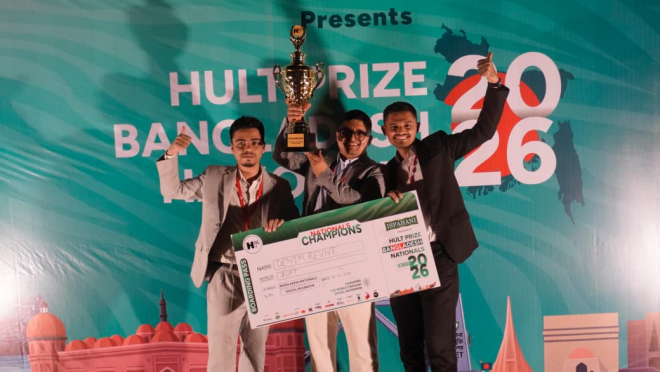
A year later, Rakib and his team stood on the national stage once again. This time, they were not just participants. They were champions. DenimRevive emerged as the winner of Hult Prize Bangladesh 2026, securing a place in the prestigious Hult Prize Global Digital Incubator and putting a student-led sustainability startup on the global map.
Yet the victory was years in the making.
“Our journey took three years and a lot of stubbornness,” Rakib recalled. “People see the trophy, but they don’t see the two years of ‘not yet’ that came before it.”
The team’s Hult Prize journey began in 2024. Their idea showed promise, but they fell short and finished as first runners-up at the campus level. The disappointment stung, but it also exposed weaknesses in their approach.
Rather than moving on, they returned stronger the following year.
In 2025, they captured the campus championship and advanced to the national round. Once again, however, success remained just out of reach. The team failed to progress further.
For a group of university students balancing academics and personal responsibilities, the setback could easily have been a signal to quit.
Instead, they asked a different question: What if the judges were right?
That question pushed them back into the field.
Over the next year, the founders spent countless hours speaking with factory owners, studying waste streams, and refining their business model. They stopped focusing on perfect presentations and started focusing on the problem itself.
That problem was hiding in plain sight.
Bangladesh is one of the world’s largest producers of denim. Every day, factories across the country manufacture jeans and denim products destined for global markets. Yet alongside this success sits a less celebrated reality: enormous amounts of textile waste.
While visiting workshops and factories, Rakib became increasingly troubled by what he saw. Piles of discarded denim accumulated with little economic value attached to them. Material that had already consumed resources, labour, and energy was often treated as waste.
“It didn’t come as a lightbulb moment,” he said. “It came as a question I couldn’t stop asking.”
The numbers made little sense to him. Bangladesh generates vast amounts of textile waste every year, but only a small fraction is recycled into higher-value products. Much of the rest is dumped, burned, or exported in raw form, only for recycled materials to be imported back into the country at a higher price.
To Rakib, the equation seemed fundamentally broken.
That realisation gave birth to DenimRevive.
The startup aims to create value from discarded denim by building a circular solution that connects waste producers with sustainable manufacturing opportunities. At its core, DenimRevive seeks to transform what the industry considers waste into a resource.
The concept sounded promising on paper.
Reality proved much harder.
“The hardest parts were never on stage,” Rakib said. “They were in the supply chain and in convincing people to take us seriously.”
Bangladesh’s textile sector is one of the country’s most experienced industries. For a group of students to walk into factories and propose a new solution was not always met with enthusiasm. The team spent months earning trust, asking questions, and hearing variations of the same response: this will not work.
Sourcing denim waste presented another challenge. The supply chain was fragmented, informal, and often inconsistent. Building a reliable model required far more than a well-designed pitch deck.
But every rejection revealed a weakness. Every obstacle exposed a gap that needed fixing.
By the time the team returned to the Hult Prize stage in 2026, DenimRevive was no longer simply a competition idea. It was a venture grounded in research, industry conversations, and practical learning.
That difference showed.
When the judges announced DenimRevive as the national champion, it was the culmination of three years of persistence rather than a single moment of brilliance.
Today, the startup is preparing for the next stage of its journey through the Hult Prize Global Digital Incubator, where it will receive mentorship, networking opportunities, and support to scale its impact.
Rakib’s vision extends well beyond competitions.
Over the next five years, he hopes to see DenimRevive grow into a globally recognised player in sustainable fashion and circular manufacturing while proving that environmental impact and business profitability can coexist.
For him, however, the biggest lesson has little to do with sustainability or entrepreneurship.
It is about patience.
Too often, success stories are told as if they happen overnight. The headlines celebrate the victory but ignore the years of uncertainty that came before it.
DenimRevive’s story offers a different perspective.
Three years separated a runner-up finish from a national championship. Two major setbacks came before the breakthrough. Countless conversations, revisions, and doubts existed behind a single trophy.
“What people call overnight success,” Rakib reflected, “usually took about a thousand nights.”
And for DenimRevive, those thousand nights may have only been the beginning.