Inside EPIC, a student-led theatre platform of Rajshahi University
Students rehearse after classes, sacrifice weekends, build props with their own hands, and perform without pay. What drives them is not money, but conviction.
Inside EPIC, a student-led theatre platform of Rajshahi University
Students rehearse after classes, sacrifice weekends, build props with their own hands, and perform without pay. What drives them is not money, but conviction.
A gallery-packed audience stares at the stage. A pin-drop silence fills the hall—only voices drift out from the stage itself. On that stage, someone has taken on the role of Shakespeare’s famous Macbeth; someone else is performing as Komolakanter Jobanbondi from Bankimchandra.
What is astonishing is that there is no way to tell from their acting that none of these performers are professional actors. Rather, driven purely by passion, they rehearse and shape these performances day after day, month after month, before presenting them to an audience.
They rehearse after classes, sacrifice weekends, build props with their own hands, and perform without pay. What drives them is not money, but conviction. This is EPIC—an independent theatre platform run by students of the Department of English at the University of Rajshahi.

Photo: Courtesy
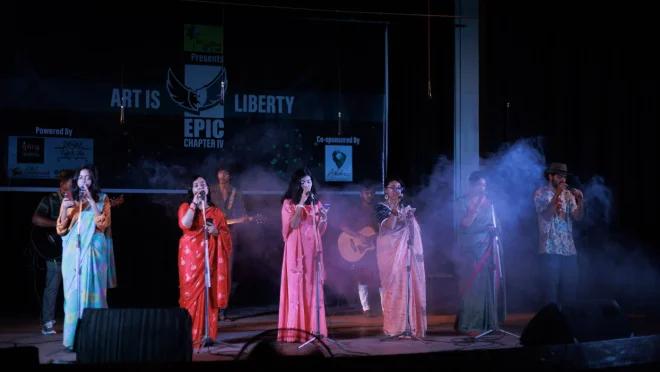
Beyond drama, EPIC’s chapters are also enriched by carefully curated dance, music and recitation performances, which add rhythm and variety to the theatrical experience and reflect the platform’s broader cultural vision. Photo: Mahmud Jami
A gallery-packed audience stares at the stage. A pin-drop silence fills the hall—only voices drift out from the stage itself. On that stage, someone has taken on the role of Shakespeare’s famous Macbeth; someone else is performing as Komolakanter Jobanbondi from Bankimchandra.
What is astonishing is that there is no way to tell from their acting that none of these performers are professional actors. Rather, driven purely by passion, they rehearse and shape these performances day after day, month after month, before presenting them to an audience.
They rehearse after classes, sacrifice weekends, build props with their own hands, and perform without pay. What drives them is not money, but conviction. This is EPIC—an independent theatre platform run by students of the Department of English at the University of Rajshahi.

Photo: Courtesy
Over the years, EPIC’s journey has unfolded chapter by chapter, each production adding a new layer to its evolving identity.
Art as liberty
EPIC was founded in 2017 by Samin Yasar Nafi, then an undergraduate student with a deep love for theatre and literature. For Nafi, studying Shakespeare, Homer, Christopher Marlowe or Oscar Wilde was never meant to remain confined to textbooks. He wanted to see these works breathe, struggle, and rebel on stage.
“I initially created EPIC simply out of love for theatre,” Nafi said. “I wanted to create a platform for artists who would find freedom through their art form.”
That belief soon crystallised into a philosophy—’Art is Liberty’. For Nafi, art was an act of rebellion: a way of breaking free from reality’s shackles, of creating something new rather than merely consuming what already exists.
When he first shared the idea with teachers in his department, the response was encouraging. Fellow stage actors were supportive too. Beyond that circle, reactions were mixed. Some believed in the vision, some questioned it, others watched from a distance.
Starting with original concepts was risky, but Nafi was determined. “I had a vision,” he said, “and I did what I rightfully could to make it happen. I faced problems and sought solutions, even when others only saw the problems.”

Photo: Courtesy
Each chapter refined EPIC’s identity—grand yet intimate, literary yet experimental, rooted in both English and Bangla traditions.
Building something unique
EPIC’s first chapter was unlike anything the Rajshahi University audience had seen before. Its debut production, Liberty, an EPIC original, shared the stage with Komolakanter Jobanbondi. The response was curiosity, surprise—and scepticism from some quarters. Many dismissed its early success as luck.
That notion did not survive for long. Chapter 2 brought Gilgamesh alongside Padotika, and Chapter 3 followed with Tale of Troy and Khyatir Birombona. By then, EPIC’s structure and vision were undeniable. The model worked.
“There was no monetary profit,” Nafi admits, “but there was no financial loss either. What we gained were memories worth cherishing.”
Each chapter refined EPIC’s identity—grand yet intimate, literary yet experimental, rooted in both English and Bangla traditions. Chapter 4 marked another milestone with Shakespeare’s A Midsummer Night’s Dream paired with Punorjagoron, an EPIC original.
A collective effort
Former EPIC member Umme Kulsum Prosun, who performed in Chapters 2 and 3, recalls how the platform evolved over time. “The response was extraordinary in both cases,” she said. “But EPIC kept gaining more popularity with each chapter.”
She points to Chapter 3 as a turning point, particularly with the addition of Bangla theatre. “The artists won hearts with their masterful performances,” she said. “EPIC’s English theatre was always a main attraction, bringing tragedies and comedies to life. And I’m never disappointed with music or dance.”
Behind the curtain, an army of volunteers works relentlessly—guiding audiences, managing logistics, building props, and composing background scores. Beyond drama, EPIC’s chapters are also enriched by carefully curated dance, music and recitation performances, which add rhythm and variety to the theatrical experience and reflect the platform’s broader cultural vision. “What makes EPIC epic,” Prosun said, “are these young, creative, selflessly enduring souls working together both on and off stage.”
Despite remaining largely seasonal, EPIC inspires confidence. “People should come for the sheer joy of experiencing fresh perspectives from young souls who promote creativity, vitality, art and life itself,” she adds.

Photo: Courtesy
Chapter 4 marked another milestone with Shakespeare’s A Midsummer Night’s Dream paired with Punorjagoron, an EPIC original.
Growing in form and ambition
Rion, another former member who joined during Chapter 2, has witnessed EPIC mature before his eyes. “I’ve seen three houseful shows,” he said. “The cultural expressions became more refined and varied.”
Chapter 5 excites him for its ambitious format—three dramas inspired by ancient Greek festivals of Dionysus—and EPIC’s first-ever musical. “If I’m not wrong,” he said, “this will be the first original English musical in the Varendra region.”
For Rion, EPIC is not merely a performance. “It’s an evolving artistic moment worth witnessing live.”
The present generation
For Mushfiqul Islam Mitin, an organiser of Chapter 5, EPIC reshaped his university life entirely. “I never knew I would be this involved with cultural programmes before enrolling in the English department,” he said. What began as curiosity soon became responsibility—he is now helping run the entire show.
“It’s much tougher than it looks,” Mitin admits. “But the joy is real when performers go beyond expectations.” He describes the Chapter 5 team as one that is pushing past its limits to deliver an unforgettable experience on 31 January 2026 at TSCC, Rajshahi University.
Actor Samarita Nag echoes that emotional pull. Her time in Chapter 4, she said, was “magical”. “We rehearsed every morning for a month,” she recalls. “Somewhere along the way, we became a family.” When it ended, she felt a quiet emptiness—”like the silence after a beautiful storm.”
Now, with Chapter 5 approaching, anticipation fills that space. “Another unforgettable explosion of memories,” she hopes.
For Tawfiq Al Hasib Tamim, EPIC’s value lies in opportunity. “It allows students to showcase their creativity,” he said, “and gives audiences experiences they’ve never seen before.”

Photo: Courtesy
For the artists, it is freedom. For the audience, it is discovery.
Originals and new voices
This year’s chapter places original work at its core. Raad Bin Tarek and Mubtasim Shifat, two of the directors, reflect on why EPIC matters to emerging playwrights. “Drama allows us to express unique ideas through characters, raw performance and dialogue. EPIC flourishes that creativity.”
Writing an original stage drama, they explained, demanded unorthodox storytelling. “The motto was simple—show people something they recognise, but in a way that amazes them.”
Over the years, EPIC’s journey has unfolded chapter by chapter, each production adding a new layer to its evolving identity. The inaugural Chapter 1 paired Liberty, EPIC’s first original work, with Komolakanter Jobanbondi, immediately signalling the group’s intent to merge original thought with canonical texts. Chapter 2 followed with Gilgamesh and Padotika, expanding EPIC’s literary canvas, while Chapter 3—featuring Tale of Troy alongside Khyatir Birombona—marked a noticeable surge in popularity and artistic confidence.
By Chapter 4, EPIC had firmly established its versatility, staging Shakespeare’s ‘A Midsummer Night’s Dream’ next to Punorjagoron, another EPIC original, and demonstrating its ease in moving between English and Bangla theatre. Now, as Chapter 5 approaches this January, the platform is preparing its most ambitious leap yet: Verdict, an original production, alongside Rhinoceros and Odyssey, a musical that represents EPIC’s first foray into the form and perhaps the region’s first original English musical of its kind.
Beyond the stage
As EPIC stands the test of time, its founder believes its impact will only deepen. Tickets are deliberately priced low—often described by audiences as “absurdly cheap”. Nafi smiles at that. “These chapters were never built for profit,” he said. “They were crafted out of love.”
EPIC continues to evolve, shaped by each new generation that steps onto its stage. For the artists, it is freedom. For the audience, it is discovery. And for Rajshahi University, it is proof that sometimes, the most powerful theatre is born not from institutions, but from belief.