When law meets enterprise: The story of GRAMSTAR
Business competitions rarely expect law students to walk in and dominate. Yet in just four months, two LL.B. students from Bangladesh University of Professionals entered eight national contests and walked away with six awards.
When law meets enterprise: The story of GRAMSTAR
Business competitions rarely expect law students to walk in and dominate. Yet in just four months, two LL.B. students from Bangladesh University of Professionals entered eight national contests and walked away with six awards.
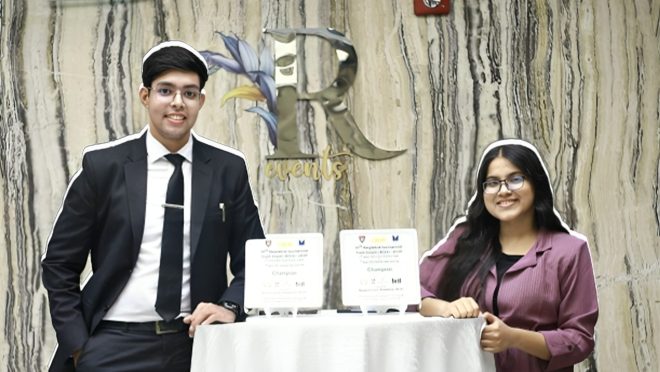
Team Agranee’s latest wins came through the business competition segment of the 10th Bangladesh International Youth Awards (BIYA) 2026, where they entered not as business students but as LL.B. (Honours) learners with a stubborn belief:
“Justice does not always arrive through arguments. Sometimes, it has to be built.”
To understand how they did it and what non-business students should know before stepping into national-level pitching rooms, I spoke to Team Agranee, the minds behind GRAMSTAR.
GRAMSTAR
Team Agranee is made up of Fuad and Oishee, both fifth-semester law students at Bangladesh University of Professionals (BUP), each with a science background before transitioning into law.
Their partnership was built long before BIYA 2026 through MUNs, policy debates, and smaller competitions, where they learned one habit early: challenge everything.
Their trigger was Bangladesh’s growing number of NEETs, young people not in education, employment, or training. In their view, the issue is not talent. It is access.
“Many of them are not unemployed because they lack talent; rather, they lack access.”
For Agranee, the motivation did not begin with prize money in mind. It began with a question that sounds uncomfortable because it is.
Their idea, GRAMSTAR, is built around one central gap: skilled people exist, products exist, but markets remain out of reach.
“Bangladesh has thousands of young people categorised as NEET. But many of them already produce beautiful traditional clothing, clay crafts, home décor, and food items. The tragedy is not a lack of skill; rather, it is a lack of market connection.”
GRAMSTAR positions itself as the bridge. The team identifies the primary beneficiaries as NEET artisans and agents, while also pointing to a wider impact on the national economy. Underutilised skill is not just an individual loss; it is a systemic one.
They stress-tested their model before anyone else could. If delivery failed, what was the fallback? If artisans were exploited, what safeguards existed? If revenue dipped, what would adjust?
The model was treated less like a pitch and more like a case file. That is risk management done early, not added as a panic patch on the final night.
Building the team
Team formation is rarely about formal titles. It is about endurance, who can stay consistent when the work turns repetitive and the pressure turns personal.
“Every slide was cross-questioned by the other. We were each other’s toughest judges before facing the real ones.”
Their teamwork did not start at BIYA 2026. They had already competed together in MUNs, policy debates, and other business contests. Agranee formed formally for the BIYA 2026 business segment after that pattern of collaboration became a habit.
They reflect what most winning teams quietly are: comfortable enough to critique each other without damaging the partnership. Every slide was interrogated before it entered the room.
What Made Them Stand Out
Where many teams try to impress by promising rapid growth, Agranee chose restraint and treated restraint as credibility.
“We deliberately avoided rapid-profit projections. Social innovation is not about explosive growth; it is about stable, ethical growth.”
Their model projects minimal profit in the first year with full reinvestment. Exports begin in the fourth year, with profit increasing gradually rather than aggressively. They were not trying to sell a fantasy. They were trying to sell something that could survive.
Agranee does not claim they were the most technical team in the room. They acknowledge that others had strong business backgrounds or brilliant technological ideas.
Their differentiator, however, was structure, the ability to integrate social impact and financial planning without allowing either to collapse into buzzwords.
Their proposal did not rely on inspiration alone. It mapped year-by-year financial flows, outlined an export timeline beginning in year four, calculated reinvestment strategies, and anchored impact claims to measurable indicators. It read less like an idea and more like a plan already in motion.
In competitions, judges can spot improvisation quickly. Structure is one of the few things that still reads clearly in a room full of confident speakers.
Challenges
Every social-impact team eventually hits the same wall: caring is not a revenue stream.
Agranee describes their biggest challenge in one clean sentence: “Turning emotion into numbers.”
They had to quantify impact, justify revenue streams, and anticipate operational risks because judges evaluate feasibility. That is the part many teams avoid until they are forced into it during the Q&A. Agranee treated it as core work, not an afterthought.
By the final round, questions were no longer about intention. Judges pressed them on numbers, profit margins, scalability, and product-market fit. Could this model survive beyond a competition stage?
They were prepared.
The takeaway
Winning mattered, but not as a trophy count. As law students, they see it as proof that their discipline is not a box.
“It proves that law students can innovate beyond textbooks.”
A common myth suggests that business planning requires a completely different kind of mind. Agranee does not deny the learning curve, but they argue that legal training prepared them for exactly the kind of pressure competitions demand.
“Legal education teaches you to anticipate conflict before it happens. We applied the same mindset to business.”
Their advice is blunt, and it is meant to be.
“Do not assume business competitions are only for business students. If you understand a problem deeply and can structure a solution responsibly, you belong there.”
Your background is not the barrier. Your preparation is.
Team Agranee stands as evidence that when you combine a justice-driven lens with business-grade structure, you do not just compete. You become difficult to ignore.