Are Dhaka’s toddlers safe from pollution, even at home?
Dhaka’s outdoor air does not stay outdoors. Pollution infiltrates through windows, gaps, doors and ventilation openings, exposing toddlers to respiratory risks
Are Dhaka’s toddlers safe from pollution, even at home?
Dhaka’s outdoor air does not stay outdoors. Pollution infiltrates through windows, gaps, doors and ventilation openings, exposing toddlers to respiratory risks
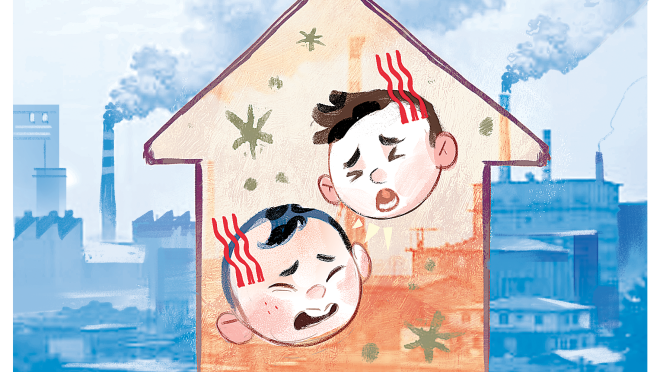
Tania is three years old. This winter, she has been coughing almost constantly — a dry cough that lingers through the night and returns whenever she plays.
Her breathing turns noisy when the air feels heavy. Some mornings she wakes with a blocked nose, watery discharge, and that familiar tightness in her chest that makes her parents wonder whether it is “just another cold” or something that has taken root in the home itself.
Like many toddlers in the capital, Tania spends most of her day indoors. She eats, sleeps, crawls, runs, and tumbles on the same floors where dust settles invisibly. She touches everything and then, as toddlers do, brings her hands to her mouth.
Her family cleans when they can, but the dust keeps returning—on shelves, on curtains, inside fans, and in the corners of rooms where sunlight rarely reaches.
In winter, when outdoor pollution peaks and windows stay shut, the home can begin to feel like a sealed box. But that sealed box is not as protective as parents assume.
A recent study monitored indoor air quality across a few dozen homes in Dhaka and found that indoor air can be significantly more polluted than the air outside. The average pollution level recorded in the sampled homes was 75.69 µg/m³ — nearly five times higher than World Health Organization guideline levels – and in some homes it exceeded 200 µg/m³.
The study identified outdoor air intrusion as a major driver of indoor pollution, while prolonged cooking, especially sessions lasting more than 1.5 hours, sharply increased fine particulate (PM2.5) levels.
Now, a different but connected concern is emerging from research into household dust: microplastics.
Dust inside homes is not just “dirt”.
It is a complex mixture — fibres shed from clothes, fragments from packaging, particles from degraded plastics, soot and outdoor pollutants that enter through gaps, and the fine debris that builds up in carpets, curtains, bedding and furniture. For babies and toddlers, that mixture matters.
They breathe faster than adults, their airways are smaller, and their behaviours – crawling on the floor, putting hands and objects in their mouths – increase exposure.
A Dhaka-focused study of indoor dust found an average concentration of microplastics at 4,333 ± 354 particles per gram of dust, an extremely high level.
The most common microplastics detected were black, fibre-shaped, and smaller than 0.5 millimetres — tiny enough to be inhaled or swallowed without anyone noticing.
PET (polyethylene terephthalate), widely used in bottles, clothing and packaging, was among the most abundant polymers identified.
The implication is unsettling — even when families are indoors to escape dust-filled streets, the floor and furniture may still be delivering a steady stream of pollution into a child’s body.
Professor Kamruzzaman, an expert on Dhaka pollution, says the idea of “safe indoors” breaks down once you understand how homes in the city actually function. People spend roughly two-thirds of their day inside – at home or in offices – and in many Dhaka residences the indoor environment becomes a collection point for multiple pollution sources.
Cooking is one of the biggest.
“In residential spaces, cooking smoke becomes a major contributor,” he explained, noting that using a kitchen hood is still not common in many households.
Without effective extraction, smoke and fine particles from the kitchen drift into bedrooms and living rooms – the very spaces where children, elderly people, pregnant women and those who are unwell often spend the most time.
In the morning and evening cooking windows, many working adults are outside, but children remain at home, inhaling the worst of the indoor peaks.
Then there are the surfaces that quietly store pollution.
Carpets trap dust deep within fibres. Curtains collect soot and particles and release them again when disturbed. Fans accumulate grime on blades, then redistribute it every time they are switched on.
Air conditioners can become reservoirs of microbial and particulate pollution when filters are not cleaned regularly. Damp walls can generate dust and encourage mould. Homes with pets may add another layer – tiny particles from fur, skin flakes, and microorganisms that become airborne.
And Dhaka’s outdoor air does not stay outdoors. Pollution infiltrates through windows, gaps, doors and ventilation openings, building up indoors when air exchange is poor. In winter, families often keep windows shut to block cold air and street smoke, which can trap pollution inside for longer. The result is a home that looks clean but behaves like a container: particles enter, settle, get stirred up, and enter small lungs again.
For babies and toddlers, health impacts can show up as repeated respiratory symptoms – runny noses that never fully clear, coughing that drags on, chest tightness, disturbed sleep, snoring, and recurring colds that seem to return the moment one finishes. Professor Kamruzzaman warns that without proper ventilation, dust and fine particles accumulate and repeatedly re-enter the body through breathing.
Professor Dr Rabi Biswas, paediatric endocrinologist and head of the Department of Paediatric Endocrinology and Metabolic Disorder at Bangladesh Shishu Hospital and Institute, frames the risk in terms of vulnerability.
“There are two groups,” he said. One group is children who are predisposed to allergies – “atopic children” – who are born with a tendency for allergic responses.
Dust is an allergen, he noted, and pollution can act as an allergen too. For these children, respiratory problems become more frequent: repeated breathing difficulties, chronic runny nose, adenoid enlargement, coughing, and night-time symptoms that disrupt sleep.
The second pathway is less obvious but potentially widespread — vitamin D deficiency.
Vitamin D is synthesised when sunlight reaches the skin, Dr Biswas explained. But in polluted cities, sunlight can be blocked or weakened by a haze of particles.
“Pollution acts as a barrier between sunlight and the body,” he said, and he stressed that most vitamin D – around 85–90% — comes from sunlight exposure, not food.
Many children in Bangladesh are not getting consistent daytime sunlight, partly because they are in school and indoors, partly due to lifestyle patterns, and partly because polluted air discourages outdoor time.
For South and Southeast Asian populations, darker skin tone can also mean vitamin D levels tend to run lower, making adequate sun exposure even more important, Dr Biswas said.
If the risks are so embedded in the city, what can parents realistically do?
Ventilation, Professor Kamruzzaman said, is “number one” — cross-ventilation when outdoor air quality is relatively better, and targeted ventilation during and after cooking.
In practice, that means timing. If families can identify hours when outdoor pollution is lower – after rain, or outside peak traffic and winter smog windows – opening windows for a controlled period can help flush out indoor air. During heavy pollution episodes, limiting open windows and using other approaches becomes more important.
Cleaning is not only about visible floors. Filters and surfaces that recirculate air need regular attention. Air conditioners and fans should be cleaned periodically; curtains should not be left for years; the tops of cupboards, wardrobes and less-touched surfaces should be cleaned because they shed dust back into the room over time.
For babies like Tania, small routines can reduce exposure — frequent handwashing, wiping down surfaces that toddlers touch often, and keeping play areas away from kitchens during cooking. Parents can also create a “clean-air corner” — a room where dust is controlled more carefully, fabrics that trap particles are limited, and ventilation or filtration is prioritised.
Dr Biswas’s vitamin D warning adds another practical piece — when air quality and safety allow, short daily sunlight exposure on the skin can matter — not as a luxury, but as part of a child’s basic health.