CGPA inflation: When everyone gets an A, does anyone truly excel?
These days, almost every semester, results come with a huge number of 3.90 and 4.00 scorers. But CGPAs in Bangladesh don’t necessarily reflect real academic strength
CGPA inflation: When everyone gets an A, does anyone truly excel?
These days, almost every semester, results come with a huge number of 3.90 and 4.00 scorers. But CGPAs in Bangladesh don’t necessarily reflect real academic strength
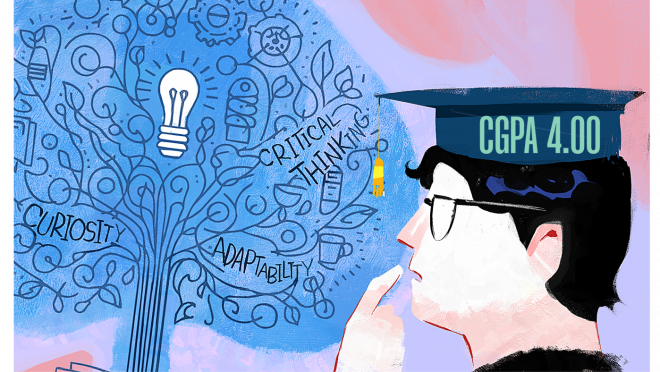
After spending almost eight years in academia, one concern keeps resurfacing in my mind: Are we giving our students a real education, or just high CGPAs?
These days, almost every semester result comes with a huge number of 3.90 and 4.00 scorers. On paper, it looks impressive. Parents feel proud, universities feel successful, and students feel confident. But when we look closely, the picture becomes confusing. Are these students truly ready for the job market? Can they cope with higher studies abroad?
My doubts proved true during my second Master’s programme at the University of Kentucky. Despite being a top performer in both my undergraduate and graduate studies at Dhaka University, I found myself struggling to adapt to academic expectations abroad. It wasn’t a lack of dedication or intelligence. The challenge lay elsewhere — in the academic culture itself.
In the US, classrooms are full of questions. Research is a habit, not a burden. Everything is about asking “why”, not memorising “what”. That environment took time for me to adjust to, even though I was considered a “top performer” back home. This made me realise something concerning: Our CGPAs do not necessarily reflect real academic strength.
Where the problem begins
In many Bangladeshi classrooms, teachers still speak for the entire class period while students quietly listen. Asking questions often seems like a burden to teachers. At times, students hesitate because they fear they might be wrong or sound silly.
As a result, they fail to develop the habit of critical thinking and inquiry. When assessment is heavily based on notes, lectures, or repetitive exam patterns, it becomes easy to score well without truly analysing the material.
Another issue that is often ignored is the pressure on teachers. In many universities, student evaluations carry significant weight. If a teacher is strict, sets challenging questions, or grades honestly, students often respond with poor evaluations. This later becomes a headache for the teacher.
So what happens? Some teachers quietly choose the “easier” path. Over time, the system becomes unfair to sincere students who work hard. When almost everyone gets an A, genuine effort gets lost in the crowd, and gradually, the CGPA loses its meaning.
Faculty members are also stretched by administrative duties, large class sizes, and research expectations that remain frustratingly unsupported. In such a strained environment, grading generously becomes the easiest way out.
Are we mentoring or merely grading?
Bangladeshi academia has a long tradition of bright minds and inspiring mentors. But the culture has shifted. Increasingly, classroom practices prioritise covering content rather than cultivating inquiry. The irony is painful.
Today, we often observe that many toppers know little beyond their textbooks. They haven’t watched classic films, don’t know major books or poets, and are unaware of important cultural milestones.
This may sound trivial, but in reality, it matters a great deal — especially for those who aspire to join academia. A good teacher is not made by scores alone. A good teacher is shaped not only by academic performance, but by curiosity, exposure, and the ability to draw from diverse sources of knowledge.
What happens next?
When these graduates enter the job market, employers quickly notice the gap. Many struggle with presenting ideas, analysing issues, or solving real-world problems. They may know the theories, but they cannot connect theory with life. When they go abroad for higher studies, they face the same shock I once felt — sometimes even worse.
They find themselves in classrooms where debate is normal, research is intense, and independent thinking is essential. In the long run, both faculty and students pay the price. Employers complain that graduates lack communication skills, problem-solving abilities, and adaptability.
International universities also note our students’ struggles in research-heavy environments. The root cause is not a lack of talent, but a systemic failure to nurture that talent.
At the end of the day, our goal should not be to produce thousands of “perfect scorers.” Our goal should be to produce graduates who are confident, curious, analytical, and capable of working anywhere in the world. A 4.00 CGPA is good, but a 4.00 mind is what the nation needs.
Nadia Rahman is an Assistant Professor at the Department of Mass Communication and Journalism, Bangladesh University of Professionals. She likes to explore human communication, variations of thoughts, and diversity in cultures.