How imported second-hand clothes keep Bangladesh warm
Bangladesh’s trade in imported second-hand clothing supports thousands and meets rising winter demand, even when import restrictions, quotas and local garment production squeeze a long-established business
How imported second-hand clothes keep Bangladesh warm
Bangladesh’s trade in imported second-hand clothing supports thousands and meets rising winter demand, even when import restrictions, quotas and local garment production squeeze a long-established business
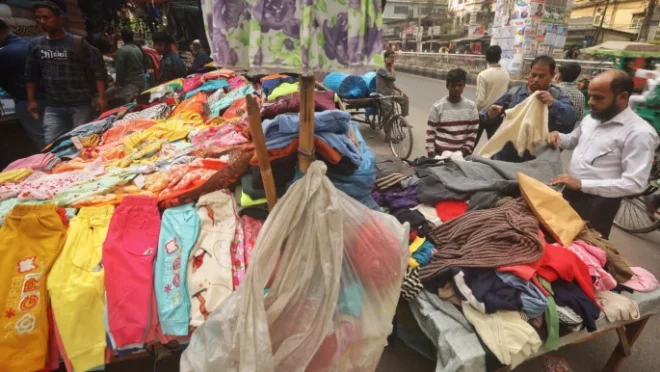
If you walk along Sadarghat’s Northbrook Hall Road by the river, you will notice shops whose nameplates do not match their ware. These shops were once hubs for wholesale vegetable trading. Now they are stacked with used clothes brought from Chattogram, which have been imported from some Asian countries.
Demand rises sharply when forecasted cold waves begin to bite into the lives of middle- and lower-income people.
These clothes arrive in tightly packed bags, tied with flattened ropes and wrapped in square-shaped plastic packaging. Traders locally refer to these bags as “bale“, while some call them “guide.”
Wholesale traders open intact bales, while retailers come from different parts of Dhaka and inspect the opened bales, sorting through the garments. Some choose specific items, while others purchase entire bales.
Tulsideb Saha came to buy some clothes for his footpath shop near Baitul Mukarram. He has been in this business since 1972. He stood sorting through an unroped bale. He then explained his buying strategy, “About a month ago, I stocked two bales of clothes at my shop. Now I’ve come again to buy more. This time, I will not take one whole bale, I will buy 200 jackets and 100 sweaters instead.”
Temporary footpath shops, particularly in New Market, Motijheel, Baitul Mukarram, Gulistan, Paltan, and Mirpur, are filled with used winter clothing. Jackets, sweaters, cardigans, shirts, mufflers, caps, blankets, and comforters of various designs and qualities are being laid out or hung for display.
However, the largest wholesale and retail markets for used clothing are in Chattogram. Since imported garments arrive through Chattogram Port, most of the clothes are first stored at Amin Market in the city’s Khatunganj and in the Majhirghat area after being moved directly from the port. From there, wholesalers supply these clothes across the country based on demand.
According to Abul Kalam, President of the Bangladesh Used Clothes Traders Welfare Association, “From Khatunganj, Majhirghat, and Zohura Market, traders from across the country buy used clothing bales.”
Outside Dhaka and Chattogram, demand is particularly high among middle- and lower-income groups in colder regions, where winter conditions are harsher and affordable warm clothing is a necessity rather than a fashion choice.
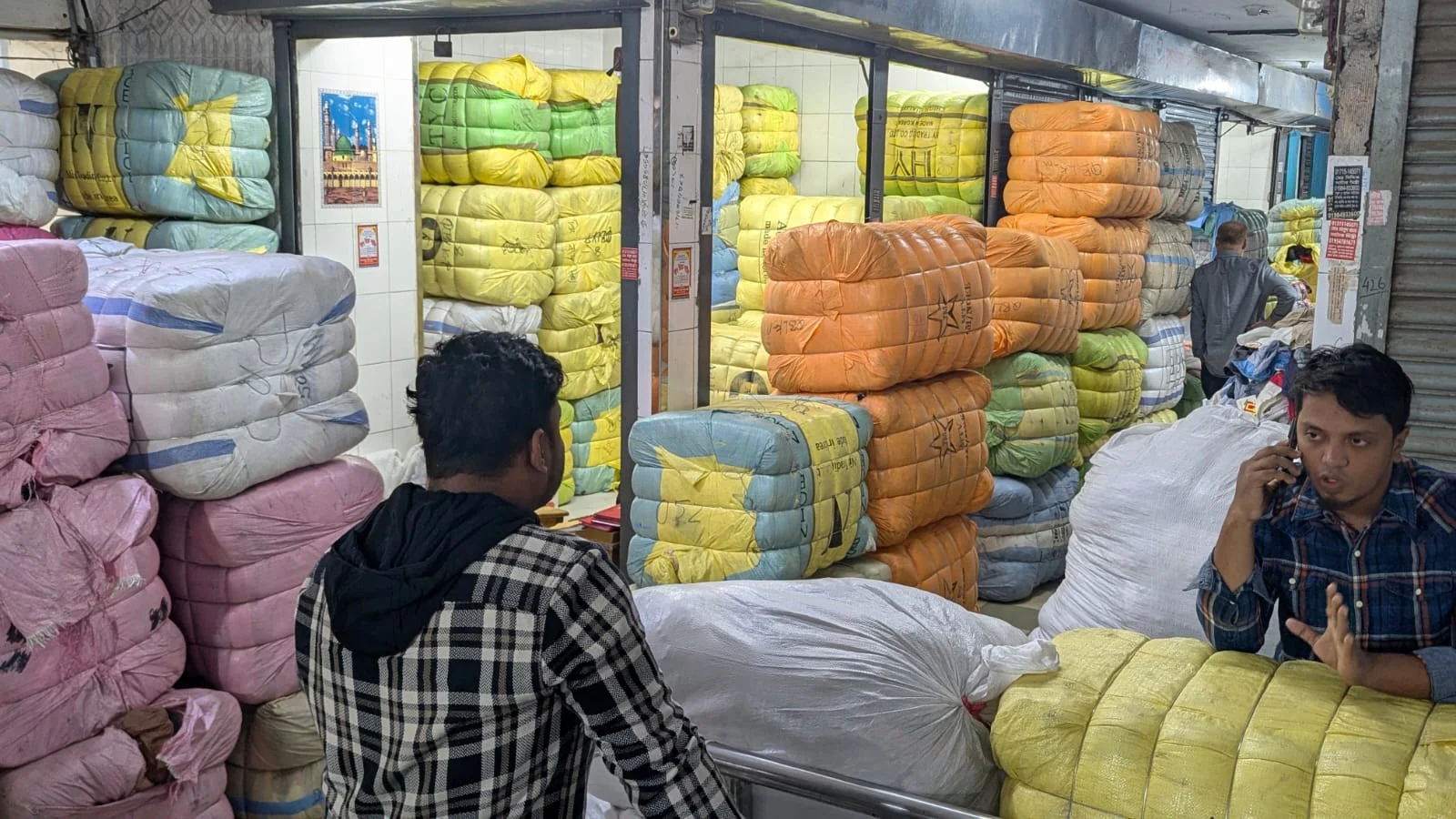
Bales of imported second-hand clothes from foreign countries arrive at Chattogram port. Photo: TBS
Retailers in Dhaka mostly source clothes from Sadarghat’s North Brook Hall Road market and Mallik Tower near Banglabazar Mor. Some vendors also collect garments directly from Chattagram through trusted suppliers.
An 80–100 kg bale of zipped jackets can cost between Tk18,000 and Tk35,000, depending on quality and country of origin, while bales of sweaters and other small garments cost Tk15,000–25,000.
Blankets and comforters are priced at around Tk12,000–20,000 per bale. However, shirts and stylish jackets are mostly sold by the piece due to quality concerns. One hundred shirts can cost approximately Tk25,000, but when the quantity increases to 200 pieces or more, the total cost decreases by at least Tk10,000, meaning 200 shirts can be purchased for around Tk40,000.
“Products from South Korea and Japan are of better quality. Whether it’s jackets or shirts, some clothes look almost new, which is why they cost more,” Tulsideb said.
This is also a seasonal business, involving everyone from footpath hawkers to small entrepreneurs. “Someone can start this business with as little as Tk20,000 to Tk50,000, and the profit margin is quite good,” said a wholesaler at the Khatunganj market.
Hawkers adjust their products according to the season, like Rubel Hossain in Purana Paltan, who is selling blankets, comforters, and curtains on the footpath this season.
“Earlier this year, throughout the summer season, I was selling shirts, pants, and trousers. Now I am selling these winter items. When winter ends, I will switch to something else,” he said.
“Business is not what it used to be. Three to five years ago, I used to sell at least 20 to 25 blankets a day. Now I cannot even sell 10,” he added.
Blankets and comforters are priced at around Tk12,000–20,000 per bale. However, shirts and stylish jackets are mostly sold by the piece due to quality concerns. One hundred shirts can cost approximately Tk25,000, but when the quantity increases to 200 pieces or more, the total cost decreases by at least Tk10,000, meaning 200 shirts can be purchased for around Tk40,000.
Second-hand imports helping millions stay warm in winter
During the evening rush hour, hawkers spread piles of used warm clothes, heavy jackets, sweaters, and cardigans on tarpaulins along the roadside in front of New Market in Chattogram. Passersby crowd around, seeking affordable winter wear, as vendors call out to attract buyers, offering warm garments suited to the needs of middle- and low-income customers.
“These clothes are good. Once they are washed and ironed, they look almost new. People like us cannot always afford to buy new clothes. An item that would cost Tk 800–1,000 new can be bought here for Tk 400–500, and often in even better condition,” said Ruma Haque, a regular customer.
Prices are flexible, and good bargaining can secure a full winter wardrobe for under Tk2,000.
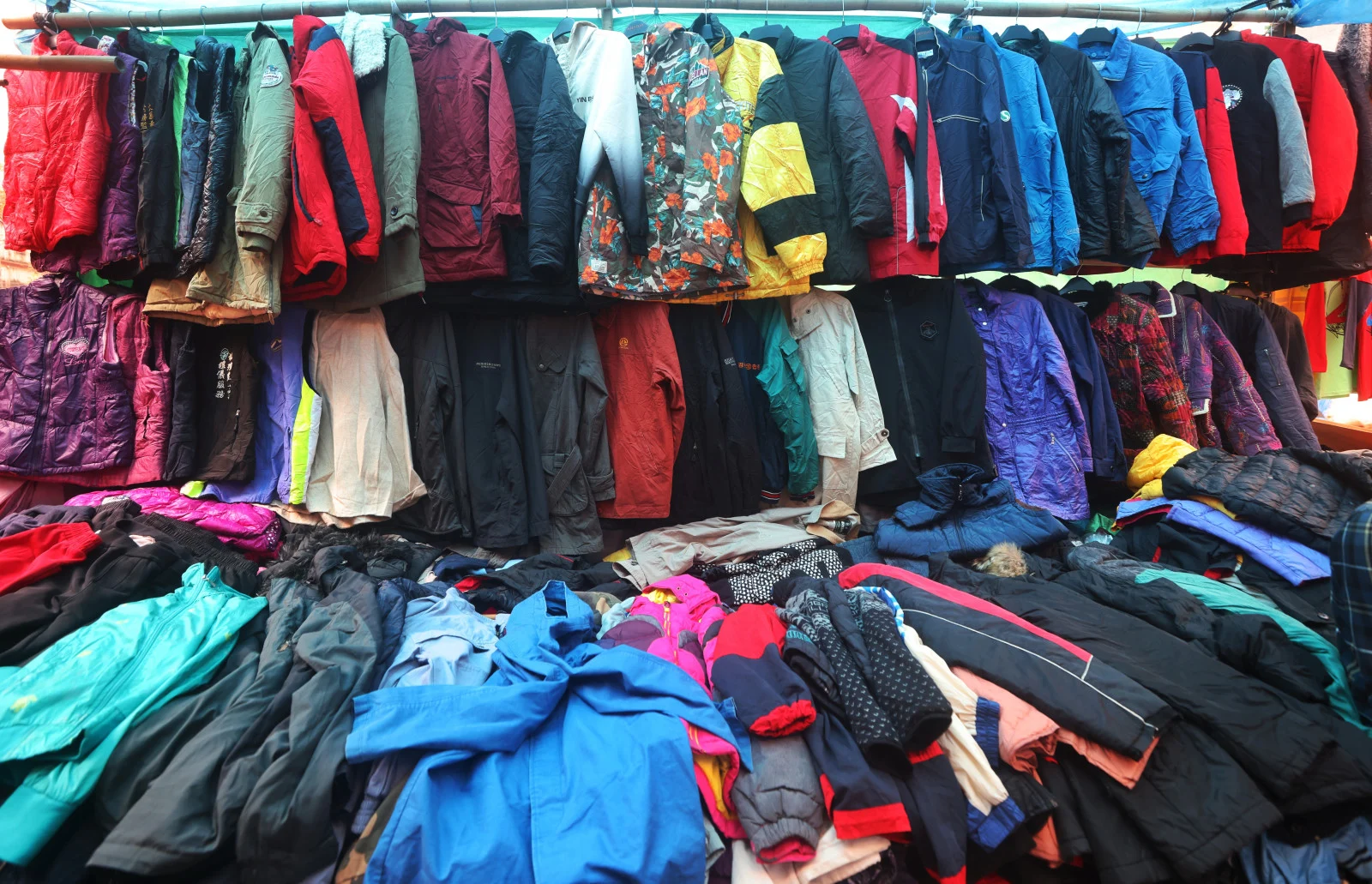
Imported second-hand clothes are displayed on the footpath near capital’s Baitul Mokarram mosque.
In Dhaka, the sales continue until 10–11 pm. According to the Hawkers’ Association, at least 60 used-clothes vendors operate in front of the Baitul Mukarram mosque, while the number exceeds 100 in the New Market area. Vendors said sales typically remain slow at the start of winter but increase as the cold intensifies.
Outside major cities, temporary stalls are set up in open market spaces in district and upazila towns as soon as winter begins, especially in colder regions. With demand rising during the season, the supply of winter clothing also remains high.
“In colder regions, particularly in the northern and southern parts of the country, local people depend heavily on imported used clothes,” said Saimun Amin, a former Dhaka University student who leads a Rangpur-based organisation that has been raising funds and distributing winter clothing in the north for the past five years.
Form a charity programme to import business
After Bangladesh’s independence in 1971, the country was devastated by war, leaving many families unable to afford warm clothing. At the time, Western NGOs, particularly England-based Oxfam, organised charity drives and sent warm clothes, blankets and other essential items to Bangladesh.
Recalling the period after the war, Tulsideb Saha said he was 15 when the conflict ended and that life was especially difficult during the winter, until the government arranged relief clothing.
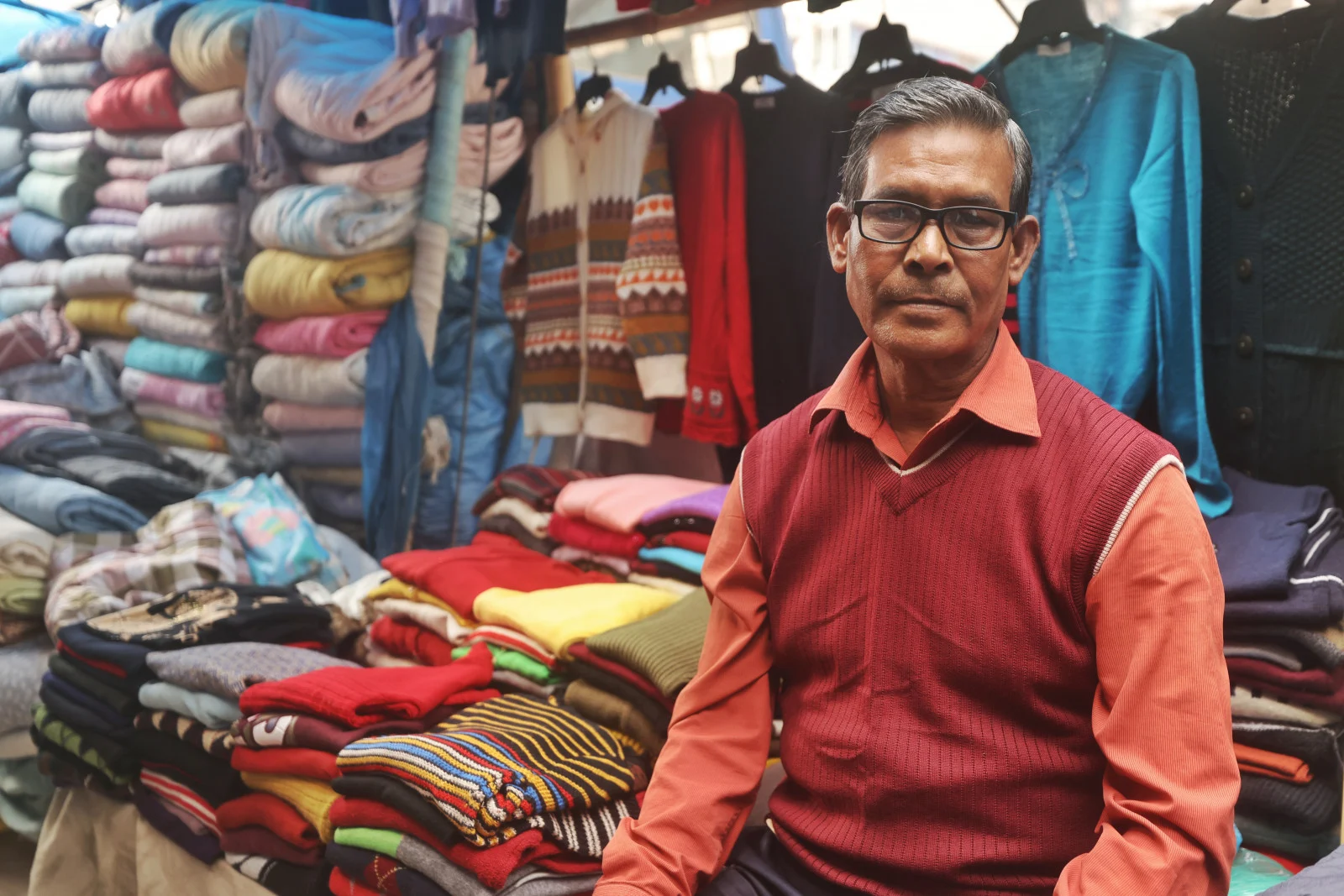
Tulsideb Saha, who has been in the second-hand clothes business since 1972, is in front of his shop.
He added that once supplies began arriving, they continued. Initially, clothes arrived from the US, Australia, England, Japan, and some European countries
Today, Bangladesh mainly imports used clothes from Asian countries, including Japan, Taiwan, Korea and China, and occasionally from Malaysia and Pakistan.
According to the Office of the Chief Controller of Imports and Exports, the government allows 3,000 traders to import used clothing, permitting Tk50,000 worth of imports per trader, which amounts to Tk15 crore annually.
FBCCI member SM Jalil explains, “We are allowed to import six types of garments: men’s sweaters, zipper jackets/coats, cardigans, men’s trousers, blankets, and shirts.”
With this amount, an estimated 500–700 containers of used clothing are imported, each carrying around 250–300 bales. The import season usually runs from April–May to October each year. Volumes were higher before the growth of the RMG industry during and after General Ershad’s tenure.
Mohammad Golam Mostafa, assistant controller at the Chief Controller’s office, said, “Importers operate through appointed agents who collect garments and facilitate the import process.”
“No one can import goods simply by choice. Importers must follow prescribed procedures, and everything has to go through legal channels,” he said.
However, traders said the decades-old business has been shrinking since the Covid-19 pandemic due to import cuts, quotas and increased local garment production, even as demand continues to rise.
Calling for a higher import cap, trader Kalam said raising the limit from Tk150 million to Tk300 million would benefit both consumers and traders, lower prices further, and make affordable winter clothing accessible to more people.