Scientists discover Galileo’s early annotated Almagest
In January, historian Ivan Malara was combing through 16th-century printings of The Almagest at Italy’s National Central Library in Florence when he noticed something unusual.
Scientists discover Galileo’s early annotated Almagest
In January, historian Ivan Malara was combing through 16th-century printings of The Almagest at Italy’s National Central Library in Florence when he noticed something unusual.
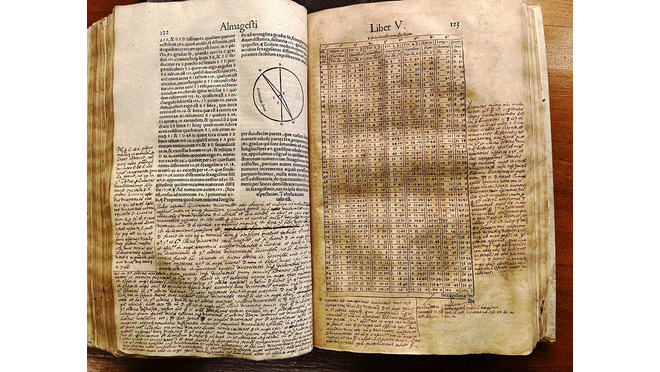
On an otherwise blank page, someone had transcribed Psalm 145 in handwriting that resembled a very famous Tuscan astronomer. Malara soon realised the book had been extensively annotated by Galileo Galilei himself.
Reported by Science Magazine, the discovery, detailed in a paper under review at the Journal for the History of Astronomy, offers fresh insight into one of science’s most famous paradigm shifts: the displacement of Earth from the centre of the cosmos.
A young revolutionary studying the old masters
The Almagest, written by second-century astronomer Claudius Ptolemy, set out a geocentric model of the universe that dominated Western astronomy for 14 centuries. Galileo’s annotations, likely written around 1590—two decades before his telescope observations of the Moon and Jupiter—show a young scholar both revering and critically examining Ptolemy’s work.
Malara suggests that Galileo’s eventual advocacy for heliocentrism was not a rejection of mathematics or logic but an extension of it. Mastery of Ptolemy’s system, he argues, led Galileo to realise that a Sun-centered cosmos better fulfilled the mathematical reasoning Ptolemy had established. This challenges the conventional image of Galileo as motivated primarily by philosophy, personal ambition, or political strategy. “He has been presented as a big-picture sort of guy—not interested in the nitty-gritty technical details of astronomy,” says James Evans, a historian at the University of Puget Sound.
Evidence and discovery
Malara, a postdoctoral scholar at the University of Milan, had long suspected that Galileo’s bold heliocentric stance required a solid grounding in traditional astronomy. After years of compiling examples of Galileo quoting Ptolemy in scholarly debates, he began surveying early Latin printings of The Almagest across European libraries.
In Florence, he found the annotated copy. By the early hours of the following morning, Malara was convinced that the notes were Galileo’s, emailing Italian Galileo scholars in disbelief. Michele Camerota of the University of Cagliari, one of the first recipients, agreed: “I regard the attribution of the marginal notes to Galileo as fully secure.”
Handwriting specialists, scholars at the Galileo Museum, and comparisons to Galileo’s contemporary works support the attribution. Even the unusual Psalm 145 transcription fits a pattern. A note in another 16th-century edition of The Almagest suggested that Galileo prayed before studying Ptolemy. A 1673 letter by mathematician Alessandro Marchetti also recorded that Galileo offered prayers each time he approached the text.
Rethinking the iconoclast
Galileo is often remembered as a late-stage revolutionary defying church authority and centuries of established wisdom. These early annotations reveal a different side: a methodical, thoughtful scholar wrestling with the ideas of the past before developing his own revolutionary vision.
Malara hopes the discovery will inspire new research into Galileo’s intellectual journey. “The big problem is, how? Why?” he says, highlighting that even the greatest iconoclasts emerge from careful study, not sudden inspiration.