Champions League round of 16: A tale of two halves
The Champions League Round of 16 draw is now finalised, and the bracket appears sharply divided. One side looks relatively open, while the other resembles a battlefield packed with European heavyweights.
Champions League round of 16: A tale of two halves
The Champions League Round of 16 draw is now finalised, and the bracket appears sharply divided. One side looks relatively open, while the other resembles a battlefield packed with European heavyweights.
Some teams have been handed a clearer path; others face a minefield, particularly on the left side of the draw.
Arsenal’s opportunity
Starting with Arsenal, they topped the league phase and are currently leading the Premier League title race. They will also host the second leg in every round until the final, should they continue progressing. That is a significant advantage.
They face Bayer Leverkusen in the Round of 16. Leverkusen are organised, tactically disciplined and dangerous in transition. They may not dominate possession against Arsenal, but they will wait for opportunities to counter. If Arsenal commit too many players forward, they could be punished.
Looking ahead, if Arsenal progress, they could meet either Sporting CP or Bodø/Glimt in the quarter-finals. On paper, that is one of the softer possible routes. However, being labelled as favourites brings its own pressure.
Bayern’s difficult path
Bayern Munich face Atalanta, the only remaining Italian side in the competition. Atalanta eliminated Borussia Dortmund in dramatic fashion and have shown they can match high-intensity opponents.
Bayern remain powerful and experienced in Europe. Under Vincent Kompany, they have looked energetic and aggressive. However, if they advance, they could face either Real Madrid or Manchester City in the quarter-finals. That would represent a brutal sequence of opponents.
Real Madrid vs Manchester City: The Modern Classic
For the fifth consecutive season, Real Madrid and Manchester City meet in the knockout stages. It has become an annual rivalry.
The statistics underline how evenly matched they are. In 15 head-to-head meetings, each side has won five times, with five matches ending in draws. Even the goals are identical, 29 scored by Madrid and 29 by City.
City defeated Madrid 2–1 in the league phase earlier this season. Under Pep Guardiola, their philosophy remains clear: control possession, dominate territory and reduce chaos.
Real Madrid approach the competition differently. They thrive in chaotic moments and remain composed when matches become emotional. Their 15 Champions League titles are not merely historical records; they reflect an enduring mentality under pressure.
City may enter the tie as slight favourites, given recent form and Guardiola’s experience against Madrid. However, in the Champions League, Real Madrid can never be discounted. This contest is as psychological as it is tactical. The winner is likely to face Bayern or Atalanta next. There is no respite.
Liverpool and Barcelona: Favourites with caution
Liverpool FC face Galatasaray. On paper, Liverpool are strong favourites. They are structured, disciplined and experienced in European competition under Arne Slot.
However, Galatasaray at home are formidable. They eliminated Juventus in the play-off round and survived a tense second leg that extended to extra time. Although the lowest-ranked team remaining, they will attempt to make the tie intense and emotionally charged.
Liverpool also have injury concerns, including Florian Wirtz, which may affect their creativity and control. Over two legs, squad depth and rotation become decisive factors.
FC Barcelona face Newcastle United. Barcelona defeated Newcastle 2–1 in the league phase at St James’ Park, which will give them confidence. Under Hansi Flick, Barcelona press high and move the ball quickly.
Newcastle are energetic and fearless. Their intensity can disrupt possession-based teams. The midfield battle will be crucial. If Barcelona control the tempo, they should progress. If Newcastle turn it into a physical contest, the tie becomes unpredictable.
The winner could face Atlético Madrid or Tottenham Hotspur in the quarter-finals, adding further difficulty.
Tight margins elsewhere
Atlético versus Tottenham is an uncomfortable draw for both sides. Atlético, under Diego Simeone, specialise in knockout football. They defend compactly and capitalise on opponents’ mistakes.
Tottenham have struggled domestically and need a strong European campaign to salvage their season. If they lose patience, their Champions League run could end quickly. This tie is likely to be tight and low-scoring.
Paris Saint-Germain face Chelsea FC. PSG are the defending champions but only narrowly overcame AS Monaco in the play-offs, suggesting vulnerability.
Chelsea, led by Liam Rosenior, are youthful and energetic. They defeated PSG in last summer’s Club World Cup final, which may provide psychological confidence.
The greater challenge for both lies in the bracket. Should PSG progress, they could face Liverpool in the quarter-finals, Manchester City in the semi-finals, and potentially Arsenal or Tottenham in the final. That would represent one of the toughest possible routes to the trophy.
The dark horse
Bodø/Glimt provide the tournament’s most compelling storyline. The Norwegian side defeated Manchester City and Atlético in the league phase before eliminating last season’s runners-up Inter Milan. They are fearless and well coached by Kjetil Knutsen.
They now face Sporting CP. If they continue their remarkable run and reach the quarter-finals, they could meet Arsenal or Leverkusen. Compared to the opposite side of the draw, that path appears significantly less congested.
So who benefits?
Arsenal appear to have one of the clearer routes, provided they maintain focus and respect their opponents. Liverpool’s path is manageable if injuries do not derail them. Barcelona are in a competitive yet balanced section.
Meanwhile, Real Madrid, Manchester City, Bayern Munich and possibly PSG occupy the most dangerous half of the bracket. Even exceptional performances may simply lead to another heavyweight confrontation.
This year’s draw has created two distinct realities. One side offers opportunity. The other promises survival of the strongest.
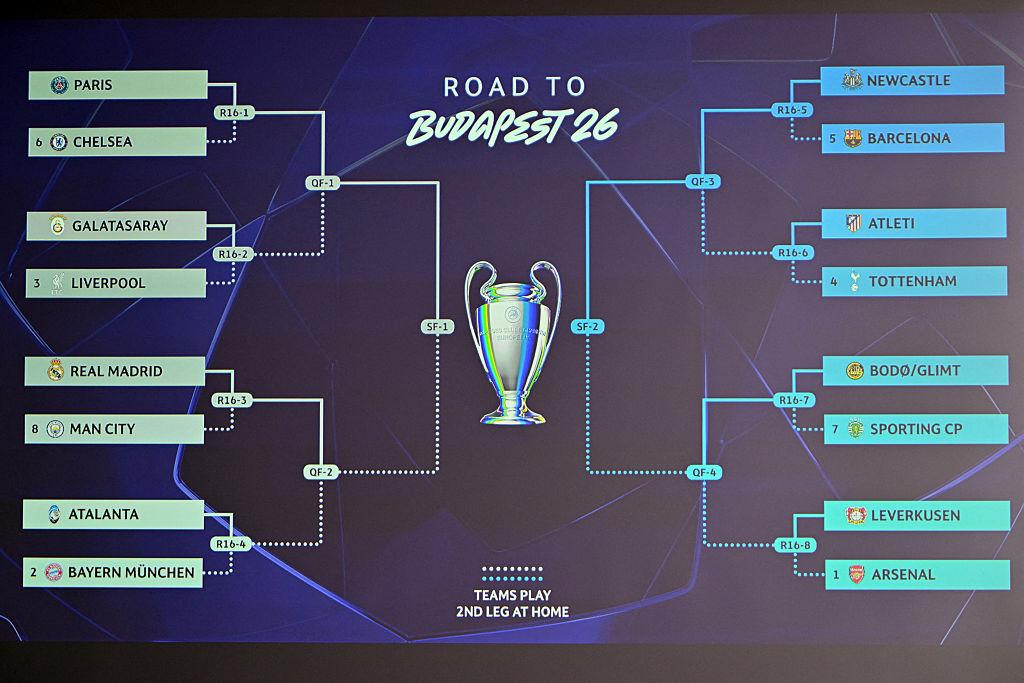
In the end, the draw shapes the journey, but it does not decide the champion. Knockout football is about moments, discipline, and nerves. The road to Budapest is now visible. The Champions League’s big nights are back, no matter, whichever team goes through.