Is Manuel Neuer the greatest goalkeeper of all time?
“40-year-old goalie made 9 saves at the Bernabéu.” Doesn’t fit, right?
Is Manuel Neuer the greatest goalkeeper of all time?
“40-year-old goalie made 9 saves at the Bernabéu.” Doesn’t fit, right?
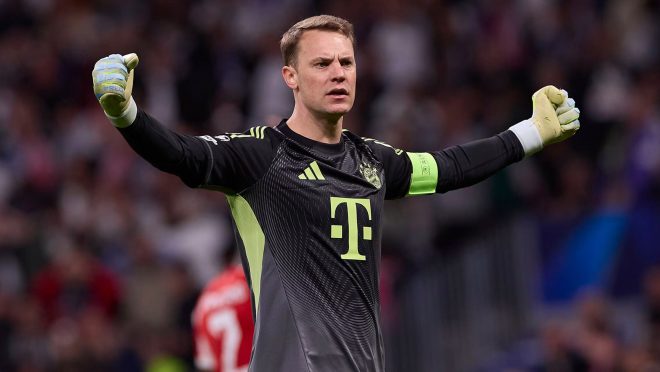
Manuel Neuer was the MVP in the match versus Real Madrid at the highest level of the Champions League, where Bayern clinched a 2-1 win.
On a night packed with stars, Mbappé, Vinícius Júnior, Kane, Díaz and more, it was a 40-year-old goalkeeper who stole the spotlight.
A player once thought to be approaching the end of his career a few years ago is still performing at the very highest level.
For over a decade, Neuer has been the reference point for goalkeeping. A saviour for both club and country. So perhaps it is no surprise that he can still produce performances like this. Yet it inevitably raises a question: when he eventually hangs up his gloves, will he be remembered as the greatest goalkeeper of all time, or at the very least of the modern era?
After all, this is a man who has won absolutely everything there is to win, including being named the best goalkeeper in Europe and the world five times each, to go with a World Cup winners’ medal, two Champions League titles, 12 Bundesliga trophies and an ultimate insurance policy for Germany, appearing in 124 internationals.
I remember watching the 2014 World Cup as a 12-year-old and seeing Neuer as something close to superhuman, though Neuer had infinite peaks and longevity. That same year, he finished third in the Ballon d’Or rankings, behind Lionel Messi and Cristiano Ronaldo, an almost unheard-of achievement for a goalkeeper.
Neuer was not merely exceptional in his role; he reshaped what the role itself could be.
During the 2014 World Cup in Brazil, particularly against Algeria, he famously embodied the “sweeper-keeper” role, having 21 touches outside of his penalty area and routinely acting as an auxiliary defender. Bayern’s former chairman, Karl-Heinz Rummenigge, once confirmed that Pep Guardiola came to him and was convinced that Neuer had all the makings of a top midfielder and was keen to test him out after his Bayern side. That alone says everything.
Neuer joined Bayern in 2011. But the story began at Schalke 04, where Neuer, once an outfield player by nature and only a goalkeeper by circumstance, turned an accident of fate into a revolution in gloves with fearless Champions League performances and ice-cold penalty heroics.
Schalke gave him his stage, but Bayern Munich turned him into a dynasty.
At club level, his honours are equally extraordinary: multiple league titles, Champions League triumphs, two trebles in 2013 and 2020, and a historic sextuple with Bayern Munich, along with clutch moments in big games.
Even in his late 30s and 40s, he is still operating at a level where clubs are forced to adjust their attacking plans around him. That is rare for any position, let alone one so physically demanding.
Modern goalkeepers like Alisson Becker and Ederson Moraes now play with similar principles, stepping out, building play, acting as extra defenders. But that is the inheritance of Neuer’s era.
So when he stands at the Bernabéu at 40, making nine saves on a Champions League night, it is not merely nostalgia.
It is the continuation of the same legacy, in a different era.
Manuel Neuer is iconic, a glitch in football’s system. When he retires, he will surely stand among the Mount Rushmore of goalkeepers that this beautiful game has ever produced.