Norway’s underdog shocks Europe: The Bodø/Glimt story
In football, as in life, the most extraordinary stories often emerge from the most unlikely places.
Norway’s underdog shocks Europe: The Bodø/Glimt story
In football, as in life, the most extraordinary stories often emerge from the most unlikely places.
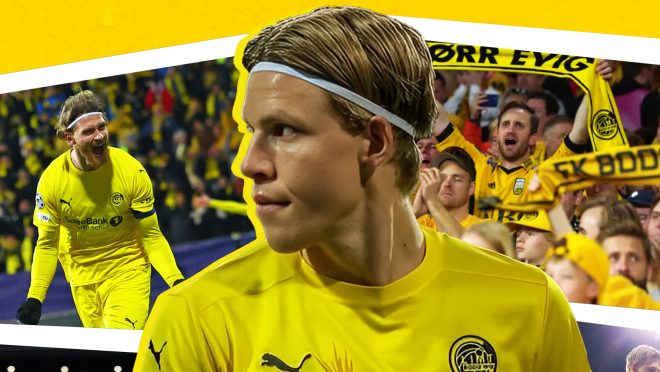
Bodø/Glimt, a small club from the north of Norway, has written its own David versus Goliath story, triumphing over Europe’s giants.
Against all odds, the modest Norwegian side Bodø/Glimt has secured a place in the Champions League round of 16, defeating Inter Milan over two legs in the playoffs. Earlier, they stunned Pep Guardiola’s Manchester City, Simeone’s Atlético Madrid, and earned a draw against Borussia Dortmund in their very first Champions League campaign.
To put this achievement in perspective, Bodø/Glimt is the first team from outside Europe’s top five leagues to win four consecutive games against top-five league opponents in a European cup since Johan Cruyff’s Ajax in 1971–72. This is not the first time Bodø/Glimt has shocked the world. They beat José Mourinho’s AS Roma in the Conference League with a massive 6-1 scoreline, one of the heaviest defeats ever suffered by Mourinho as a manager.
In 2025, they reached the European League semi-finals, beating FC Porto and Lazio, becoming the first Norwegian club in history to reach the last four of a major European competition.
Despite the fairytale wins, Bodø/Glimt’s success is not the result of a petro-billion-euro project or signing superstars. In fact, the club’s turnover in 2025 was around €70 million, less than what some players earn in a year in Europe’s top leagues.
So the question arises: how did a team from such a quiet corner of the world make such a ruckus on the European stage?
The Top-Gun Maverick
The story begins in 2017. Bodø/Glimt had been relegated to Norway’s second division.
To rebuild the mentality, they turned to an unlikely figure: Bjørn Mannsverk, a fighter pilot. He had no prior interest in football. A man who flew missions in Afghanistan and Libya brought that elite combat psychology into football, addressing a “collective mental breakdown” after their relegation.
For more than twenty years, Mannsverk served as an air‑force pilot at the NATO airbase in Bodø. After the 9/11 attacks, he was deployed to Afghanistan and later, in 2011, to Libya. His role as the club’s “mental coach” was to get players to speak openly about their feelings, reduce stress levels, change attitudes and routines around training and nutrition, and remove the stigma surrounding mental training. Wins and losses became secondary. Mannsverk suggested that players meditate, wearing their kits, every morning before training. This mental shift laid the groundwork for the club’s later success, many believe.
The Tactical Blueprint
What makes their rise even more incredible is that this is not a tale of a petro-dollar takeover or a billionaire saviour. There is no sovereign wealth fund behind Bodø/Glimt. Their rise has been fueled by methodical planning and strong principles, both on and off the pitch. The best part of their story is that they do not play like underdogs.
The architect behind FK Bodø/Glimt’s rise is their manager Kjetil Knutsen. He built a team with a proactive 4-3-3 formation. Knutsen emphasises pressing high up the pitch and maintaining possession, inspired by Jürgen Klopp. Under Knutsen, they won four Eliteserien titles in five seasons.
Jens Petter Hauge plays as a complete winger, with speed, skill, the ability to create and finish, and strong tactical discipline. Only Kylian Mbappé, Anthony Gordon, Harry Kane and Erling Haaland have scored more goals than Hauge in the Champions League this season. He ranks joint-first for take-ons completed. Patrick Berg, a solid and well-rounded midfielder, provides the stability and engine that powers their gameplay.
Before Europe came calling, Bodø had to prove this was not a dream idea but a genuine process. They proved it ruthlessly at home.
Smart Recruitment and Data-Driven Decisions
The club has adopted a La Masia-style system that produces its own talents. They also made several smart transfer deals rather than flashy investments. Clever acquisitions, like Albert Kronbeck, bought for around $7 million and later sold for nearly $20 million, and Faris Mubana, purchased for $1.6 million and sold for almost seven times that, reflect their strategy. Victor Bonaface, now a household name, was scouted from Nigeria, developed, and sold for around $8 million.
But there is more to the story. The club has an AI-backed in-house data platform called “Fokus”. It aligns with the Moneyball philosophy: targeting undervalued players and building a team that relies more on systems than big names.
Owner Frode Thomassen spoke in an interview about the phrase Vårres måte, which means ‘our way’ or ‘our method’. They prioritise the club’s homegrown players. For example, at least four players – Håkon Evjen, Jens Hauge, and Patrick Berg – were academy graduates in their lineup against Inter Milan, playing pivotal roles in both legs.
This Champions League run will also boost the club immensely. For a club like Bodø/Glimt, reaching the Champions League is not just glory; it guarantees infrastructure development. Simply making the league phase earns a fixed payment of €18.62 million under the 2025/26 distribution model, before performance bonuses. Reaching the round of 16 will earn an additional €11 million. These funds will support better recruitment, longer player retention, and provide leverage when bigger clubs come calling.
Bodø is home to just over 50,000 people. A standard European football stadium has more seats than the entire population of the town. Bodø/Glimt’s stadium, Aspmyra, holds around 8,000 spectators. In the frozen north, under the endless skies of the Arctic Circle, a small club has turned the impossible into reality, beating Europe’s biggest clubs. Their journey might end soon, but it will surely be a blueprint for smaller clubs to dismantle the myth that only the rich and powerful can reign.
As Ted Lasso puts it: BELIEVE.