PSG’s calm, Arsenal’s pain: A final of missed moments
The 2026 UEFA Champions League Final in Budapest was everything European football promises but rarely delivers in full: chaos, control, collapse, and redemption compressed into breathless minutes.
PSG’s calm, Arsenal’s pain: A final of missed moments
The 2026 UEFA Champions League Final in Budapest was everything European football promises but rarely delivers in full: chaos, control, collapse, and redemption compressed into breathless minutes.
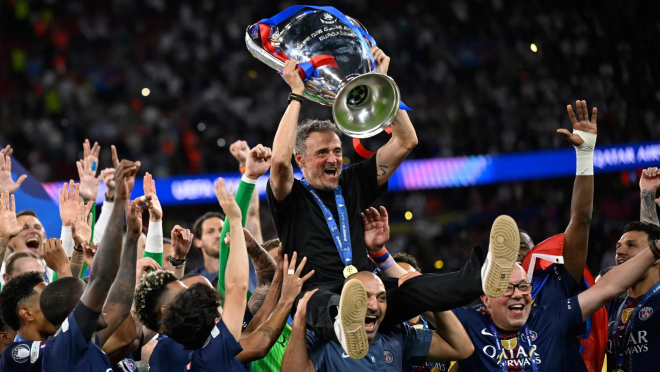
At the Puskás Arena in Budapest, Hungary, Paris Saint-Germain defeated Arsenal in a 4-3 penalty shoot-out after a 1-1 sequel in the first 120 minutes that swung violently and was decided by PSG’s superior efficiency in decisive moments.
This was not a one-sided coronation. It was a game of fine margins, where Arsenal matched PSG in intensity, possession phases, and even chances created, but failed, once again, to match their opponent’s ruthless finishing and game management in the biggest moments.
For PSG, it was a back-to-back confirmation of evolution. For Arsenal, it was heartbreak sharpened by how close they came, yet the trophy remains untouched.
First half: Arsenal strike
From the opening whistle, Arsenal imposed their rhythm. Mikel Arteta’s side built through Declan Rice and Martin Ødegaard, circulating possession patiently and pushing PSG into a compact defensive block. Bukayo Saka and Gabriel Martinelli held width high, stretching PSG’s back line. In the 5th minute of the match, Kai Havertz opened the goal-scoring account with a magnificent edge shot through the bars.
For the first 20 minutes, PSG looked reactive rather than dominant. Vitinha and João Neves were forced deeper than usual, and Arsenal’s pressing traps and haram ball format limited central progression.
But PSG did not panic. They waited. Half-time whistle: Arsenal 1–0 PSG.
Arsenal responded with maturity rather than chaos in the second half. They continued controlling possession, gradually pushing PSG deeper. Ødegaard found Saka between the lines, and the English winger glided into the box before finishing calmly into the bottom corner in the 64th minute of the game. A foul was called, and with the whistle the referee indicated a penalty. Ousmane Dembélé equalised from the penalty spot, with the scorecard at 1-1.
Second half: Tactical adjustments and rising tension
The second half began with a noticeable shift in PSG’s approach. Luis Enrique instructed his side to press higher in short bursts rather than sitting deep continuously. This disrupted Arsenal’s comfort in build-up.
Vitinha began stepping higher into midfield zones, creating overloads that forced Arsenal to adjust their passing structure. Instead of clean progression, Arsenal began facing fragmented possession sequences.
Arsenal’s structure collapsed emotionally, not tactically. PSG slowed the tempo, controlled possession in safer zones, and managed the final minutes with maturity far beyond their earlier European iterations.
End of 90 minutes. An extra 6 minutes were given, where in the 91st minute Arsenal got their first free kick of the match.
End of full time. The score was still 1-1. Nerves were on a high pitch. A break of 10 minutes and then the extra time started with the hope of seeing a team score. Despite many chances, both sides displayed their best performance to block the goal sides.
After 120 minutes, in the penalty shoot-out dramatic turns took over when Eze shot his penalty wide and Raya saved Nuno Mendes’ penalty. After 2–2 came the 3-3 equaliser. A goal scored by PSG made it 4-3. In the last penalty shoot-out, Gabriel Magalhães shot long off, restricting the goal score to 4-3, and the night belonged to PSG.
Why PSG won
PSG’s victory came down to three decisive elements: transition efficiency, clinical finishing in key moments, and holding their nerves and upholding their format till the last moment, which had a crisis in Arsenal.
Throughout the game, they played in such a way that the format was 11-0-0! Despite this, PSG controlled the emotional tempo better in the final 15 minutes.
Arsenal’s defeat was not a structural failure; it was marginal inefficiency. Missed control phases between 60–70 minutes, defensive exposure during attacking transitions, slight hesitation in closing space at the edge of the box, lack of format designing, and proper planning.
What could have changed the game
Arsenal won 11 games and made three draws throughout the Champions League this season. Undoubtedly, it shows a new start for Arsenal F.C. However, in the final, due to a lack of the clearest alternative pathway and proper tactics, the results were swapped. A single finishing moment during that phase would not have forced extra time.
PSG, on the other hand, could have been punished if Arsenal had been more disciplined in transition defence after equalising at 1–1.
Gabriel and Eze had a big role in winning the Premier League title for Arsenal. Declan Rice appreciated their effort despite the two misses that showed team spirit and upheaved the game.
The match was defined not by dominance, but by timing. The Budapest final will be remembered as one of the most balanced Champions League finals of the decade. Unlike one-sided demolitions, this was a contest decided by precision under pressure.