Chasing a PhD Dream: Rafi's journey to NUS
For many Bangladeshi students, pursuing a fully funded PhD abroad can feel complicated and uncertain.
Chasing a PhD Dream: Rafi's journey to NUS
For many Bangladeshi students, pursuing a fully funded PhD abroad can feel complicated and uncertain.
The process involves standardised tests, research experience, recommendation letters, and a costly application cycle.
Yet every year, a small number of students from Bangladesh successfully secure funded doctoral positions at global universities.
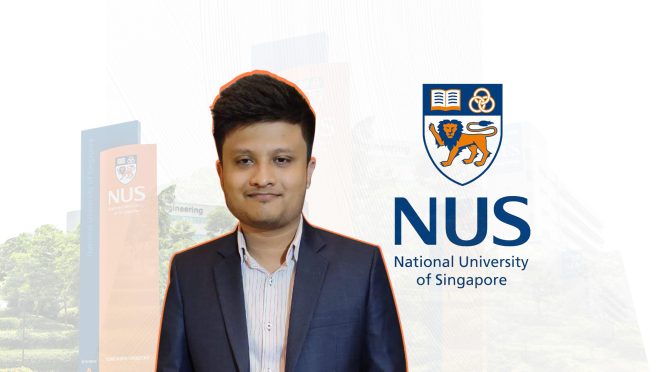
Among them is Sheikh Rafi Ahmed, who is currently pursuing a PhD in Economics at the National University of Singapore (NUS). The Ministry of Education in Singapore offers a monthly stipend and pays for his doctoral programme’s tuition. Reflecting on his path from the University of Dhaka to a fully funded PhD, Rafi thinks the process is difficult but doable with the correct planning.
Learning about Economics and the PhD path
Rafi’s academic path did not begin with a clear plan to study economics. Like many Bangladeshi students, he initially prepared for science subjects during university admissions. Eventually, he shifted tracks and enrolled in economics at the University of Dhaka.
Growing interest in development challenges was the driving force for the change. “Bangladesh is a developing nation with a lot of unsolved issues,” he says. “You can comprehend those issues and consider potential solutions with the help of economics.”
He progressively became interested in academia and research during his undergraduate and graduate studies. He eventually decided to pursue a PhD for two reasons. He first wanted to work in academia since he loved teaching. Second, he desired the chance to delve deeper into economic issues.
“A PhD is an essential training for a budding researcher. Additionally, it is often the prerequisite to secure academic positions at universities and other renowned research organisations,” he says.
According to Rafi, four elements are particularly important for a strong PhD application: academic performance, standardised test scores, research experience, and letters of recommendation.
Academic performance is often the first filter. Economics PhD programmes involve mathematically rigorous coursework, so strong grades signal readiness for the programme.
“There is no hard and fast rule about CGPA. But a CGPA around 3.5 or above generally puts applicants in a safer position,” he says.
Standardised tests are another key requirement. Most universities require the GRE along with English proficiency tests such as TOEFL or IELTS. For economics programmes, however, the quantitative section of the GRE is especially important.
“The maths is mostly high-school level,” Rafi explains. “But the test is designed to assess accuracy and logical reasoning.” Rafi secured a perfect score in the quantitative section.
According to him, you should try to score at least 160 out of 170 in the quantitative section. In terms of resources, he recommended the GregMat website for GRE preparation.
The Statement of Purpose (SOP) and letters of recommendation also play a major role. For PhD applications, the SOP functions more like a research statement than a personal essay.
“You need to explain your research interests, what questions you want to explore, your potential contribution, and why specific universities or faculty members are a good fit,” he says.
Letters of Recommendation (LoR) can often be the strongest signal in an application. A detailed letter from a professor who has worked closely with the applicant can demonstrate research ability far better than grades or test scores.
Experience
Research assistantships were central to strengthening Rafi’s profile. Working with academic researchers allowed him to gain practical experience in data analysis, fieldwork, and empirical methods.
He later worked with the ARCED Foundation, where he participated in field experiments and applied research projects. These experiences not only built his research skills but also helped him form professional relationships with senior researchers.
“PhD admissions committees want to see evidence of research potential,” he says. “Working on research projects shows that you can contribute to academic work. I worked with a professor from NUS for the past three years, and his LoR was crucial for me to secure an admission at NUS.”
Rafi suggests that students should reach out to research-active professors and ask to work with them as a Research Assistant.
“Only a professor who has closely worked with you can write meaningful stuff in the LoR. Generic LoRs from your course teacher may not be enough,” Rafi said.
Understanding fully funded PhDs
PhD applications typically open in December for programmes beginning the following year. Rafi recommends preparing most materials well before the deadline.
Applicants should ideally finalise their SOP drafts by November and send them to mentors for feedback. Faculty members who will write recommendation letters should also be informed early.
Rafi suggests applying to around 10–15 universities across different ranking tiers to improve the chances of admission.
The process can also be expensive. Application fees, standardised tests, and document preparation can collectively cost several lakh taka.
“It’s important to plan financially,” he says. “Applying to multiple universities increases your probability of success.”
Many students misunderstand what a “fully funded” PhD means. In most cases, the funding package covers tuition and provides a stipend for living expenses.
At NUS, Rafi receives a stipend funded by Singapore’s Ministry of Education, along with other academic support. The stipend is paid year-round rather than only during academic semesters (the typical case in the United States).
Although Singapore is one of the world’s most expensive cities, he says the stipend allows students to maintain a modest but stable lifestyle.
Moving abroad for doctoral studies involves significant adjustments. One of the biggest challenges, according to Rafi, is adapting to independent living and managing the academic pressure of a rigorous PhD programme.
Economics PhD programmes are highly competitive and intellectually demanding. Students regularly engage with complex theoretical models and advanced data analysis.
“The pressure can be intense,” he admits. “You have to genuinely enjoy research to stay motivated. So, do not pursue a PhD unless you are really into research.”
For students in Bangladesh who want to pursue funded PhDs abroad, Rafi recommends starting preparation early.
Building a strong academic foundation in economics, maintaining a high CGPA, and gaining research experience during undergraduate or master’s studies are critical steps.
“Understanding economics deeply should be the priority,” he says. “At the same time, students should try to work with professors on research projects whenever possible.”
With careful planning and persistence, he believes Bangladeshi students can compete internationally.
“The process is challenging,” he says. “But with the right preparation, it is definitely achievable.”