Ruet 1st, Buet 23rd: The study plan that delivered results
Who is a topper? What comes to mind is a brilliant student with a continuous track record of exceptional results. Unfortunately, that was not the case for Nafis, the young man we interviewed who stood first in RUET and 23rd in BUET.
Ruet 1st, Buet 23rd: The study plan that delivered results
Who is a topper? What comes to mind is a brilliant student with a continuous track record of exceptional results. Unfortunately, that was not the case for Nafis, the young man we interviewed who stood first in RUET and 23rd in BUET.
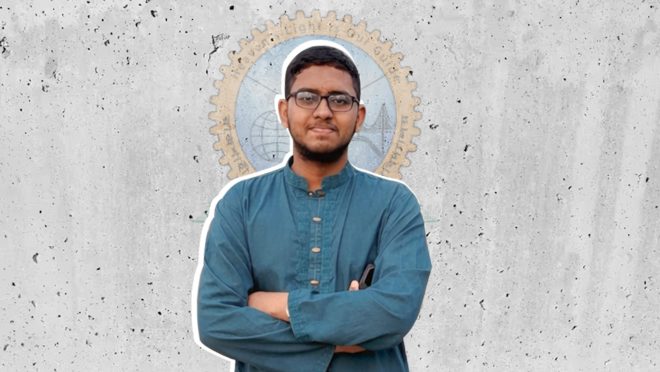
Studying efficiently and consistently, along with steady revision strategies, resulted in such an accomplishment. This eventually paved the way for him from having a modest school record to evolving into the first-place achiever at RUET.
The early pivot: When a goal becomes real
Nafis started his school life at Barishal Zilla School, where he studied from 3rd grade until the 10th grade.
The best part about studying in these competitive Zilla schools is that students are exposed to some of the brightest individuals in the district or division. He then studied at Govt. Syed Hatem Ali College, where he passed his HSC exams.
Despite being from such a competitive school, he says the turning point in his life came after 10th standard, when it was time to choose his path.
“This was the moment when my goal became clear,” said Nafis.
His passion for engineering began from there. Surprisingly, he was not a natural top performer.
He recalls, “I wasn’t even in the top 20 at the school level for a long time.”
As the date for the SSC approached, his consistency proved vital, as he scored an impressive 1256 out of 1300 in the Barishal Board.
The most pragmatic approach he took was his self-assessment mechanism. He was certain about where he lacked.
As Nafis mentioned, he was weak in subjects like BGS, Bangla and Biology, where he relied heavily on memorisation.
“I never enjoyed memorising those things.”
Rather than maintaining a combined focus, he doubled down on his strengths, where critical understanding was needed.
“Instead of forcing myself, I decided to fully focus on Maths, Physics and Chemistry, where understanding mattered the most,” he recalls.
These strategies shaped his entire university admission journey.
A blended approach: Coaching plus serious self-study
Admission seekers are often confused about whether to choose self-study or coaching.
For Nafis, a blended approach brought the best results.
“Teachers helped me understand how to study and what’s important and what’s not. After getting that guidance, most of my progress came from self-study and question-solving.”
He used coaching materials from ACS and Udvash and attended online classes from ACS. However, he emphasises that coaching can only provide direction. Free resources on YouTube helped him immensely throughout his journey, but without proper guidance, they can become confusing.
“Free resources are vast and sometimes confusing.”
His backup plan was Dhaka University Science Unit, or A Unit.
“I didn’t even appear in the medical admission test. DU A Unit was my side plan alongside engineering.”
What “Smart Strategy” actually looked like
“My result wasn’t an overnight success.”
“I actually studied every chapter mainly for admission. So HSC felt like an add-on for me,” he said.
By the time HSC arrived, Nafis had already completed his admissions syllabus. While finishing each chapter, he made concise notes to help with revisions.
Regular revision enabled him to feel confident about his preparation. For university admission tests, past years’ questions are crucial. They acted as a compass guiding his preparation.
“They show which topics matter most and help us be selective.”
Another smart strategy was attending as many mock tests as possible. He analysed all his mistakes and ensured they were not repeated. He reanalysed them again before the main admission test.
“I focused more on avoiding silly and calculation errors.”
He divided his time as follows: 40% for Chemistry and 30% each for Physics and Maths, reflecting the greater effort required for Chemistry.
“Chemistry took the most effort, mainly because of memorising reagents, reactions and factual information.”
Apart from that, his progress remained consistent, studying five to six hours each day. During intensive exam periods, this increased to 12–13 hours.
However, he emphasised that consistency played a bigger role than sheer hard work.
“Because of this consistency, my last months were smooth as butter, with no pressure and no burden. The tough days were already past.”
Managing pressure, burnout and exam hall reality
Long-term preparation inevitably brings stress. He admits burnout is normal.
“I used to reward myself with small gifts to stay motivated.”
Reflecting on BUET, he said, “During the BUET admission test, I did feel pressure, and that’s why my rank dropped there.”
A small error under pressure led to an unexpected setback. From his perspective, calming nerves during exams is crucial.
He followed a specific answering order: Maths first, then Physics, and Chemistry last.
“If I got stuck, I skipped it as fast as possible and came back later.”
Resources that mattered
Nafis credited several books and teachers, including Professor Mohammad Ishaque Sir’s Physics book, Hazari Nag Sir’s Chemistry book and Ketab Uddin Sir’s Maths book.
His preferred coaching materials were Udvash and ACS. Many conceptual problems were solved through online classes.
With numerous online and offline coaching options available, he advises students to choose teachers whose explanations they understand easily.
For students without coaching, he recommends using YouTube and online coaching effectively, as they are more cost-efficient.
“YouTube is a huge resource, and online coaching is cheaper. Personally, I would suggest at least going for online coaching because it gives focus and direction, and being focused and selective matters.”
Reflection
He believes his exam strategy gave him the edge.
“I’ve seen many students who worked harder than me. My edge was understanding question patterns and preparing accordingly.”
If given another chance, he says, “I’d spend more time building deeper concepts and do some higher-level preparation instead of revising things I already knew many times.”
Regarding his results, RUET 1st, CUET 3rd, SUST 4th and BUET 23rd, he recalls,
“I was extremely happy; words can’t really express it. I instantly called my mother. She was so happy.”
Advice for students
He advises students not to underestimate themselves. Most students start from an average position but can excel through hard work and consistency.
“Hard work can always beat talent if talent doesn’t work. Don’t feel self-guilt. Be confident. Dream big and keep going.”
Nafis’s success is a combination of an effective study plan, the right coaching, disciplined self-study, consistent effort, analysing past questions and continuous self-reflection through mock exams.
His first plaec reminds us that consistent effort and rigorous practice yield excellence. BUET 23rd place reminds us that pressure can influence outcomes but cannot erase consistency.
For aspiring engineering students, his message is clear: you do not need to be born a genius.
“You just need a proper plan, proper guidance and the determination to keep moving forward.”
His journey proves that national achievements require not extraordinary talent, but steady willpower capable of withstanding the storm.