IID–YFP poll shows low awareness of July Charter, reforms
Bangladesh is entering a crucial electoral period in the aftermath of the July Movement.
IID–YFP poll shows low awareness of July Charter, reforms
Bangladesh is entering a crucial electoral period in the aftermath of the July Movement.
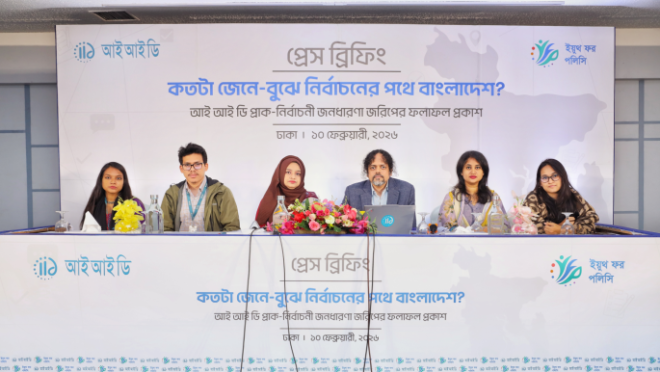
The election is being held alongside a referendum, meaning competition is no longer limited to party politics; institutional reform, voter participation and inclusion, and the credibility of results are now intertwined. A new national opinion poll suggests many people are eager to vote but are approaching the polls with significant information gaps and uncertainty about what might happen once results are announced.
The survey was conducted by the Institute of Informatics and Development (IID) and its youth platform, Youth for Policy (YFP). This non-partisan public opinion survey was designed to assess whether people have sufficient information to make informed decisions, whether they feel included and safe while voting, and their level of confidence in the fairness of the democratic process. Data were collected from 9,892 eligible voters across all eight divisions on 6–7 February 2026, using a stratified coverage plan.
Referendum: reforms reduced to a yes–no choice, raising risk of confusion
The referendum ballot asks voters to mark a single box—”yes” or “no”. However, the question bundles multiple reform issues and links them to the July Charter and various reform commission proposals. In effect, one “yes” or “no” vote is being treated as a decision on multiple promises and changes.
Survey findings suggest many voters have limited familiarity with the referenced documents. As a result, many are less confident about what “yes” or “no” actually means in practice.
Understanding the ballot: large deficit, worst among older, rural and less educated voters
Nationally, 37.2 per cent of respondents said they knew what the July Charter contained. The gaps behind this average are significant:
- Among voters over 35, 23.2 per cent said they knew, compared with 45.7 per cent of those aged 18–35.
- Among rural respondents, 32.4 per cent said they knew, compared with 41.4 per cent in urban areas.
- Among those with no formal education, only 8.4 per cent said they knew the charter’s contents, while 77.2 per cent said “no” or “do not know”.
Awareness of specific reforms also appears weak. For example, 43.1 per cent said they knew what changes were proposed to fundamental rights. Nationally, 55.3 per cent said they did not know or were unsure, with uncertainty higher among older and less educated respondents.
A key inclusion risk is the ability to read and understand the referendum ballot. Nationally, 72.4 per cent said they could easily read and understand the text. But among those over 35, that falls to 57.4 per cent. Among those with no formal education, it drops further to 26.6 per cent.
Many respondents were also unclear about what would happen if “yes” won or “no” won:
- 29.6 per cent nationally were unsure what would happen if “yes” won (42.7 per cent among over-35s; 62.2 per cent among those with no formal education).
- 33.6 per cent nationally were unsure what would happen if “no” won (47.8 per cent among over-35s; 67.5 per cent among those with no formal education).
Rural respondents were less likely than urban respondents to state they understood the implications of the outcome.
Inclusion: many unaware of their preferred party’s position; civic space remains unequal
When asked whether their preferred political party had signed the July Charter, only 43.0 per cent responded “yes”. A large proportion said they did not know (37.4 per cent), while 12.5 per cent declined to answer. Uncertainty was highest among:
- voters over 35 (48.3 per cent said they did not know)
- rural respondents (41.7 per cent)
- voters with no formal education (63.4 per cent)
This suggests many citizens are being asked to decide on reforms without knowing where their preferred party stands on the issues.
Regarding civic space, 63.0 per cent said they could speak openly about the election, while 20.2 per cent said they could not. Among indigenous or ethnic subgroups, 46.7 per cent said they could not speak openly, indicating that fear and self-restraint are not evenly experienced.
Concerns: fears of disruption and doubts over acceptance of results
A majority (55.0 per cent) believe problems or insecurity on election day could deter people from voting. This perception is important because it can reduce turnout and intensify rumours and fear, especially where information gaps are already significant.
Regarding post-election stability, only 51.0 per cent believe losing parties will accept the election results in full or in part. Meanwhile, 35.8 per cent were unsure or unwilling to answer. Uncertainty was relatively higher among women and voters with no formal education, potentially widening the space for competing claims and tensions regarding legitimacy after results are announced.
Public confidence in government impartiality also appears mixed: 47.9 per cent said the government was impartial, 11.3 per cent said it was not, while 33.7 per cent said they did not know (rising to 39.7 per cent among women). Another 7.1 per cent declined to answer.
Expectations: most feel safe voting, and expectations for inclusion are strong
Despite concerns, respondents expressed strong expectations for participation:
- 86.4 per cent said they felt safe going to the polling station (64.0 per cent yes; 22.4 per cent somewhat).
- 82.5 per cent felt religious or ethnic minorities in their area would be able to vote without fear (69.7 per cent yes; 12.8 per cent somewhat).
On women’s voting autonomy, 68.0 per cent said women vote according to their own judgement, while 21.1 per cent said women vote according to husbands’ or fathers’ preferences, suggesting family influence remains significant in some contexts.
Implications of the findings
Reform agenda without public understanding could undermine July Movement expectations
The July Movement placed anti-discrimination demands and reform at the centre of public aspiration. However, the survey indicates the election–referendum process is moving forward with major information asymmetries. Voters over 35, rural residents, and those with limited or no formal education are most likely to be ill-informed—including about what the July Charter contains and what a “yes” or “no” result means in practice.
The next government may need to treat this as a legitimacy issue and launch a time-bound, non-partisan public awareness programme that explains the reform proposals in simple terms, prioritising the least informed groups.
Too much bundled into one question could fuel post-election dispute
Field comments indicate practical confusion, including tensions among clauses within the referendum proposal. If multiple reforms are decided through a single yes–no vote, internal inconsistencies could become a source of controversy after polling. Clear, authoritative instructions before the election on how the clauses will work together could reduce interpretive conflict.
If time is short, minimum standards should be inclusion and security
Equal access to information may not be realistic within a limited timeframe. In that context, the minimum standard should be protection of participation—including visible measures against intimidation, minority suppression, and mob violence—backed by prevention, rapid response, and district-based remediation.
Neutrality and trust are prerequisites for acceptance
High uncertainty about government impartiality and whether losing parties will accept results points to weak trust. Rebuilding trust requires visible administrative neutrality, transparent communication, and accessible complaint and dispute resolution mechanisms—reducing space for destabilising narratives after results are announced.