A blend of red and yellow: The dual spirit of 14 February
If you stop someone on the street today and ask, “What day is it?” most will probably smile and say, “Valentine’s Day.”
A blend of red and yellow: The dual spirit of 14 February
If you stop someone on the street today and ask, “What day is it?” most will probably smile and say, “Valentine’s Day.”
Red roses, heart-shaped balloons, and dinner plans; the 14th of February has become a global symbol of love.
However, many people are unaware that today also represents something deeply rooted in our own cultural calendar. Today is Pahela Falgun, the first day of spring in the Bengali calendar. For Bangladesh, 14 February is not only about romantic love. It is also about the king of seasons making its arrival.
The overlap of Valentine’s Day and Pahela Falgun is meaningful. One celebrates affection, while the other celebrates renewing. Maybe that is why 14th February is a little different in our country. Bangladesh blossoms in yellow while the rest of the world is dominated by crimson.
However, this was not always the case as we grew up celebrating Pahela Falgun on 13th February. The shift happened after revisions were made to the Bangla calendar to align it more accurately with the Gregorian calendar.
In 2019, Bangladesh officially adjusted the calendar so that national and cultural dates would remain consistent with fixed English dates. As a result, the first day of Falgun moved from 13 February to 14 February.
The change caused confusion at first. Many were unaware of the change while some knowingly decided to celebrate on 13th as the sudden shift felt strange. Social media filled with debates, event posters carried mixed dates, and people questioned which day truly “felt” like Falgun.
Pahela Falgun has always marked the start of the Falgun month, indicating the end of winter’s dryness and the start of spring’s colour. Spring festivals were popular in Bangladesh during the twentieth century, thanks to cultural initiatives that focused on Bengali heritage, art, and music. What started as a seasonal remembrance grew into a strong cultural celebration.
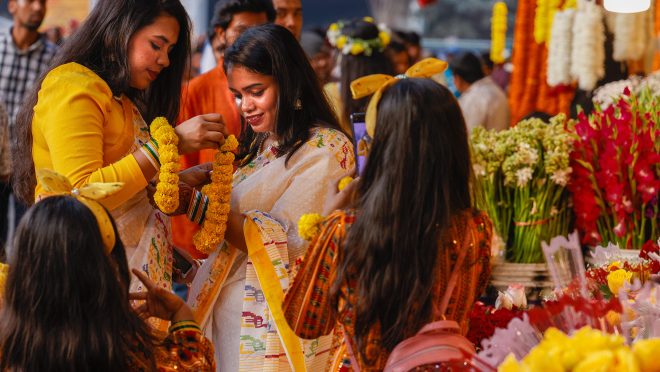
Today, that joy is more evident at Dhaka University’s TSC than any other place. From early morning, the campus transforms. Women drape themselves in yellow, saffron, and floral sarees. Men wear panjabis in warm, earthy shades.
Flower crowns are sold on sidewalks. Groups gather under trees, singing Rabindra Sangeet and reciting poetry. Cameras click endlessly as friends try to capture the “perfect Falgun photo.”
For many young people, the day is now a blend of red and yellow. A rose in one hand, a marigold in the other. Some begin the morning at TSC celebrating spring and end the evening at a Valentine’s dinner. The two occasions do not compete; instead, they coexist both speaking of new beginnings in their own ways.
If Valentine’s Day is about showing love to someone special, Pahela Falgun is about celebrating our love for renewal for a new season, new colours, and new beginnings.
Beyond the clothes and photos, Pahela Falgun is all about collaborative energy. It’s one of those rare days when strangers smile at each other without thinking twice. You might compliment someone’s saree and end up in a full conversation.
A casual group singing at TSC quickly grows into a crowd. Friends run across other friends they didn’t expect to meet.
Perhaps that is why the date shift seemed confusing at first but it did not take the real meaning out of this celebration. And anyways Falgun is less about the exact date and more about the feeling it brings. It is about gathering, singing, dressing up and celebrating this day with all other Bangladeshis.
The date shift, though initially confusing, did not take away from the essence of the celebration. Falgun is less about the exact date and more about the feeling it brings. It is about gathering, singing, dressing up, stepping outside, and letting colour return to life.
So yes, today is 14 February. It is Valentine’s Day and it is also Pahela Falgun, a day when Bangladesh welcomes spring with open arms. And in a city glowing with yellow sarees, fresh flowers, and shared laughter, it becomes clear that this day is not just about romantic love. It is about warmth in every form be it cultural, seasonal, or something deeply personal.