A fair out of time: Ekushey Boi Mela 2026 and the cost of poor planning
Sohrawardi Uddan had been unusually quiet for a February afternoon that would normally be filled with excitement. Stalls were still being assembled. Workers moved from one partially completed structure to another. Publishers were present, not to greet visitors, but to oversee the construction work.
A fair out of time: Ekushey Boi Mela 2026 and the cost of poor planning
Sohrawardi Uddan had been unusually quiet for a February afternoon that would normally be filled with excitement. Stalls were still being assembled. Workers moved from one partially completed structure to another. Publishers were present, not to greet visitors, but to oversee the construction work.
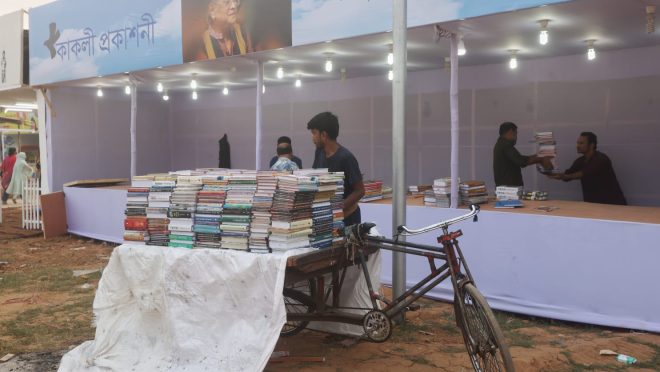
Even though the fair has started, the uncertainty surrounding it is already apparent.
People previously roaming around the venue often wondered about the opening, as February has historically been the month of the Book Fair.
From the start of January, most remained confused, seeing no visible development. Some were unsure about the dates, while others questioned whether they would be able to attend once Ramadan began. Even though the fair was supposed to open on 26 February, the atmosphere feels more like the result of protracted delays than the hub resonating to a national cultural event.
The Ekushey Boi Mela has been more than just a book fair for a long time. Organised by the Bangla Academy, it has been a living manifestation of the Language Movement, a yearly cultural event in Bangladesh that brings together literature, memory, and national identity.
But this year, its cultural significance is no longer the main concern. The focus is on whether the fair has been scheduled during a time when attendance may be weak.
A pressure filled timeline
The events related to the 2026 Ekushey Boi Mela did not develop suddenly. The fair was originally planned to take place from 20 December to 20 January, but it was postponed because of the national elections. The Ministry of Home Affairs had issued a directive prohibiting large public gatherings prior to polling.
The fair was rescheduled to begin on 20 February. That plan changed again. Only a few days prior to the event, the opening date was rescheduled first to 25 February and then to 26 February.
Timelines for preparation were unavoidably shortened by such last-minute decisions. Under pressure, staffing arrangements, book printing, stall construction, and promotional planning had to be modified. The final schedule gave many publishers the impression that the fair was being moved forward merely to maintain a symbolic February timeline, rather than to guarantee the best possible event.
Only on 18 February, following several rounds of meetings with ministers, officials, and Bangla Academy representatives, was a consensus reached. In order to guarantee attendance, stall fees were eventually eliminated.
This decision not only prevented withdrawals but also demonstrated how chaotic the situation had become.
Ramadan: A practical constraint, not just a cultural debate
There has been much discussion about holding the Ekushey Boi Mela during Ramadan, but there is a practical question that goes beyond symbolism: how many people will actually attend while fasting?
Long afternoon and evening visits have historically been the fair’s main source of income. That rhythm is entirely altered during Ramadan. Due to work commitments, heat, and exhaustion, daytime attendance is likely to remain low.
Iftar, prayers, and family time will now directly compete with the evenings, which have historically been the busiest periods. Visitors may arrive later, stay for a short time, or decide not to visit at all.
Whether or not people find value in books during Ramadan is not the issue. The question is whether the circumstances support overall involvement.
There are obvious risks associated with this timing for an event that primarily depends on urban crowds. Attendance usually peaks and sales momentum builds during the last week of the fair, which now clashes with the Ramadan closure days.
The fair may experience a drop in attendance at the exact moment when it usually flourishes if a significant portion of the city starts heading home early.
Publishers are particularly sensitive to this issue. For many, Ekushey Boi Mela revenue supports operations for months.
A weaker final phase could have tangible financial consequences, especially for smaller publishing houses.
Was timing treated as a priority?
The broader debate emerging this year is not whether the fair should have been held, but whether enough importance was given to scheduling it correctly.
Elections and administrative orders presented real challenges for the organisers. However, cultural planning necessitates long-term collaboration, particularly for a major event like the Ekushey Boi Mela.
It appears that timing became a compromise rather than an objective, due to frequent schedule adjustments, last-minute decisions, and the overlap with Ramadan.
That perception matters. Participation levels, publisher confidence, and visitor experience are all shaped by scheduling choices.
More than symbolism
For many people, Ekushey Boi Mela is inseparable from February’s historical meaning. But symbolism alone cannot sustain the fair’s vitality.
Ramadan and Ekushey Boi Mela are both deeply significant in the Bangladeshi context. Ensuring that one does not diminish the other requires foresight, coordination, and planning well in advance, not decisions made under deadline pressure.
If attendance falls short, if publishers struggle, or if the final weeks lose momentum, the question will be whether the Ekushey Boi Mela still matters.
It will be a question of whether sufficient importance was given to choosing the right time for the fair to succeed.