Shakib Al Hasan: Hero on the field, polarising off it
For almost two decades, Shakib Al Hasan was the closest thing Bangladesh cricket had to certainty. If the batting collapsed, he steadied it. If the bowlers struggled, he found breakthroughs.
Shakib Al Hasan: Hero on the field, polarising off it
For almost two decades, Shakib Al Hasan was the closest thing Bangladesh cricket had to certainty. If the batting collapsed, he steadied it. If the bowlers struggled, he found breakthroughs.
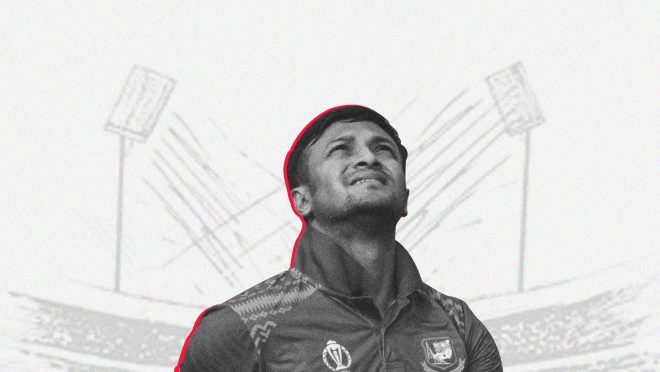
For many fans, Shakib’s name has become inseparable from the rise of Bangladesh as a competitive cricketing nation.
That is precisely why the current debate about his return to the national team feels so complicated.
The conversations are no longer just about form, fitness, or team balance. It is about whether sporting greatness can or should exist separately from politics and public accountability.
An uncomfortable question the country is now forced to confront.
BCB and the question of sporting merit
Recent discussions within the Bangladesh Cricket Board suggest that a pathway could exist for Shakib’s return to the national setup, possibly for upcoming ODI fixtures.
On purely cricketing terms, the argument is obvious. Bangladesh has struggled for consistency in recent years, particularly in the middle order. Even at 38, Shakib’s experience and skill set remain rare in Bangladeshi cricket. Players like him do not come along often.
For supporters of his comeback, the issue should end there. National teams, they argue, should select the best players available. Cricket boards are not courts, and selectors are not moral judges.
But critics see the situation very differently.
To them, Shakib’s possible return cannot be separated from the political choices he made in recent years and the controversies that followed.
Politics, public office, and the role of athletes
The turning point came when Shakib contested the 2024 parliamentary election and won the Magura-1 seat as a candidate for the Awami League.
Athletes entering politics are not unusual. Across the world, former sports stars have moved into public office. In principle, there is nothing undemocratic about that.
Yet the context in Bangladesh made the decision far more contentious. Opposition parties and international observers, who questioned the fairness of the electoral environment, the 2024 election itself was heavily criticized.
For many Bangladeshis, Shakib’s candidacy, therefore, felt less like a simple career transition and more like a public alignment with a deeply polarising political moment.
Supporters argue that this interpretation is unfair. A citizen has the right to run for office, they say, and an athlete should not lose his sporting identity simply because he chose to enter politics.
But once a cricketer becomes a lawmaker, the public inevitably begins to judge him differently.
The political controversy surrounding Shakib has been compounded by a number of legal and financial disputes reported in Bangladeshi media.
One of the cases involves a cheque issue with IFIC Bank, along with investigations into share market activities that have caught the attention of the anti-corruption commission.
His name has also appeared in connection with a case filed following violence associated with the political unrest of mid-2024.
None of these allegations amount to a conviction, and Shakib like anyone else deserves due process. Still, the accumulation of controversies has inevitably affected how sections of the public view the idea of his return as a national representative.
Fairly or unfairly, the image of the cricketer has become entangled with the image of the politician.
The silence that many fans remember
For many critics, however, the most painful issue remains Shakib’s response or lack of one during the political unrest of July 2024.
That period saw intense protests and violence across Bangladesh. Students were at the forefront of the demonstrations, and the crisis eventually triggered one of the most dramatic political shifts in the country’s recent history.
During those weeks, many public figures were pressured to speak out. Shakib largely stayed silent.
Some fans interpreted that silence as caution. Others saw it as indifference. The fact that he was abroad at the time, playing franchise cricket, only intensified the criticism.
Months later, in October 2024, Shakib said he regretted not speaking earlier and apologised to those who felt disappointed.
For some supporters, that apology was enough. For others, it felt too calculated, arriving only after public pressure had grown.
It is easy to forget, amid the controversy, just how extraordinary Shakib’s cricketing career has been.
Few players from Bangladesh have dominated international cricket the way he did during his peak years. His performances helped change how the world viewed Bangladeshi cricket.
That legacy does not disappear overnight.
Public memory, however, is complicated. Great athletes are often remembered not only for their performances on the field but also for their actions off it.
For some fans, Shakib will always be the cricketer who carried Bangladesh through countless matches. For others, his political decisions have changed how his name is remembered.
Both interpretations now exist side by side.
The question Bangladesh must answer
In the end, the debate about Shakib’s return is really about something larger than one player.
It raises a difficult question: what does it mean to represent a nation?
If national selection is purely about talent, then the case for Shakib’s return is straightforward. If representation also carries moral or political expectations, the calculation becomes more complicated.
Different Bangladeshis will answer that question differently.
What is clear, however, is that the discussion itself reflects how deeply intertwined sports and public life have become. In a country where cricket is more than just a game, the actions of its biggest stars rarely remain confined to the boundary rope.
And that is why the debate over Shakib Al Hasan’s future continues to feel less like a routine selection decision and more like a reflection of Bangladesh’s own ongoing political and social reckoning. So now it’s up to the fan that carried him in their heart for years to decide will the memory of shakib’s cricketing glory overwrite the shakib that of political controversies and problematic alignments.