Ban or band-aid? The reality of coaching centres in Bangladesh
For decades, coaching centres have been the unspoken second classroom for students across Bangladesh; a parallel system built on exam pressure, parental anxiety and the quiet understanding that school alone is often not enough.
Ban or band-aid? The reality of coaching centres in Bangladesh
For decades, coaching centres have been the unspoken second classroom for students across Bangladesh; a parallel system built on exam pressure, parental anxiety and the quiet understanding that school alone is often not enough.
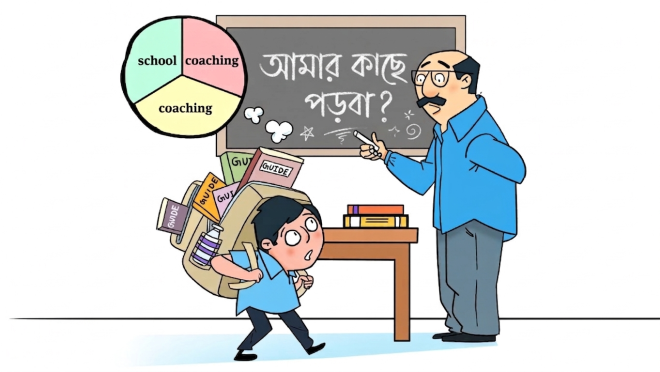
Now, that shadow system is facing its biggest challenge yet. The Ministry of Education has moved to ban commercial coaching centres as part of a wider effort to reclaim classrooms and restore confidence in formal schooling.
The move outlined in the draft Education Act 2026, is being pitched as a corrective measure, one that promises to reduce inequality, curb the commercialisation of education and shift academic support back into schools.
But as the policy gains momentum, a harder question looms: can a system that millions of students depend on be dismantled without fixing the gaps that made it necessary in the first place?
Let’s start off with why coaching centres have been a quintessential part of every school or college student for the past few decades.
Coaching did not emerge merely as a business opportunity; it grew out of structural weaknesses within the formal education system that families have been navigating for years.
Classrooms in Bangladesh are often overcrowded, leaving little room for individual attention. Teachers, burdened with heavy syllabi and tight schedules, are frequently forced to prioritise finishing the course over ensuring that every student truly understands it. In such an environment falling behind is easy, and catching up inside long school hours is rarely an option.
The country’s exam-centric culture has further fuelled the rise of coaching. Public examinations like SSC and HSC or O Level and A Level exams are treated as life-defining milestones, where a few marks can determine future academic and career paths. For many parents, coaching becomes less a luxury and more an insurance policy against failure in a high-stakes system that offers little margin for error.
There is also the question of trust. Many families, particularly in urban areas, no longer fully believe that classroom teaching alone is sufficient for competitive results. Coaching centres promise shortcuts, exam-focused techniques and predictable outcomes; things the formal system struggles to guarantee. Over time, this has normalised the idea that success requires education beyond school walls.
In that sense, coaching centres filled a vacuum rather than created one. They stepped in where the system could not meet the expectations. Any attempt to remove them, therefore, raises a critical issue: unless those underlying gaps are addressed, the demand that sustained coaching for decades is unlikely to disappear; it will simply look for new outlets.
In the short term, the ban is likely to reduce the visibility of coaching centres, with closures and crackdowns sending a strong policy signal. But demand-driven systems rarely disappear, they adapt. Past restrictions during exam seasons suggest coaching often shifts into private homes, small groups or online spaces that are harder to monitor.
Enforcement remains a major challenge. Regulating thousands of centres nationwide requires sustained oversight, something local administrations are already stretched too thin to provide. The continued involvement of teachers in private tuition, despite restrictions, could further weaken the policy if accountability and incentives are not strengthened.
Schools, meanwhile, are expected to fill the gap through “in-house” support, despite ongoing constraints such as large class sizes and limited resources. Without parallel investment in classrooms and teachers, the ban may curb coaching on paper, but struggle to deliver meaningful academic support in practice.
The sustainability of the coaching centre ban will ultimately hinge on whether it can reduce the financial and academic pressures that pushed families toward coaching in the first place. Interviews conducted by TBS Graduates show that for many middle-class households, coaching and private tuition have become a far heavier expense than formal schooling itself. Monthly school fees often range between Tk 2,000 and Tk 3,000, while spending on coaching and private tutors can climb to Tk 8,000–10,000 per child, sometimes even higher when multiple subjects or when online classes are involved.
This gap underscores how coaching has evolved into a parallel education system rather than a supplementary service.
In this context, the removal of coaching centres does not automatically translate into financial relief. If classroom teaching does not improve in quality and capacity, families are likely to redirect their spending toward less visible alternatives like private tutors, informal group study, online platforms or guidebooks, all of which continue to carry significant costs.
Education experts warn that such a shift would leave the underlying economic burden untouched, while making it harder for regulators to track or control.
There is also a risk that uneven enforcement could widen inequality. Families with greater financial means may adapt more easily by securing private tutors, while students from lower-income households may be left with fewer support options.
Without systemic reforms that strengthen schools, reduce exam pressure and lower out-of-pocket expenses, the demand that has sustained coaching for decades is unlikely to disappear. Instead, the policy risks becoming difficult to maintain over time. Not because families oppose it, but because the system has yet to offer a credible, affordable alternative.
While policy documents and government statements outline the rationale for the coaching ban, the real picture emerges when looking at the experiences of those most affected: students, parents, and teachers.
Many students say coaching has become a safety net for exam success. “I spend nearly four hours a day in coaching classes just to keep up with the syllabus,” says an HSC candidate in Dhaka. “If the centres close and schools don’t provide the same level of support, I don’t know how I’ll manage.” For students in competitive streams like science and commerce, coaching is not just extra help, it’s a lifeline for securing top grades and scholarships.
Families feel the pressure both financially and emotionally. “My son’s coaching fees are more than triple our school fees,” says a mother of two. “We want schools to be enough, but right now, coaching feels like the only way to ensure he doesn’t fall behind.” Parents worry that even if coaching disappears, the cost of extra tuition, through private tutors or online classes, will persist, undermining the financial relief the ban promises.
Educators are caught between policy and reality. Many admit that schools alone cannot meet the needs of students without additional resources. One senior teacher at a Dhaka school notes, “We’re expected to replace coaching, but our classes are already full. Without smaller classes, better training, and extra hours, students will still look elsewhere for guidance.” Teachers also fear that strict enforcement of the ban could limit their income if they rely on private tutoring to supplement low salaries.
Beyond the immediate impacts, the coaching ban raises a broader policy question: is this a genuine step toward education reform, or primarily a restriction that addresses symptoms rather than causes?
Historically, attempts to regulate coaching in Bangladesh have produced mixed results. Crackdowns during exam periods temporarily reduce visible tuition activity, but demand usually resurfaces in informal or hidden ways. Without reforms in classroom teaching, curriculum design, and assessment methods, the underlying drivers of coaching such as large class sizes, exam pressure, and gaps in teacher support still remain unchanged.
Experts argue that for the ban to be effective and sustainable, it must be paired with structural investment. Schools need smaller class sizes, more trained teachers, and extended academic support for struggling students.
Otherwise, the system risks pushing coaching underground rather than eliminating it. Economically, families may continue to spend heavily on education, just in ways that are harder to regulate or measure.
The policy also intersects with equity. Wealthier families may adapt quickly by hiring private tutors or leveraging online platforms, while students from lower-income households could face reduced access to supplemental guidance. In this sense, the ban could unintentionally widen educational inequality if not implemented alongside broader reforms.
Ultimately, the success of the coaching centre ban may hinge not on enforcement alone, but on whether classrooms themselves become spaces where students can thrive without relying on expensive, parallel systems.
The reform’s promise lies in creating an education system strong enough to make extra coaching unnecessary, a challenge that will test both policymakers and the nation’s schools in the years ahead.