Before a third language, fix the second
Isn’t it surprising that despite learning English since kindergarten, many students in Bangladesh are more fluent in Hindi than English?
Before a third language, fix the second
Isn’t it surprising that despite learning English since kindergarten, many students in Bangladesh are more fluent in Hindi than English?
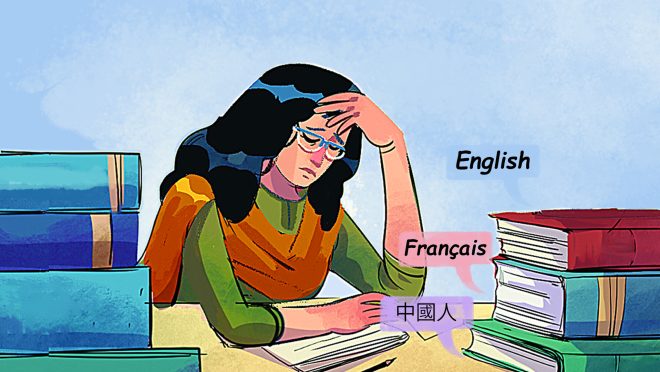
Why does this happen? One major reason is the fear of English. Another reason is the teaching methodology. Either teachers are not properly trained, or the syllabus is too focused on grammar.
As a TESOL student, I am familiar with a method called GTM or Grammar Translation Method, which focuses too much on grammar rules and written exercises and very little on speaking.
Because of this, students do not get enough practice in real communication. They become afraid of making mistakes. Hesitation grows and eventually, they avoid speaking English at all. This is the reality of English speaking in Bangladesh.
The situation is worse in many Bangla medium schools, especially those where underprivileged students study in rural areas.
Speaking to a Bangla medium teacher, who did not want to be mentioned by name, he shared, “I think most teachers have a below-average proficiency level in English. They can read short passages well. However, they make a considerable range of mistakes in writing.”
The teacher also explained that classroom conditions make learning more difficult.
“A teacher has to invest a lot in classroom management compared to teaching. I think they lack discipline and motivation.”
When teachers must spend most of their time preparing for the class, real learning suffers. Moreover, fear is another serious problem.
“The fear of being criticised prevents them from forming even simple English sentences in conversation.”
This fear stops students from practising and, ironically, this fear arises from lack of practice.
There are also structural problems. The teacher said, “First of all, the government should take steps to tackle financial constraints and provide proper teaching materials in the classroom. Teaching and learning cannot be done where teachers and students struggle with air and heat.”
On the other hand, one might assume that English medium schools are better off. However, the problem still exists but in a different form.
Sabiqun Nahar Rim from Ideal International School and College explained, “Students are great at reading and writing for exams, but they often freeze up in real conversations. They know the rules of the language but have not practised using it for fun or daily life.”
This again shows the gap between exam performance and real communication. She further said, “It is mostly fear of making mistakes. Even in English version schools, the focus is on getting high marks, not on speaking freely. Students are so worried about grammar that they forget to just talk.”
The fear of mistakes and the exam-centred system affect even English medium students.
Amid this situation, the government has taken an initiative to introduce a compulsory third language. The question, therefore, should ring loud once again. If many students can barely speak in their second language, how effective will a third language be?
In Bangla medium schools, students struggle with basic communication. In English medium schools, students can pass exams but struggle to hold longer conversations. The root problem appears to be methodology, teacher training, classroom conditions and an exam-focused culture.
When asked whether introducing a compulsory third language would be effective in this context, the Bangla medium teacher uttered one sentence very clearly, “Not at all.”
The teacher added, “While there can be changes done at the macro level, real improvement at the micro level would require professional training of teachers and extensive research on the adaptability of the curriculum to integrate any other language.”
Unlike the Bangla medium teacher, Sabiqun Nahar Rim from Ideal International School and College is more optimistic and believes there are some positive sides to learning another language.
“Yes. Learning a third language makes the brain sharper and more flexible. However, it should be taught through games and music rather than hard exams so students don’t feel overwhelmed.”
At the same time, she emphasised that we should move away from just memorising books.
Instead of making rapid changes and introducing new subjects, it may be wiser to strengthen what already exists. It is high time we move beyond GTM and other outdated methods.
Communicative teaching should be prioritised. Teachers need proper professional training. The syllabus should encourage speaking, interaction and real-life language use.
Before adding a third language, we must ensure that students can confidently speak the second one first.
The reform may look impressive on paper but unfortunately has a high probability of remaining ineffective in practice.