Between two Maghribs
The bike is moving too fast. Or maybe time is. The driver leans forward, weaving through traffic with the urgency only Ramadan evenings possess.
Between two Maghribs
The bike is moving too fast. Or maybe time is. The driver leans forward, weaving through traffic with the urgency only Ramadan evenings possess.
Cars inch ahead, rickshaws squeeze into impossible spaces, pedestrians choosing between risking accidents and reaching home a little earlier. I hold the back rail and glance at the sky.
The sun is melting.
That familiar orange, the exact shade that exists only in the last ten minutes before Maghrib, spills across the buildings. For a second, the noise disappears. The horns, the engines, the rush. All of it fades behind something softer.
And I am not here anymore.
I am small again, sitting on the floor beside the dining table, watching the clock and counting every second. Wondering if the clock is intentionally slowing time.
Ramadan, when I was a child, was a month of pursuit.
Not spirituality in the heavy adult sense, but practice, experiment and competition with myself. How many fasts could I keep? Could I do a half fast? Could I stretch hunger just a little longer to feel older than I was?
Every successful fast felt like unlocking a new level of existence.
Sehri was magic.
Waking up at an hour when the world was supposed to be asleep felt like entering a secret society. The kitchen lights were warm, my parents’ voices quieter than usual, their movements slower and gentler.
Food tasted better at night: softer rice, a glass of milk, eggs that felt like rewards rather than routine.
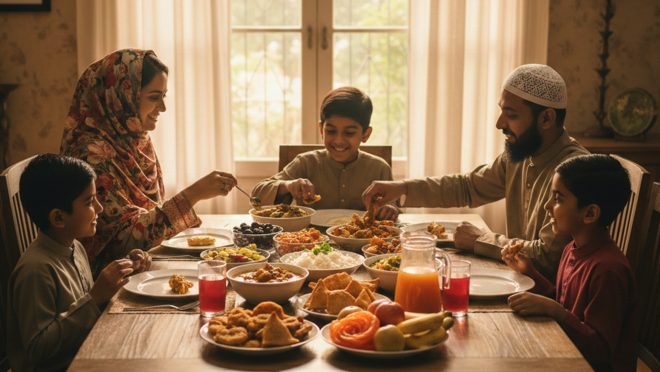
And no matter how busy life was outside Ramadan, we were always together at that table.
I had working parents, which meant mornings were rushed while evenings were unpredictable. But Ramadan rearranged the universe. Somehow there was always time for Sehri. Always time for Iftar. It was as if the month itself insisted on family.
Then came the waiting before Maghrib.
Those final minutes when everyone sat ready but still, dates on plates, glasses of water sweating in the heat, the television murmuring in the background. The azan would begin, and the first sip would travel through the body like mercy.
After Iftar, the world felt festive.
Mosques filled with people. Streets stayed alive deep into the night. There was laughter, movement and community. Ramadan felt like a shared experience, not something you carried alone.
Back then, Ramadan meant rest.
Somewhere between school years and university, that feeling began to change. Fasting became endurance: long classes with dry throats, exams during hot afternoons, the pride of surviving hunger while pretending it did not exist. But youth still carried me; energy was abundant and recovery was instant.
Adulthood is different.
Now there are classes, office work, deadlines and responsibilities layered on top of each other. Some days I am counting minutes not out of excitement, but exhaustion. I rush through the city of Dhaka trying to reach home before the azan, calculating traffic like strategy. I understand something now that I had never noticed before.
My parents were tired.
Not just casually tired, but the deep physical fatigue that sits behind the eyes. I remember how they would sometimes doze off after Iftar, sitting upright, conversations fading mid-sentence. As a child, it looked strange. As an adult, it makes perfect sense.
And I know this weight is not mine alone. Somewhere far from this city, Ramadan is unfolding in smaller, quieter rooms.
Sristi Samah, an international undergraduate student in Australia, once said that “the loneliest part of Ramadan is during Sehri and Iftar”, missing “the way we used to celebrate Ramadan together as a family, the food cooked by Maa, and the fact that it was probably the only time of the year when all of us would sit down together for two meals”.
Balancing study and work, she speaks of how she deeply misses “the essence of sitting down in a place called home”, explaining that as a working student she is “rarely able to stay home for Iftar”.
Back in Bangladesh, she remembers, “no matter how busy we were, we always made sure to be home by the time of Iftar”, but in Australia, “because of cultural differences and responsibilities, that is not always possible”.
Which reminds me why all of us who have our parents with us should be eternally grateful.
Fasting does not pause responsibility anymore. It runs parallel to it.
Yet, despite everything, Ramadan still carries the same air.
There is something intangible that arrives with the month, a softness in the evenings, a kindness in people, a strange optimism that prayers might actually fix things. Problems feel negotiable. Worries feel temporary. Even the city seems to move differently, as if it remembers something sacred.
The bike slows.
We are almost home now. The sky is darker. Lights flicker across balconies. Somewhere, someone is already making dua. Somewhere, a child is staring at a clock the way I once did.
I realise then that Ramadan did not become smaller.
Life became heavier.
The excitement of childhood Iftar has transformed into something quieter and deeper. Less festival, more meaning. Less anticipation, more gratitude. But the essence remains untouched.
The same hunger.
The same azan.
The same relief in the first sip of water.
The same moon above, watching different versions of me each year.
The driver stops. I step down. The call to prayer begins.
And for a moment, across time, every Ramadan I have ever lived feels connected, the child, the adolescent, the adult, all breaking their fast together.