Corruption: A way of life in Bangladesh
Corruption: A way of life in Bangladesh
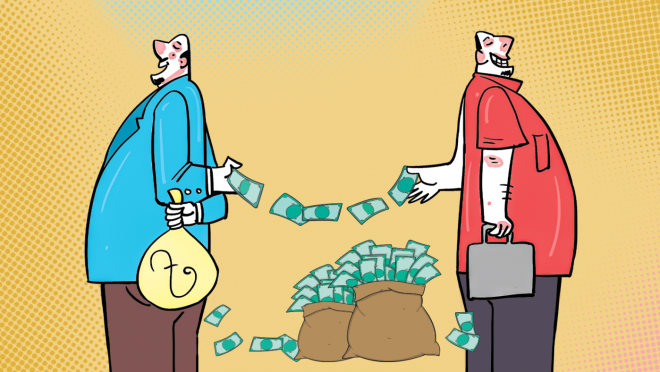
According to the Transparency International Bangladesh (TIB) National Household Survey 2023, 70.9% of households reported experiencing corruption when accessing services. Services ranging from law enforcement, judicial services, land services, public healthcare, and other government agencies have all failed to cater to the public and are mired in institutional corruption.
All the laws mentioned in the book are ineffective, and the political leadership over the years has consistently shown a well-informed ignorance regarding the various woes of the public.
9 December marks the adoption of the United Nations Convention against Corruption (UNCAC) by the UN General Assembly in 2003, and since then this day has been celebrated as International Anti-Corruption Day.
The Bangali experience
For anyone reading this piece, the experience of paying a small bribe, benefiting from nepotism, or being rejected due to it is part and parcel of daily life.
The same TIB survey indicates that Bangladeshi households particularly faced corrupt practices in 48% of cases within public healthcare, meaning that roughly half of the population encounters corruption while availing the most basic human rights of healthcare.
The question then arises: why are we so corrupt? Is it due to a lack of resources, or a lack of ethical consciousness?
There is a considerable correlation between a country’s GDP and its position on the corruption scale. The most corrupt countries are often war-torn and have very ineffective social institutions. They lack a strong institutional base, and education, healthcare, and other public services are concentrated among a few elites.
Countries such as South Sudan, Somalia, Syria, Yemen, and Libya occupy the top spots in TIB’s most corrupt nations, and they share similar misfortunes. Their GDPs are among the lowest in the world, and they have very little in the way of independent, strong institutions such as effective government or law enforcement.
However, Bangladesh does not share these misfortunes. The country is on its way to graduating from its LDC status and has a GDP per capita of $2,593, which is higher than many of its fellow corrupt nations. The literacy rate among Bangladeshis is above 70%, and the trend continues to rise.
Despite this, favouritism and nepotism still prevail. The shortsightedness of political parties over past decades has cultivated a culture of carelessness, where big businesses and a handful of individuals dominate headlines with bankruptcy and money laundering scandals. The high literacy rate also coexists with widespread cheating in exams, reliance on simplistic guides, and an entrenched outside coaching culture, reflecting a lower standard of practical education.
This indicates that higher GDP and literacy alone are insufficient to curb corruption. Wealth and abundance should deter corruption, but when governance is ineffective and the state itself participates in corrupt practices, there is no limit to what constitutes ‘abundant wealth’. Similarly, while the number of high-performing students in board exams has increased year after year, the quality of candidates entering universities and the job market has declined considerably.
The solution
Effective governance, checks and balances, and accountability are essential to curbing corruption. Although the roots of the problem are widely recognised, its prevalence continues unabated.
Leadership plays a crucial role in eradicating corruption. Implementing state-sponsored checks in institutions filled with over-bloated bureaucracies is likely to meet extreme resistance. Very few are willing to challenge the system, and even fewer dare to address the main instruments that allow corruption to flourish.
The state often finds it easier to ignore corruption, while political parties make vague promises about eradicating it without spelling out concrete policies. Consequently, the conscious mind of the nation becomes poisoned, and bureaucrats and high-ranking officials no longer see corruption as extraordinary; it has become embedded in the balance sheets of daily expenditures.
As the nation becomes accustomed to this comfort of incompetence, one might question the value of resisting the temptation to join the privileged class and benefit from the system. In a society where corruption is deeply ingrained, many find it more profitable to participate than to resist.