High salinity causes premature strokes, coastal families sink into debt
The stroke mortality rate is highest in the Khulna Division, standing at 0.17 per 1,000 people. In stark contrast, Chittagong Division records the lowest stroke mortality rate at 0.06 per 1,000
High salinity causes premature strokes, coastal families sink into debt
The stroke mortality rate is highest in the Khulna Division, standing at 0.17 per 1,000 people. In stark contrast, Chittagong Division records the lowest stroke mortality rate at 0.06 per 1,000
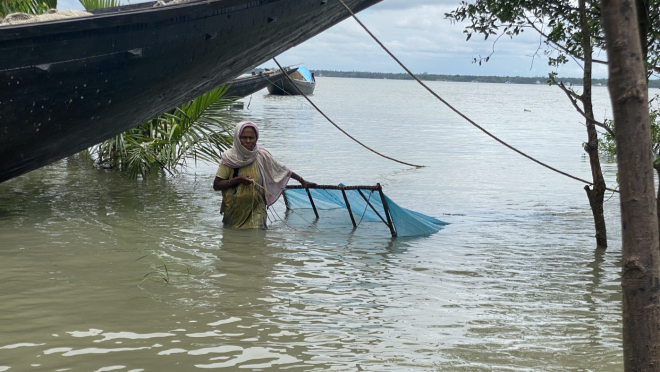
Abdul Hamid supported his six-member family by harvesting fish and crabs in the saline waters of the Sundarbans in southern Bangladesh for nearly 30 years.
But in mid-2025, he suffered a stroke and his family had to pawn his fishing boat and net to pay for his treatment. While Hamid survived, the stroke left him paralysed and he wasn’t able to get back to work, pushing his family into financial uncertainty.
“The hospital doctors informed us that my husband’s condition was caused by prolonged labour in highly saline water,” Rowshan Ara, Hamid’s wife said. “His illness has paralysed our entire family. Our three children had to drop out of school. I earn a meager income working as a domestic helper in neighbouring houses, but it isn’t enough. We are barely surviving, often skipping meals.”
Paikgachha Upazila people’s representative SM Anamul Haque said that hundreds of coastal families are trapped in a vicious cycle of poverty and debt after suffering stroke.
According to a 2014 World Bank study, driven by global climate change, rising sea levels are continuously increasing salinity levels across Bangladesh’s coastal districts. This environmental shift is acutely felt in the riverine areas of Khulna, Bagerhat, and Satkhira adjacent to the Bay of Bengal.
Speaking to over fifty local workers, it was found that, on one hand, the rising salt levels ravage agriculture and contaminate freshwater sources, on the other, prolonged exposure to high salinity is triggering hypertension and cardiovascular diseases among labourers. Consequently, working-class individuals are suffering debilitating strokes at a relatively young age, losing their ability to earn, and sinking their families into inescapable debt to afford medical care.
Government data and studies state that people living near saline regions of Bangladesh are more likely to suffer from strokes.

Four years after suffering a stroke, Ashraf Ali, a resident of Paikgachha Upazila Sadar, waits for treatment at Khulna Medical College Hospital in early April. Photo: Awal Sheikh
For instance, data from the Management Information System (MIS) of the Directorate General of Health Services (DGHS) reveals that among Bangladesh’s eight administrative divisions, the stroke mortality rate is highest in the Khulna Division, standing at 0.17 per 1,000 people. In stark contrast, Chittagong Division records the lowest stroke mortality rate at 0.06 per 1,000
Furthermore, divisional data analysis indicates that Khulna has the highest prevalence of stroke patients, with 1.77 individuals affected per 1,000 people. The Rangpur Division has the lowest prevalence at 0.62 per 1,000.
A separate study on the prevalence and risk factors of stroke in rural Bangladesh, conducted by the Institute of Advanced Research (IAR) at United International University (UIU), confirmed that Khulna tops the list among the country’s seven divisions.
The research further highlighted that within the Khulna Division, the stroke burden is heavily concentrated in the Khulna, Satkhira, and Bagerhat districts.
Prof Dr Khondaker A Mamun, director of the Institute of Advanced Research at UIU, stated, “Our research conclusively demonstrates that the incidence of stroke is disproportionately higher among the population in the Khulna region.”
Dr Mohammad Hasan, a public health and brain specialist at Satkhira Medical College Hospital, said that as salinity levels in the rivers and groundwater of the Khulna region escalate, labourers are forced to consume excessive amounts through the water they drink.
“This leads to chronic hypertension, which is the primary catalyst for strokes and heart diseases,” he said. “In recent years, we have seen a surge in stroke patients aged between 40 and 50, and salinity-related factors are a major contributor to this trend.”
One such climate-induced stroke pushed Deepali Mondal, a resident of Bainbaria village near the Sundarbans, into poverty. Her husband, Uzzal Mondal, who died in January, had suffered a stroke about eight months earlier, which left him bedridden.
“From that point on, the family spent most of their days navigating hospitals,” said Deepali.
By the time he passed away, the family had accumulated a debt of Tk800,000. They were unable to afford the funds required for his funeral rites. Yet, just eight months earlier, this family was considered one of the most affluent in the village.
“We became so helpless that we couldn’t even afford the SSC exam registration fee for our daughter. Her education came to an abrupt end,” Deepali said. “We eventually had to sell four bighas of land to repay the debt. Now, we have nothing left but our homestead. Everything my daughter’s father accumulated in his lifetime was exhausted on his treatment.”
Almost all upazilas in coastal Khulna suffer from varying degrees of fresh drinking water scarcity. Khairul Alam, a teacher at Sundarban Secondary School in Koyra upazila, said, “Various projects have been undertaken at different times to solve the water crisis in our upazila, but they were not sustainable. Often, even when ponds are excavated, they get submerged in saltwater during natural disasters. Consequently, drinking water can no longer be obtained from them.”
He further stated, “Many of those involved in shrimp farming are facing health risks due to continuous contact with chemical and saline water. Working in this environment for a long time is causing skin diseases, high blood pressure, and other complex health complications among them.”
Gouranga Nandy, chairman of the Centre for Environment and Participatory Research (CEPR), warned that if climate change continues unabated, salinity in the Khulna region will only intensify, worsening both health and financial crises for low-income families.
“Salinity in coastal Khulna is no longer just an environmental issue; it has evolved into a full-blown humanitarian crisis,” Nandi emphasized. “Every day, countless people are unknowingly ingesting what acts like slow poison, only to be suddenly struck down by a life-threatening stroke.”
According to Nandi, while the government has initiated projects to supply safe water and build climate-resilient infrastructure, sluggish implementation and a lack of maintenance remain major hurdles. Many water supply systems become non-functional shortly after installation. Therefore, implementing scientifically backed, sustainable projects is an urgent necessity.
Dr Sujat Ahmed, deputy director of Khulna Medical College Hospital, stressed the need for a coordinated response. “To tackle this crisis, we must focus on three pillars: first, ensure easy access to safe drinking water; second, raise public awareness about the dangers of excessive salt consumption; and third, make localised healthcare accessible so hypertension can be detected and managed early.”
“A stroke does not happen overnight,” Dr Ahmed added. “It is the culmination of long-term, uncontrolled high blood pressure. If timely screenings and medical interventions are made available, it can be prevented in many cases.”
However, Khulna Deputy Commissioner Hoore Jannat said while such diseases are more common in the coastal areas, there has not been much discussion about the fact that workers are getting sick and getting trapped in debt. The government provides various facilities to fishermen at different times, the officer said and the Public Health Engineering Department is working to solve the salt water crisis.
Ibrahim Md Taimur, executive engineer of the Public Health Engineering Department in Khulna, said, these problems in the coastal areas are mainly centred on climate change. Every year, the government is providing some projects so that the people of the coast can consume clean water. We are working to build and preserve clean water reservoirs.
This story was produced with the help of Thomson Reuters Foundation.