War and wildlife: How conflict mediates extinction
War not only destroys habitats, it also arms the people living within them. When conflict descends on a region, the institutional architecture of wildlife protection collapses almost immediately
War and wildlife: How conflict mediates extinction
War not only destroys habitats, it also arms the people living within them. When conflict descends on a region, the institutional architecture of wildlife protection collapses almost immediately
There is a particular kind of violence that does not end when the ceasefire is signed. It seeps into soil. It persists in half-lives. It unravels ecosystems that took millennia to assemble, with the casual brutality of a policy decision made in an air-conditioned room thousands of miles away. War, in its full accounting, is not merely an assault on human civilisation — it is a sustained, often irreversible assault on the living world.
The evidence spans continents and decades. It is written in the deformed forests of Vietnam, the oil-blackened shores of the Persian Gulf, the landmine-riddled corridors of Zimbabwe, the silent skies of Guam, and the shrinking territories of species that are running out of world while the powerful run out of targets.
There are numerous examples, but humans barely learn anything.
The green inferno: Vietnam
In the Vietnam War, the United States military sprayed approximately 20 million gallons of herbicide over Vietnam’s forests and farmlands. Swedish Prime Minister Olof Palme was among the first world leaders to name it plainly: ecocide. Defoliants destroyed around 7,700 square miles of forest — roughly 6% of Vietnam’s total land. Combined with 13 million tons of bombs dropped across Vietnam, Laos, and Cambodia, the landscape was architecturally dismantled. The species that depended on those forests did not wait for the peace treaty.
Today, the forests of Indochina are called green deserts, there are tracts of forests but none of them holds anything large and significant.
The sea on fire: Persian Gulf, 1991
To stop the advancing Coalition Force, Iraqi forces opened the valves of the Sea Island terminal and released an estimated 480,000 cubic metres of crude oil into the Persian Gulf — the largest deliberate oil spill in history. A slick 160 kilometres long, 68 kilometres wide, five inches thick, coating 604 kilometres of coastline. It was not collateral damage. It was environmental terrorism.

Future of striped hyena in the war-torn Levant is in peril.
The Marine Sapphire lost 99% of its population. Over 100,000 waders were killed. Fifty dugongs and an uncounted number of dolphins were found dead. Nearly half of the coral in affected areas was damaged and 99% of the Marsh Sapphire, a small plant, declined along the coast of Saudi Arabia. Till this day, the Persian Gulf coast is yet to fully recover.
The gun and the bushmeat
War does not only destroy habitat. It arms the people living inside it. When conflict descends on a region, the institutional architecture of wildlife protection collapses almost immediately.
Rangers are conscripted or flee. Park budgets are redirected. International conservation organisations evacuate. Legal frameworks governing hunting and trade dissolve into the general disorder — and into that vacuum walk men carrying automatic rifles, weapons manufactured for killing soldiers that prove equally efficient against elephants, gorillas, and lions.
In the forests of Central Africa, the wars that ravaged the Democratic Republic of Congo through the 1990s and 2000s flooded the region with weapons. Bushmeat hunting, once limited in scale by traditional technology, became industrialised overnight. Armed factions funded operations through ivory, bushmeat, and live animal sales. Entire populations of forest elephants, okapis, and bonobos were decimated not as a side effect of conflict but as an economic engine of it.

An Arabian leopard from the Judean Desert, photographed in 1985. Now, it is only confined in Yemen and Oman and very likely awaiting a formal declaration of extinction.
The illegal wildlife trade is the fourth largest criminal enterprise in the world, and war is its most reliable supplier — generating simultaneously a surplus of weapons and a collapse of governance. In post-civil war Mozambique, rhino populations that had survived centuries of subsistence hunting were eliminated within a decade. The horn moved through the same networks as the weapons. The same actors profited from both.
Markets that opened under wartime duress remain open because they are profitable. Species hunted to feed soldiers continue to be hunted to feed cities. War transforms people to see the forest as a resource to be extracted under pressure — and that lesson exists after the armistice.
The weaponised grounds
Some of war’s ecological damage lies inches beneath the soil, patient and indiscriminate. Over three million anti-personnel mines were planted along Zimbabwe’s borders during the Rhodesian liberation war. Zimbabwe inherited this legacy in 1980, with mines lining more than 700 kilometres of its borders with Zambia and Mozambique.
The illegal wildlife trade is the fourth largest criminal enterprise in the world, and war is its most reliable supplier — generating simultaneously a surplus of weapons and a collapse of governance. In post-civil war Mozambique, rhino populations that had survived centuries of subsistence hunting were eliminated within a decade. The horn moved through the same networks as the weapons. The same actors profited from both.
Decades of clearance efforts have made inroads, but vast tracts remain contaminated. In the Sengwe Wildlife Corridor, over 11,000 elephants navigate terrain laced with explosives, following ancestral migration paths etched across millennia — walking into death without warning. These minefields contain up to 5,500 landmines per kilometre, among the densest in the world.
Sound as weapon
Military sonar emits sound at intensities that cause acoustic trauma in cetaceans. Cuvier’s beaked whales began appearing on beaches in the Canary Islands with alarming regularity through the 1980s and 1990s — every mass stranding coinciding precisely with Spanish naval exercises. When exercises were present, whales died on shore. When absent, no strandings occurred. Following a 2004 ban on military exercises in the region, the mass strandings ceased entirely. The whales had been telling us long before we listened.
The accidental invasion
Shortly after World War II, the brown tree snake arrived in Guam as a stowaway in military cargo. In its native range, predators kept its numbers in check. In Guam, there were none. Its population eventually reached densities exceeding 100 per hectare. Twelve native bird species were driven to extinction — the Guam flycatcher, the Mariana fruit dove, the Micronesian rufous fantail, all gone. The island has suffered over 2,000 power outages in two decades from snakes entering electrical infrastructure. Guam remains a major Pacific transportation hub, and the snake continues to threaten further spread across Hawaii and the broader Pacific. Extinction requires no budget and offers no refund.
The paradox of abandonment
There is an unsettling irony embedded in all of this: sometimes, when humans vacate a space entirely, nature recovers. The Chernobyl Exclusion Zone has become an unlikely wildlife sanctuary — wolves, lynx, and brown bears moving through abandoned forests. The Korean Demilitarized Zone, one of the most heavily fortified borders on Earth, shelters red-crowned cranes and Amur leopard cats in the no-man’s-land between two armies. The Marshall Islands, site of 23 American nuclear detonations, have developed reef ecosystems of unusual density in the craters of those explosions.
These examples share a single, deeply uncomfortable revelation: that the primary threat to biodiversity on this planet is not war, but the ordinary, everyday presence of human economic life — the farming, the hunting, the development, the noise. War, in its most extreme expressions, has accidentally proven the conservationists’ most radical argument.
These recoveries were purchased at enormous human cost, by communities who paid prices they were never asked to agree to. There is nothing to celebrate here.
And, yet the rewilding is real. The wolves are there. The cranes are there. The reef fish are there. The verdict is unambiguous. Nature does not need us to save it. It needs us to leave.
No ceasefire for the wild
And then there are the animals who received only the war itself — wars they did not start, fought by powers that will never inventory what they destroyed.

An landmine survivor Asian elephant going through rehabilitation. Mined ground is one of the most underrated threats to wildlife.
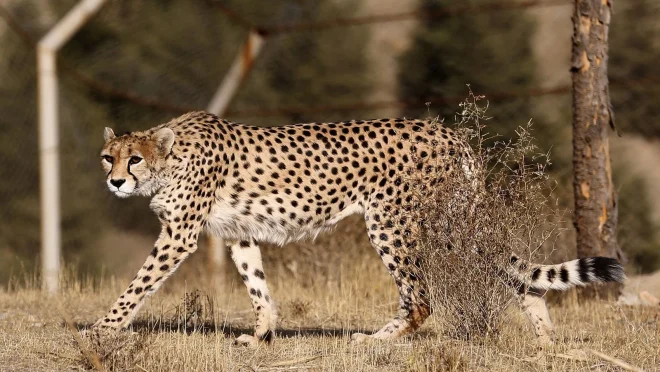
The Iranian cheetah, fewer than a dozen individuals confirmed alive, is vanishing inside a country subjected to decades of American-led sanctions and the perpetual threat of military strike.
The Arabian leopard of Yemen is dying inside a war prosecuted against one of the poorest countries on Earth. Fewer than 200 survive across the entire Arabian Peninsula. There is no anti-poaching enforcement because there is no functioning state. The leopard is listed as critically endangered. It is already extinct in Saudi Arabia, where millions have already spent to find a single trace of the species. And we are letting it go where we know they are still there.
The striped hyena of Levant walks hillsides that have bombed across five decades — most notoriously in 2006, when one million cluster munitions fell on southern Lebanon, the majority in the final hours after a ceasefire had already been agreed. Nobody is counting the hyenas carefully enough to know how few remain, because Lebanon has been given precious little peace in which to do any conservation.
The Iranian cheetah and the Arabian leopard are on their last legs. These animals are the collateral of a global order in which certain states possess the power to wage war, impose sanctions, and supply weapons to proxies — and are never required to account for what they unmade.
So, what are we doing in trying times? The powerless document. Their name. They insist, against the indifference of power, that what is being lost has a name, and a territory, and a place in the order of things.