The market value of a memory
The year was 2126. A company had found a way to store human memories outside the mind. Extracted gently, preserved perfectly, and transferred as well. It was marketed as a comfort, a way to hold on to the moments you were afraid of losing.
The market value of a memory
The year was 2126. A company had found a way to store human memories outside the mind. Extracted gently, preserved perfectly, and transferred as well. It was marketed as a comfort, a way to hold on to the moments you were afraid of losing.
Your child’s first laugh, your wedding day, the voice of someone you lost too soon. Memories did not have to fade anymore; that was the initial promise.
The company was called ReCall. Sleek branding, calming reels, and ads that spoke like lullabies. ReCall made it possible for people to relive their favourite memories, a way for people to look back at their lives and reminisce.
But the world did what it always does to beautiful things: turned it into a profit scheme. Soon the technology was not about saving memories; it was about selling them.
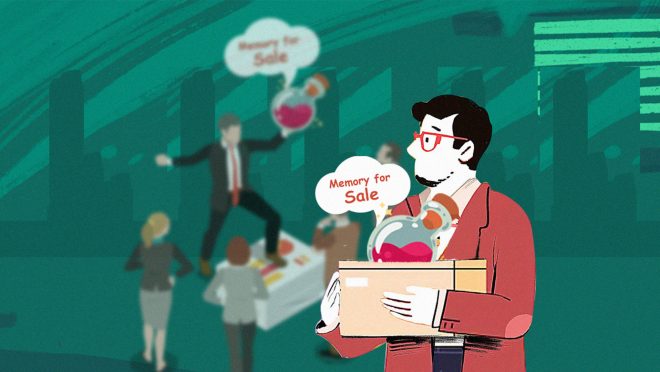
Turning the past into currency, turning pain and pleasure into payment. Their tagline was, “Trade the past for the future. Your memories are worth something.” Dystopian, insane, and almost Black Mirror-esque.
A single memory of a first kiss could pay rent for a month. A childhood birthday party, bright and untouched, could cover hospital bills. The memory of being truly loved was considered premium stock, the kind rich people bought the way they once bought diamonds. The poor, of course, were the suppliers.
Zayan was twenty-seven years old when he first walked into a ReCall branch. He did not look desperate, not in the dramatic fashion movies tend to show, at least. He just looked tired. The kind of tired that settles into the bones after years of living from pay cheque to pay cheque, after watching life become a series of bills with occasional breathing space in between.
The receptionist welcomed him with a warm smile.
“Selling or storing today?” she asked, her smile never wavering.
“Selling,” Zayan said, gulping.
“Wonderful, we have excellent rates this week. Nostalgia is up, and so is love,” she said, showing him a brochure.
They led him into a white room with a chair that looked too comfortable to be honest. A technician attached thin wires to his temples.
“What memory would you like to trade?” she asked, as casually as if she were asking for his phone number.
Zayan hesitated. “Something small,” he admitted.
The technician laughed softly. “They’re never small to the person who owns them.”
He chose a memory from when he was seven. A rainy afternoon, his mother cooking in the kitchen, humming a song in a soothing voice. The smell had been everything. Safety. Warmth. A home that had not yet learned how to break apart.
The machine hummed, and soon the memory left him the way air leaves a punctured tyre, quietly, until his insides felt flat. He walked out with money in his account and an odd blankness in his chest.
That night, he tried to remember the song his mother used to hum. Nothing came. He stared at the ceiling for a long time, feeling cheated, even though the transaction had been fair. That was the genius of it. Nobody stole from you. You volunteered to trade the memory.
The rich loved ReCall. They bought memories of people as entertainment. A banker in Gulshan could experience the joy of a fisherman’s childhood in Barisal, just for fun. A lonely CEO could experience the feeling of being held by someone with love.
Influencers hosted memory-tasting parties, giggling as they sampled heartbreak, laughter, poverty, war.
“Try this one,” someone would say, passing a capsule. “It’s so raw.”
Raw was fashionable. Pain was artisanal.
Meanwhile, people like Zayan kept selling. First, it was small things: the smell of his mother’s cooking, the sound of his father’s laugh. Then bigger things, because bigger things paid better. The day he graduated. The first time he felt proud of himself. The moment he realised life could be more than survival. He became lighter with every sale, like a man slowly disappearing without physically moving.
His friends noticed.
“You’ve changed,” one of them said over tea.
Zayan shrugged. “Everyone changes.”
“No,” the friend replied. “It’s like you’re missing pieces.”
Zayan smiled because it was easier than explaining that pieces were expensive, and he had rent due.
One afternoon, he returned to ReCall again. The receptionist greeted him like an old customer.
“Back again! What are we letting go of today?”
Zayan tried to joke. “Whatever’s left.”
The receptionist chuckled politely, the way people laugh at serious situations because silence is worse.
They offered him a new deal. A premium extraction.
“Core memories,” the technician explained gently. “The kind that shape who you are. They pay extremely well.”
Zayan swallowed. “What happens if I sell too many?”
The technician tilted her head, as if he had asked something adorable. “You’ll be fine. Most people don’t even notice. Life goes on. You just feel lighter.”
He almost walked out. He really did. But then his phone buzzed with another overdue notice. Another reminder that, in this world, dignity was a subscription service. So he sat down.
This time, he sold the memory of his mother holding his face in her hands when he was a child, telling him he would be okay. It paid enough for three months. It cost him something he could not name, because he could not remember.
Days passed. Zayan laughed at jokes a second too late. He stared at old photos like they belonged to strangers. He called his mother and felt nothing but obligation, like love had become a chore. The horror was not that he was sad. The horror was that he was not.
One evening, walking past a luxury apartment building, he saw an advertisement projected onto the glass.
“Experience authentic poverty — limited edition memories from real people.”
A couple stood nearby, smiling.
“Oh my God,” the woman said. “I tried one last week. It was heartbreaking. Like, so immersive.”
Her partner nodded. “Honestly, it made me grateful. Five stars.”
Zayan stood there for a long time. He wondered, distantly, if they had bought one of his memories. If someone, somewhere, was sipping wine while wearing his childhood like a costume.
At home, he sat on the edge of his bed and tried, one last time, to remember himself. The world outside kept spinning, efficient and hungry. ReCall stock prices climbed. The rich collected human experience like souvenirs.
Zayan closed his eyes and searched for something solid to hold on to, some proof that he had once been more than a balance sheet of moments sold.
There was nothing dramatic waiting for him, no final collapse or scream. Just a quiet understanding settling in: that he had traded his past to survive the present, and in doing so, gave up his future without realising it.
Somewhere, his memories were being replayed, rated, reviewed, and admired. Somewhere else, he sat in an empty room, alive but uninhabited.
And the cruelest part?
The world would never call it theft.
It would be called innovation.