Henna nights before Eid: Then and now
Applying henna prior to Eid used to be a small, peaceful tradition in many Bangladeshi homes.
Henna nights before Eid: Then and now
Applying henna prior to Eid used to be a small, peaceful tradition in many Bangladeshi homes.
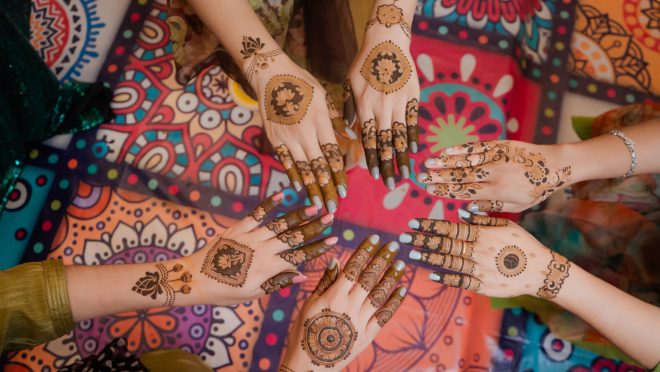
Henna nights often took place one or two days before Eid, after iftar, when the evening had finally slowed down.
Someone would come back from the local shop with a few henna cones tucked into a plastic bag, and that was enough to begin.
It was not a huge deal most of the time. Usually, one sister would hold out her hand while the other sat cross-legged on the bed with a henna cone.
Occasionally, a friend would join them, and the three of them would alternately sketch little patterns, flowers, curling vines, or a tiny circle in the palm.
Nobody was bothered by the imperfect lines and slightly tilted flowers. It was made special by the quiet thrill of Eid just a few days away.
Those evenings often had a soundtrack. The television might be on in the next room, and almost inevitably, the familiar strains of Romjaner Oi Rozar Sheshe would play.
For anyone who grew up in Bangladesh, that song carries something difficult to put into words, a feeling that Ramadan is slowly drawing to a close and the festival is almost here. Hands carefully wrapped or left to dry, everyone would sit together, talking about Eid plans, clothes, visiting relatives, or even what they hoped to eat the next day. It was ordinary, but it felt special.
Things are different now, especially in Dhaka. Although henna remains popular, it has evolved into a more social activity.
Rather than quietly applying henna on each other’s hands at home, groups of friends now plan trips to markets in shopping malls a few days before Eid. Everywhere you go, there are temporary henna artists offering intricate designs that are almost impossible to replicate at home.
Chand Raat, the night before Eid, has become a highlight for social gatherings. The streets are jam-packed with people doing last-minute shopping, markets stay open late, and friends walk from stall to stall, comparing designs and joking. What was once a private, at-home ritual has become a vibrant social activity.
This change can be explained by a few factors. Professional artists can produce intricate details that take years to perfect, and elaborate henna designs influenced by Arabic or bridal motifs are highly valued.
Also, as urban life and smaller households result in fewer extended family gatherings, going out with friends feels more natural. Social media has also left its mark: elaborate designs posted online create expectations that make the simple patterns done at home seem less appealing in comparison.
Despite all these changes, old memories remain. Moments like the careful stillness while waiting for henna to dry, the quiet excitement of seeing the colour deepen overnight, the casual conversation while someone attempted to draw a vine that never quite worked out, these moments are still vivid.
Many people are reminded of a slower, more reserved Ramadan, when small traditions felt like their own little celebrations.
Traditions change, and henna is no different. What was once a low-key activity among friends or sisters has developed into a lively social ritual full of movement.
However, henna still marks the end of Ramadan, whether it is applied at home or under the bright lights of a busy market. It remains a simple, joyful custom that signals Eid is almost here and the festivities are about to begin.