Kothay khabo? Eat, pose, wait, repeat
At every Eid in Dhaka, a silent, unspoken ritual takes place.
Kothay khabo? Eat, pose, wait, repeat
At every Eid in Dhaka, a silent, unspoken ritual takes place.
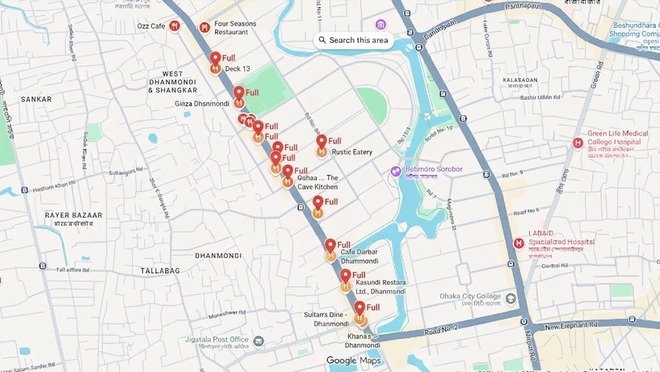
Shemai or meticulously plated biryani at home are not part of this ritual. Rather, it starts at noon, when groups of young people who have just gotten dressed open their phones and send the same message across multiple WhatsApp groups: “Kothay khabo?”
The plan is straightforward in theory: put on your Eid outfits, persuade a few friends to get together, and go directly to a restaurant.
Of course, the restaurant is about more than simply the food. It is also the chosen backdrop for documenting everyone’s Eid outfits—the carefully coordinated kurtas, fresh panjabis, and the inevitable group photo taken somewhere near the main entrance.
In reality, the plan has slowly evolved into something very similar to a competitive sport, requiring patience, planning, and sometimes the ability to wait for your serial number to be called while standing on a restaurant staircase for an extremely long period of time.
One person, who had clearly endured this ritual more times than he could count, described it with the calm resignation of someone who knew exactly what was coming. For the last three consecutive Eids, he said, he had left home at exactly 1pm, convinced that this time he had finally figured out the perfect timing. However, it never works out.
He believes that the issue is that there are two extremes in the timing of Eid restaurant visits. He ends up waiting on the stairway like someone hoping to enter a highly elite club, because he either arrives too early, before the restaurant has fully started seating customers, or he arrives slightly later and is handed a slip with his serial number for a table. Last year, that number was 33.
Serial number 33, for context, roughly translates to: please reconsider your life choices.
Waiting is an experience in itself. Friends lean on railings, families cram themselves into corners, and everyone acts as though nothing is wrong. Every few minutes, someone from the staff emerges and calls out a number, causing a ripple of movement among the hopeful crowd.
But nobody ever leaves the line, of course. Because if you give up, you will have to start the entire process over at a different restaurant, where you are sure to be given another number.
Thus, the cycle continues. Like determined pilgrims of overpriced food, groups stroll from restaurant to restaurant. By mid-afternoon, many have visited three different places and memorised the interior staircases of half the city’s restaurants.
Ironically, this happens despite the fact that every Eid meal at home is loved by all. There is always a table somewhere filled with pulao, korma, kebabs, and desserts that appear in endless rotation throughout the day. But for some reason, the thought of dining out is still alluring.
Perhaps it’s an excuse to get dressed up and go out with friends. Perhaps it is the infrequent occasion when everyone is free at the same time. Or perhaps it is just the excitement of the pursuit.
When a table eventually opens after an hour or two of waiting, the group squeezes in with a tiny sense of victory, as though they have just won a competition rather than merely gotten lunch. By then, most people are so hungry that they are no longer even debating the menu, and when the food arrives, it disappears remarkably quickly.
Somewhere between the first bite and the last group photo, someone will surely say what everyone is already thinking: that they should arrive earlier next year. And naturally, when the next year comes, around noon, the group message “Kothay khabo?” appears once more, and the entire marathon starts over.