Mangoes, lychees, and the mystery of fathers
I can’t remember when I started noticing that my father wrote my name differently from how everyone else did. All caps. Like I was a headline, something everyone should notice and feel the importance of.
Mangoes, lychees, and the mystery of fathers
I can’t remember when I started noticing that my father wrote my name differently from how everyone else did. All caps. Like I was a headline, something everyone should notice and feel the importance of.
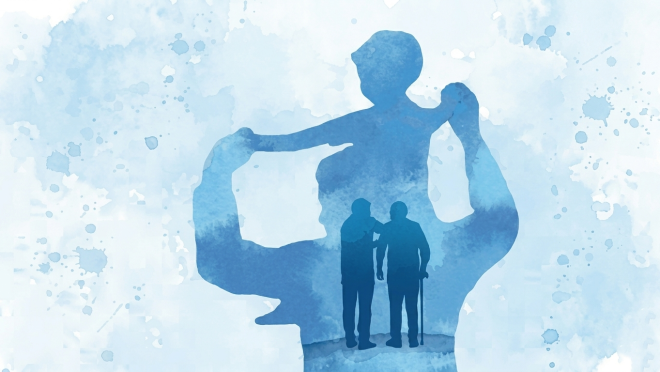
Even now, there lies an entire basket of mangoes and lychees in our house he brought because he knows how much I love them. There are times when I wonder, is this how fathers love? And more importantly, is this how they are forgiven?
We’ve all heard that Humayun Ahmed quote: “There are many bad people on earth, but there is no bad father.” Earlier, I thought he wrote it just because it aligned with his broader literary interests. We all know how he explored family relationships, parental bonds, and human nature in his novels and other works. But if you look at Humayun Ahmed’s own life, you see choices that make him look like the ‘bad father’. And yet he himself said there’s no such thing as a bad father. There’s something almost defiant in that statement, isn’t there? So I cannot help but wonder if he also brought mangoes and lychees for his kids.
I have always thought about the equation that defines a “good father”. What exactly tips the scales? Is it the skill of providing and the ability to fill baskets and dining tables? Is it a father’s capacity to serve his child’s physical and mental growth? Is it a sacrifice, that painful removal of his own happiness to make space for yours? Is it wearing those let-me-go-I-cannot-exist-anymore shoes, the ones that wear the wearer thin? Is it wealth, honesty, or kindness? What exactly decides if a father is good enough to be considered a ‘good father’?
I have never been able to answer that properly. Because, like Humayun Ahmed, I’ve met rotten people in life. Rotten to the core, yet somehow universally known as good fathers. I’ve met people carrying stories about their fathers being abusive, cheaters and wholly unhelpful, ununderstanding, unsupportive, and so much more. I’ve met fathers who make the homes feel like danger zones, and the kids feel safe in the roads and woods. But here’s the paradox: once these children enter adulthood or barely the edge of it, the fathers are forgiven. Always. Or mostly always.
Is it the sheer syllables of the word ‘father’ that earn them such deep forgiveness? Or is it because Islam and other religions tell us to respect them? Is it that the ‘bad fathers’ eventually do something so monumentally good that it erases the past? Or is it the fact that, entering adulthood, we suddenly see the burden he’s been carrying, the weight of providing, of protecting, of existing as the one responsible? Do we forgive him because we finally understand the shape of his struggle and recognise it in ourselves?
Is it the mangoes themselves, or the love that moves through his hands when he chooses them? What is the sheer mysterious part of fatherhood that earns forgiveness so deep that we stop noticing the old wounds and start noticing the fruit instead? What exact alchemy transforms hurt into hunger for connection and silence into gratitude?
Perhaps Humayun Ahmed was right all along. A husband can be a failure, and history is full of them. A son can be a disappointment. A brother can be irritating, competitive, cruel, even. But a father? A father seems to exist in a different moral universe altogether, one with different rules, different weights, different accountings.
I am a daughter to a father for whom I am the entire world. Every time I doubted myself, when I felt like I had failed, ruined my life, disappointed everyone who believed in me, my father trusted in me anyway. There were countless times when I said, “I cannot do this. This is not for me,” and my father would just say: “I know you can,” or “I know you will win.” Every time I failed miserably, wanting to cease to exist, my father would enter and tell me how incredibly proud he is of me. I still couldn’t figure out what exactly he’s proud of.
But I have friends and families whose fathers cheated on their mothers, whose hands became weapons, whose voices were tools of control, who made entire households exhale in fear. I see them looking at my father and saying I am lucky that I don’t have complaints. That he never told me what field of education I should choose, that I shouldn’t pursue engineering, that it’s not a female field, that he doubts me, or anything ever in my life that makes me question my worth. But through some weird sorcery, I know that a few years down the line, they are going to forgive their fathers and love the mangoes he brings home.
And I wonder what it means that I know this so certainly. It speaks to something profound in how we are wired as children to our fathers. It shows that forgiveness is not something we decide consciously, but something we discover in a moment of sudden clarity, or maybe while writing a Father’s Day article. Perhaps it arrives when we finally glimpse the weight our father carried without complaining. Perhaps it comes when we understand that a person can be broken in some ways and still possess the capacity to be good. Perhaps it arrives simply because the longing for our father’s love never truly leaves us, no matter what he did or didn’t do.
I think that’s some kind of blessing fathers are blessed with. With an almost magical ability to be remembered not by the sum of their deeds, but by the persistence of their love. Love that shows up as fruits or a name in all caps.
Happy Father’s Day to all the fathers in the world. The already declared good ones and the ones awaiting to be declared. The ones that bring money, mangoes, and happiness home. Your child loves you.