My first vote: A dream finally lived
The experience began when my exams were finished and I departed from Dhaka to Chittagong.
My first vote: A dream finally lived
The experience began when my exams were finished and I departed from Dhaka to Chittagong.
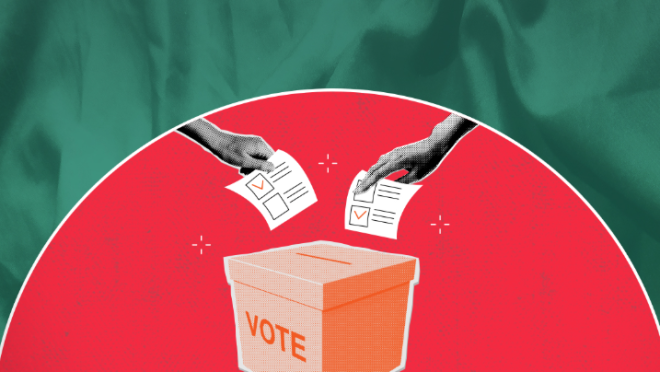
For many, like me, going home to participate in an election was something we had never experienced. The joy of it, coming with friends and imagining the future of the country, debating, discussing, sharing political memes, and cracking jokes without intimidation, felt surreal.
Before I delve into my first experience of voting, let me tell you a story from my school days. It was probably mid-June, and I was going through my half-yearly examinations. On the day of my English 2nd paper exam, a composition question appeared that left me baffled. I had to write a composition on A Journey by Train. Until then, I hadn’t had a single journey by train.
I can vividly remember the day, sweating and getting nervous as it became harder for me to imagine what to write after the first few lines. I somehow finished it, very poorly, to be specific.
That incident made me realise that nuances can be experienced through imagination; they have to be sensed and lived through. Since then, I have had many journeys by train, and every time it made me realise how much I could have written if I had experienced it before my exam.
Long gone are the days of school, and as time passed, I believe I developed my imagination skills. Just to prove me wrong, to show how much I had yet to develop and how much I had missed, came the experience of voting for the very first time. I had lived in imagination to participate in a free and fair election, and to witness that imagination in reality felt far more self-accomplishing.
When I reached home, I experienced quite a different buzz in my area. This time, the sound was lower and the posters fewer. The opposing contestants seemed to be very amicable towards each other. That was surprising for me, as I grew up listening to political blaming, slandering, and shaming directed at one another from early childhood.
The best part of the election was the festivity and reunion, something I usually experience only during Eid. Even during Eid, many of us have family functions and social bindings, but this was the first time I reunited with my friends and it was not Eid. The surprising part was that we returned to our roots to participate in an election, to elect the wheel-steerer of the country for the next five years.
The night before the vote felt like the night before an exam. I was going through the manifestos, agendas, promises, affidavits, and policy plans of the contenders till the middle of the night, as if I were revising my lessons just before an exam. But the difference between an exam and this was that there was hope instead of anxiety, nerves not in fear but in excitement.
Finally, the day came. I went to vote, dressed with pride and confidence. As I approached my voting centre, I saw a group of female voters of different age groups, from young adults to older women. They were shining in new dresses and glittering with excitement. I met my local uncles and elders along the way. I greeted friends at booths established by different parties — those I had grown up playing cricket with and who were now serving for the parties they supported. They did not coerce me to vote for their party; instead, they were happy that we were finally coming out of our homes and participating.
Finally, I entered the centre, and an Ansar member helped me find my queue. He was very friendly and helpful, something we often miss from officials in charge. I stood in line for more than one hour before casting my vote. It was around 11, and I was sweating. Yet what made me forget the discomfort was the smile of the children who came with their fathers and sat on their shoulders. They were happy because they could see the line from a view others were not allowed to have. One child told me, “I am a drone,” smiling.
It was the gesture of the law enforcement agencies and the apology from an army official for the slow casting of votes due to an insufficient number of rooms that made me believe changes could happen if we address the issues. Everyone was convinced when the army official spoke not because of the arms he was carrying or the uniform he wore, but because of the language he spoke from his heart.
I had a smoother experience, and I thanked the officials for working so hard to ensure our democratic rights. The reflected satisfaction I saw on their faces just because I acknowledged their work was fulfilling. It made me realise that maybe we, the ones voting for the very first time, might have to participate in electoral responsibilities in the next election, and we have to carry forward these experiences to the newer generations.
We have to work on how we can make the system efficient and rewarding. There will be debate and discussion about the transparency of the election, and that is part of the process. Yet the democratic journey that began today should be continued, not through bloodshed, but through participation.
Tahasin B Chowdhury is a campus delegate at TBS Graduates and a student of Dhaka University
Disclaimer: The views and opinions expressed in this article are those of the author and do not necessarily reflect the opinions and views of TBS Graduates