Paying homage to Azam Khan: The eternal voice of courage and freedom
On this solemn 5th of June, we gather in remembrance of the Rock Guru Azam Khan, a luminous figure whose life wove together the threads of resistance, creativity, and unwavering love for his homeland.
Paying homage to Azam Khan: The eternal voice of courage and freedom
On this solemn 5th of June, we gather in remembrance of the Rock Guru Azam Khan, a luminous figure whose life wove together the threads of resistance, creativity, and unwavering love for his homeland.
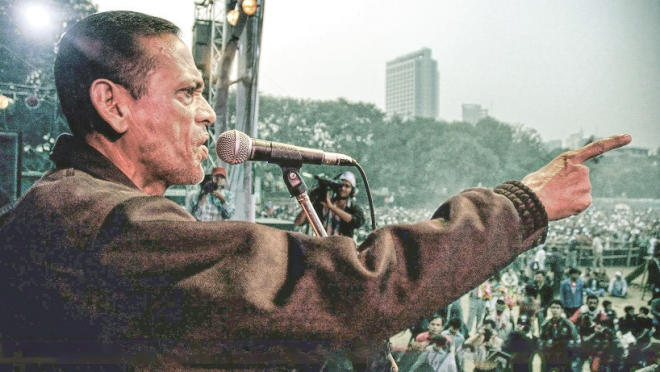
Born Mahbubul Haque Khan on 28 February 1950 in Dhaka’s Azimpur Government Colony, Azam grew up in an environment where music and a strong sense of justice flowed naturally. His mother, Jobeda Begum, was a singer whose influence kindled his early passion for melody, while his father, Aftabuddin Khan, instilled in him values of integrity and patriotism.
From his school days at Motijheel Provincial School and later Siddheswari Boys’ High School, Azam displayed a restless spirit that yearned for something greater than ordinary life. By the time he enrolled at T & T College in 1970, the winds of change were already sweeping through East Pakistan.
Even before the full storm of the Liberation War arrived, Azam Khan stood firmly on the side of justice. In 1969, as a young man deeply moved by the mass uprising against Pakistani oppression, he joined the Kranti Shilpi Goshthi, a revolutionary artists’ collective. Through songs and performances, he lent his voice to the growing resistance, composing pieces that challenged authoritarian rule and awakened the consciousness of his peers. This early involvement was not mere youthful rebellion; it was the foundation of a lifelong commitment to freedom and dignity.
When the Liberation War erupted in 1971, Azam Khan, then only twenty-one years old, made a choice that would define his legacy forever. Inspired by his father and driven by an unshakeable sense of duty, he set out with two friends on a perilous journey on foot towards Agartala. His destination was Sector 2, where he sought to serve under the command of the respected Major Khaled Mosharraf. After receiving rigorous training at the Melaghar Camp in India, Azam threw himself into the fight with remarkable courage and determination.
His military service was marked by both daring action and quiet resolve. Initially engaged in operations around Comilla, Saldah, and Agartala, he soon transitioned into the intense guerrilla warfare that defined much of the urban resistance in Dhaka and its surrounding areas. As part of the elite Crack Platoon, Azam operated under extremely dangerous conditions, executing missions that disrupted enemy supply lines and morale. He rose through the ranks to become a section commander, shouldering heavy responsibilities in coordinating attacks and managing operations in critical zones such as Jatrabari and Gulshan.
One of the most notable contributions during his military service was his leadership in “Operation Titas.” Under his guidance, the team targeted gas pipelines supplying Dhaka, with a strategic focus on lines feeding major establishments like the Hotel Intercontinental (now the Sheraton Hotel). The objective was not only to weaken the occupying forces but also to draw international attention to the horrors unfolding in Bangladesh. These operations required extraordinary bravery, precision, and a willingness to face overwhelming odds. Azam and his comrades moved like shadows through occupied territory, striking at key points to support the broader fight for liberation.
The dangers he faced were very real. During one intense engagement, Azam was injured when a bullet struck near his left ear, an injury that would affect his hearing for the rest of his life. Yet even this did not diminish his spirit. His section achieved significant victories, including a hard-fought battle at Trimohoni near Madartek, where they successfully confronted Pakistani forces. By mid-December 1971, as victory drew near, Azam Khan entered Dhaka alongside his fellow fighters, witnessing firsthand the dawn of a free Bangladesh that he had helped bring into existence.
This chapter of his life reveals the depth of Azam Khan’s character. He was not content to merely sing about freedom, he was prepared to bleed for it. His military service was not a brief interlude but a profound expression of love for his motherland. In the face of fear, uncertainty, and immense personal risk, he chose action over words, sacrifice over safety. The experiences of war would later infuse his music with authenticity and emotional power that resonated deeply with listeners.
After the war ended and Bangladesh emerged as an independent nation, Azam Khan channelled the same passion that had fuelled his military service into healing a broken country through music. The land he had fought for was now scarred by poverty, famine, and the heavy emotional toll of conflict. In 1972, he formed the band Uchcharon, introducing rock rhythms, electric guitars, and a bold new energy to Bengali music. Songs such as “Ore Saleka, Ore Maleka,” “Alal O Dulal,” “Ami Jare Chaire,” “Ashi Ashi Bole Tumi,” and the profoundly moving “Bangladesh” became anthems for a generation seeking hope amid hardship.
His stage presence, with flowing hair, bell-bottom trousers, and a magnetic charisma, symbolised a new era of youthful expression and cultural awakening. Yet beneath the stardom, Azam remained the same sincere soul who had once walked through war zones. He used his platform to address social issues, promote unity, and remind people of the sacrifices made for the freedom they now enjoyed. His music became a bridge between the battlefield and the hearts of ordinary citizens, transforming personal and national pain into something uplifting and enduring.
Throughout his career, Azam Khan carried the lessons of his military service with quiet dignity. He understood the true cost of liberty, and this awareness gave his art a rare depth. Friends and fellow musicians often spoke of his humility, kindness, and unwavering commitment to his principles. Even as he achieved fame as the Pop Samrat and the Rock Guru, he lived simply and stayed connected to his roots. His influence extended beyond music, touching cinema and inspiring countless young artists who followed in his footsteps.
On 5 June 2011, Azam Khan left this world after a battle with cancer, at the age of sixty-one. He was laid to rest with full honours at the Martyred Intellectuals’ Graveyard in Mirpur — a fitting resting place for a man who had fought both with arms and with melody for his nation’s dignity. Years later, in recognition of his extraordinary contributions, he was posthumously awarded the Independence Award in 2025, Bangladesh’s highest civilian honour.
As we mark another anniversary of his passing, our hearts fill with gratitude for the life he lived. Azam Khan’s military service stands as a testament to the courage that defined him: a young man who risked everything so that future generations could live in freedom. His songs continue to echo across time, reminding us of resilience, hope, and the power of authentic expression. In remembering him, we do more than recall a great artist; we reconnect with the ideals of bravery, creativity, and love for Bangladesh that he embodied so fully. Let this day inspire us to revisit his timeless melodies, to share his remarkable story, and to reflect on the sacrifices that built our nation.