Sultana’s Dream: A century-old vision still relevant today
More than a hundred and twenty years ago, a woman dreamed of a land free of male domination, where women were the only inhabitants.
Sultana’s Dream: A century-old vision still relevant today
More than a hundred and twenty years ago, a woman dreamed of a land free of male domination, where women were the only inhabitants.
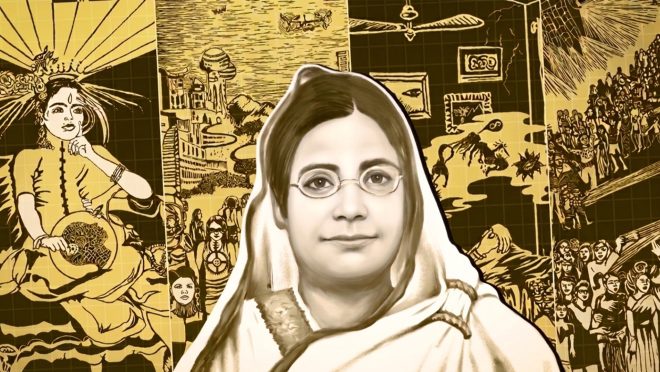
Sultana’s Dream was written by Begum Rokeya Sakhawat Hossain in 1905.
This book is one of the eminent literary pieces which offers a subversive alternative reality for women in colonial Bengal. Not just for the colonial era in Bengal, the book remains highly relevant today.
Rokeya was born in 1880 into an upper-class, landowning, conservative Muslim family. During that colonial period, women’s freedom was limited to the home.
Rokeya’s Sultana’s Dream transformed the idea that the foundation of a safe nation for women should begin at home.
Her utopian vision of a country was such a place where women hold the ultimate power in social, political, economic, and territorial spheres. “Ladyland” is the name of Sultana’s imaginary country, and Sultana is Rokeya’s protagonist and voice for women’s emancipation.
Through this novel, Rokeya envisioned a female-led community that reversed the traditional gender roles in society. There were many issues in the fiction that persist even today.
Women in many parts of the world still face restrictions in their education, autonomy, and intellectual expression, making Rokeya’s vision as urgent and contemporary as ever. Ladyland is a female-governed society where women have learned sciences and applied their intellect to build a more civilised and peaceful nation, while men are confined to their homes, doing household chores, looking after the children, and building military power.
The setting of the story is a reversion of the purdah system that was once weaponised to keep women imprisoned within four walls.
Rokeya imagined a place for women that could set them free by realising the power of education and intellectual freedom. The novel also deals with the progression of science, technologies, and advanced agriculture.
In Ladyland, women are seen using new technologies such as flying cars and solar energy to maintain their power. Also, religion here has more feminine beauty; it is simplified to love and truth.
No strict religious rules are enforced on women, and marriage is seen as a sacred practice in society.
Rokeya focused on gender inequality in the novel through the lens of an imaginary radical society, where she flipped the conventional gender roles because males are not treated as equals to women and are secluded within the mardana; the polar opposite of the concept of zenana, a common veiled practice in her time.
This discrimination of the purdah system may have prompted her to write so fiercely that she did not leave room for empathy for the males. Sultana’s Dream represented a form of resistance and empowerment on her part.
By dissipating warfare from the land, she criticised the male institution for its aggressive and war-prone nature. The instances of Ladyland depict the psychological violence against women and question societal norms for emancipation. Rokeya’s writings on rebellion present a vision of an egalitarian society.
Ultimately, it is more than a historical curiosity; it is a foundational blueprint for feminist texts in the Indian subcontinent. By imagining a world in which the entire societal structure was a radical reevaluation of power, knowledge, and peace, Rokeya inverted the system that had once oppressed women.
The unfinished feeling of the story’s potential ending also demonstrates that the battle is ongoing and probably will not end for women. But Sultana’s Dream leaves us with a question: What will it look like when a society is entirely built on feminine intellect or when females are in the power hierarchy?
Even a century later, the answer to this question feels challenging, as freedom for women has always been, and may always remain, an imagination.