The brain vs discipline: Lessons from Neuro-Discipline
Neuro-Discipline by Peter Hollins is not just about theories on self-discipline or how to stay disciplined. This book explains many reasons why we usually feel lazy, and the science behind how our brain seeks instant pleasure and comfort.
The brain vs discipline: Lessons from Neuro-Discipline
Neuro-Discipline by Peter Hollins is not just about theories on self-discipline or how to stay disciplined. This book explains many reasons why we usually feel lazy, and the science behind how our brain seeks instant pleasure and comfort.
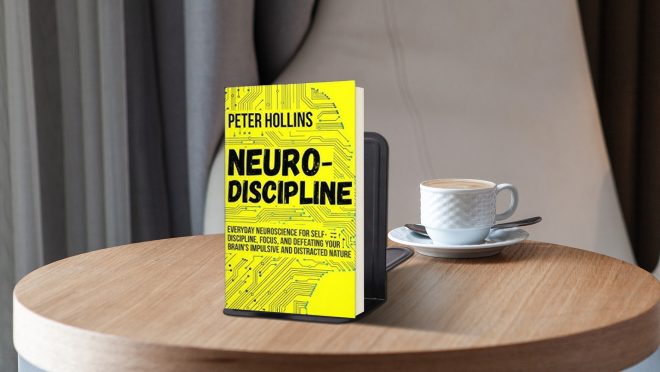
It is surprising to learn that our brain has two systems constantly battling, which makes it hard for us to stay disciplined. The book focuses on how our brain affects our behaviour and also presents research-backed solutions to resist instant gratification and choose discipline instead.
When we make a schedule for our work, planning to do everything in order or perfectly, sometimes it just does not go as we expect. We have all experienced this in life. Is it due to a poor strategy, or are we just not committed to finishing our tasks on time? My curiosity to understand this led me to read Neuro-Discipline.
The book explains how our brain controls us, and why most of the time we get stuck in the comfort zone and struggle to get out of it.
The brain components behind our decisions
The author begins with a beautiful example: Kate, a girl eager to learn French, but unable to find time in her busy schedule. This is similar to all of us. We plan to learn something new or try something different, but somehow never find enough time. Behind this struggle, our brain has two main components at work: the prefrontal cortex and the limbic system. Hollins calls the prefrontal cortex “Albert Einstein” because it handles analytical thinking and decision-making, while the limbic system is likened to a “skittish cat”, which keeps us in our comfort zone. When these two components battle each other, that is where self-discipline breaks down. Essentially, our brain controls us, often more than we realise.
But the author gives a solution for it: Mel Robbins’ Five Second Rule. Whenever we are supposed to do any difficult work or a task that feels uncomfortable in our mind, we should count down from five to zero and act.
This is how we can stay focused on our work, avoid distractions, and take immediate action. When we stop and think, this is usually when we change our mind and the brain components manipulate us.
Usually, when we pause to think, our brain’s components manipulate us, making us change our mind or stay in the comfort zone. By acting quickly, we give our prefrontal cortex a chance to lead, and stop the limbic system from controlling our decisions.
How visualising your future self helps discipline
We hear many people say to stay in the present, just focus on the present. But when we understand the connection between our present and future selves, it becomes much clearer how to plan for the future.
When we imagine our future self as the best version, we can work on ourselves better in the present. For this, the author mentions research by Professor Hal Hershfield at the University of California, where participants used virtual reality to interact with their future selves.
The results showed that people who connected with their future self were more likely to make decisions that benefited both their present and future. This study demonstrates that the better we can visualise and relate to our future self, the better we are at taking care of it today.
The progressive principle: learning to take small steps
The author emphasises the importance of taking small steps before attempting any difficult work. People who keep making small progress on important projects become more productive.
The author calls this the progressive principle. It is a way to train your brain to work consistently towards a goal while associating self-discipline with reward.
Each small step provides a sense of achievement and satisfaction, which motivates us to tackle bigger challenges. Human beings naturally feel motivated as they get closer to completing a task, and these small successes build momentum for larger goals.
The 10-10-10 method: decide for your future self
The 10-10-10 method might make you wonder, “What is this method?” Simply put, before doing any work, you think about how it will affect you after 10 minutes, 10 days, and 10 months.
If the outcome has a meaningful impact after 10 months, the work is valuable and worth doing. But if, after 10 minutes, you feel regret, then it is probably a waste of your time. Using this method before every task helps you distinguish between short-term pleasure and long-term impact.
This simple practice can make a huge difference in making better choices and prioritising what truly matters in life.
This book is not just a collection of tips on how to be disciplined. It begins by showing what we actually do in our daily lives, using many examples and research studies.
Beyond that, the author provides several practical methods that are proven to be effective. Our brain can be manipulative.
If we fail to control it, we end up being controlled by it. To stay focused and disciplined, we need to understand our brain and sometimes even trick it into cooperating with us.