Pressure Cooker: Raihan Rafi refuses to play safe and wins big
First of all, Raihan Rafi deserves an applause as he didn’t spoon-feed the plot to the audience.
Pressure Cooker: Raihan Rafi refuses to play safe and wins big
First of all, Raihan Rafi deserves an applause as he didn’t spoon-feed the plot to the audience.
Many of the modern movies we see today often underestimate the audience’s intelligence, which leads them to overexpose the plot, narrate the dialogues just to expose it a bit more, and finally lead to a very predictable happy ending, or a not-so “shocking” one.
Pressure Cooker avoided all this and took me back to a bygone era, an era where you just stayed glued to the screen just to understand what will happen next, an era where nostalgia wasn’t a vessel for attention-seeking; nuance was the name of the game.
I arrived at the cineplex at 7:30, having missed Bonolota Express. I thought, why not watch Pressure Cooker?
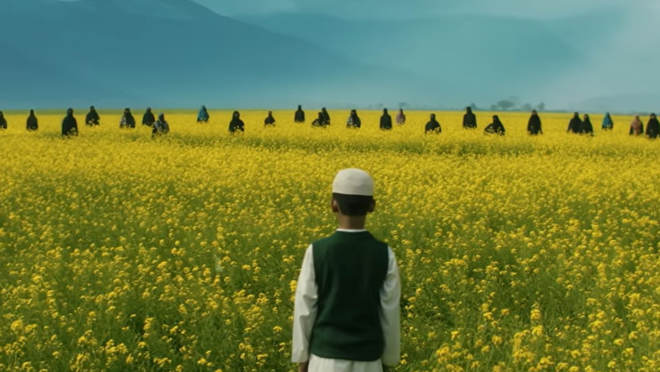
The poster on the yellow mustard field, where a madrasa boy stands still looking at multiple women in burkhas, had intrigued me.
With that, I was able to get one of the last remaining tickets available on the second row, right by the door. A horrible seat; nonetheless, I was excited, and right after the opening 5 minutes, I knew very well this was no ordinary film.
I was in for a ride, and these horrible seats would not be a nuisance for me at all.
The scene opens with Nazifa Tushi, right on the Mogbazar flyover, looking all distressed and hopping into an unknown car to reach work. As it happens, she hitches a ride on Shahiduzzaman Selim’s taxi or Uber, I don’t know.
But not knowing was a theme throughout the first half of the film, and you did not feel rushed towards any plot points, a characteristic so wonderfully woven throughout the almost three-hour film.
Maybe not knowing it was a three-hour film made me more patient and not look for answers right away.
The backdrop
It’s a man’s world after all, and women are just here for the ride. The movie had this undertone throughout. However, it did not try to be virtuous. Rather, it had its usual masculine characters portraying toxic behaviour, but it had some sweet characters; according to my observation, ladies in the hall fell for both.
Four women: one young and in love, one social media influencer, also in love, one married to a politician, not entirely in love but has a side “guy-chick”, and the main one, Tushi, who is not just in love but full of loving, naive energy.
The character of Tushi, known in the film by her stage name Pakhi, is a character to fall in love with.
She embodies it all: the innocence in the first half, the naivety towards her cheating husband Chanchal Chowdhury, who was magnificent in the few moments he was on the screen.
Tushi’s acting was also immaculate.
From the first half, being a naive girl torn in the contradiction of her not-so-innocent job as a quasi-prostitute and massage therapist, to the latter part of the film where a more self-determined wonder woman faces the world head-on, she executed her role to perfection.
Simultaneously, the young high-flyer Mariya Shanto was also acing her role as a young girl, forcibly being married off to an old uncle, but inevitably fleeing while holding her lover’s hand.
Bubly and Snigdha’s predicament also played to the tune of ambitious women, plotting their way through life in search of recognition.
Except for Bubly’s role, where she played a politician’s wife, quite well I might add, the other three were all characters of the middle- and lower-middle-income households in Dhaka, surviving with the very little they earn and scarcity fuelling their decisions at every step of the way.
One may also include the city of Dhaka as another important character as well. The familiar shots of the streets meant that the people, along with the surroundings, felt just like home.
These characters were not so distant from you and me; rather, they could very easily have been our next-door neighbours, quietly going through life with regular hurdles.
The later half
The later half of the film is lit up by a masterful performance by Fazlur Rahman Babu, not your usual one-dimensional good or corrupt character.
A sophisticated character, cunning and light on his feet. His quick thinking and zeal hold up the latter parts as a separate entity all by itself.
I felt it was Babu’s performance which made the film not feel like an unusual three-hour story. The plot moved quickly and with a decisive tone.
The latter half is also where the “protagonist” Tushi embraced her evil side. The shift from a naive and struggling single mother to a determined prostitute filled with confidence did not feel rushed at all, owing to Raihan Rafi’s incredible and precise screenplay, which made every shift in the complex character of Tushi sensible and gave the character depth.
The quiet blockbuster
As mentioned earlier, I had a seat on the second row. The first row, as well as the third row as I saw it, was not completely filled.
I didn’t get the blockbuster feeling. However, I also saw Utsab last year on the second day of Eid, and it wasn’t a houseful either.
Utsab quietly picked up the pace with its word-of-mouth fame, and I wholeheartedly feel Pressure Cooker will do the same.
Three hours of my time were filled with thrill, comedy, drama, and a few gruesome, weird scenes of handjobs under pink lights, a sight I never thought I would see on a big screen.
The best part was, the movie did not want its characters to provide you the comfort of a happy ending. You rooted for every character, hoped they would remain pure, and hoped so furiously that Tushi’s character would, for once, catch a break.
But the best part was, Pakhi never did catch a break, and SPOILER ALERT, the movie does not have a happy ending, unlike some of its male characters, who were seen getting a happy ending from Pakhi multiple times.
That is precisely why Raihan Rafi succeeded. He did not feel the need to send people home happy. It was a thought-provoking film, and you were left longing for more.
What more can you ask for from great cinema?