Savory and sinister: The art of Hannibal
There are crime dramas, there are really good crime dramas, and then there is Hannibal, the quintessential TV drama that feels like it was not made for TV.
Savory and sinister: The art of Hannibal
There are crime dramas, there are really good crime dramas, and then there is Hannibal, the quintessential TV drama that feels like it was not made for TV.
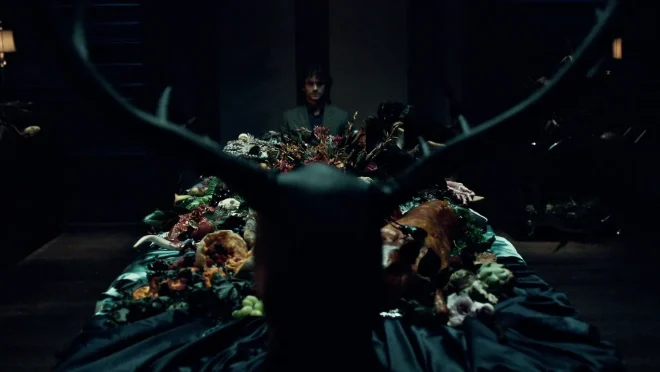
Created by Bryan Fuller for NBC, Hannibal pushed boundaries not just with a unique storytelling arc, but also by portraying horrific crime scenes as beautiful works of art. It is visually striking, visceral, and brutal in a way that still managed to receive a TV-MA rating.
Based on the literary works of Thomas Harris, the show follows the chronicles of Hannibal Lecter, a psychologist with an appetite for human flesh. Mads Mikkelsen’s portrayal of the suit-clad cannibal is vastly different in demeanour and aesthetic compared to that of Anthony Hopkins in The Silence of the Lambs (1991). Mikkelsen’s Hannibal is far more social and friendlier, with a mask that has yet to slip and reveal the true monster he is.
If I were to conduct a character analysis of Hannibal, the first thing I would refer to him as is a high functioning psychopath. Hannibal is painfully charming and warm on the outside. He will look at you and smile, shake your hand, and you will feel the warmth of his flesh. He appears to be a man of honour, someone who will keep a promise, someone who will be a friend in need. Hannibal’s human exterior is the polar opposite of his monstrous interior. He lacks any and all forms of empathy.
His cannibalistic tendencies stem from severe narcissism and the belief that he is superior to everyone else. Hannibal considers human beings to be animals, to be butchered, seasoned, and cooked to perfection.
In this series, he is not just a villain but a charismatic predator whose intellect and charm manipulate those around him. Unlike many depictions of serial killers, his violence is ritualised and aesthetic, representing an almost poetic and philosophical worldview. Hannibal embodies the duality of man: civility and barbarity coexisting. He is a living reminder that sophistication can cloak monstrosity.
Another key character in the show is FBI Special Agent Will Graham. Will has an extraordinary ability to reconstruct crime scenes in his head. His empathy is off the charts, which allows him to enter a killer’s mind and understand the thought process behind their actions. This deep empathy makes him fragile, bordering on mental instability.
Every crime scene chips away at his sense of self until Will is no longer certain where his thoughts end and the killers’ begin. With all his empathy, Will still struggles to form human connections. He lives alone with dogs, not out of preference but necessity. Humans are “too loud, too demanding, and too morally confusing”, according to him. He believes, correctly and tragically, that something in him is broken. This self awareness does not save him; it only deepens his isolation.
Hannibal does not corrupt Will by force. He recognises him. Where society sees Will as unstable, Hannibal sees him as unfinished. Hannibal validates Will’s darkness, reframing it not as illness but as potential. This is the most dangerous gift of all: understanding without judgement. Their relationship is not mentor and student, nor strictly predator and prey. It is an intimate philosophical seduction. Hannibal offers Will a version of himself that is coherent, powerful, and honest, if only Will is willing to abandon conventional morality. Will resists, but resistance does not mean rejection. Part of him wants what Hannibal offers: clarity, acceptance, a world without moral noise.
Food in Hannibal is how Hannibal speaks when words would be too honest. Hannibal does not cook like a monster. He cooks like someone who learned early that feeding people is a way to care for them.
He chops, sautés, tastes, and adjusts. He stands alone in his kitchen after long days, sleeves rolled up, music playing softly. These are human rituals, comforting ones. We have all seen them. We have all done them.
Hannibal does not feed people to shock them. He feeds them to connect, to be seen. Every dish says, I know you. I chose this for you. That is the cruelty of it. The act itself is tender. Cooking requires patience. It demands attention. It is love expressed through labour. Hannibal performs all of it sincerely. He is not rushing. He is not angry. He is calm, almost gentle, as if the kitchen is the one place where he does not have to pretend.
For Will, eating becomes uncomfortable long before the truth is clear. Something in him resists, even when he cannot explain why. Each meal leaves a faint residue of doubt, a sense that he has already crossed a line he does not remember choosing to step over.
And we cross it with him. We admire the plating, the care, the ritual. The show makes us feel the warmth before reminding us what it costs. It asks a cruel, human question: if something feels this intimate, this beautiful, does it still matter where it comes from?
By grounding the horror in such ordinary gestures, the show collapses the distance between him and us. It forces an unsettling realisation: evil does not always arrive screaming. Sometimes it washes its hands, sharpens its knives carefully, and worries about seasoning.
Ultimately, Hannibal is not so much about the hunt to catch a murderer as it is about looking into the mirror of our own complicity. It lures us close with warmth, grace, ritual, and attention, and then tells us that what we might think of as intimacy can be toxic as well. The show pulls us into its silent, predatory familiarity and makes us sit at a table where we cannot separate beauty from horror.
Every act of tenderness, every carefully prepared dish, tells us that evil does not always shriek; it waits, watches patiently, and reaches into our lives with a hand we recognise.
And through that faith, through that lingering warmth, we come to understand the horror of it: the mesmerising attraction of connection, of understanding, of love, when it is a comfort that will never hesitate to destroy.
Hannibal stalks not with blood, but with the idea that there is a thin line between the human and the monstrous, that it is closer, much closer, and far more intimate than we want to acknowledge.