BSc in Election Engineering: Curriculum, internships and career prospects
As soon as Bipolobi Billal finished his HSC, he found himself at an impasse. On one hand he was unsure what subject to choose at his university; on another, growing parental pressure was forcing him to steer towards engineering.
BSc in Election Engineering: Curriculum, internships and career prospects
As soon as Bipolobi Billal finished his HSC, he found himself at an impasse. On one hand he was unsure what subject to choose at his university; on another, growing parental pressure was forcing him to steer towards engineering.
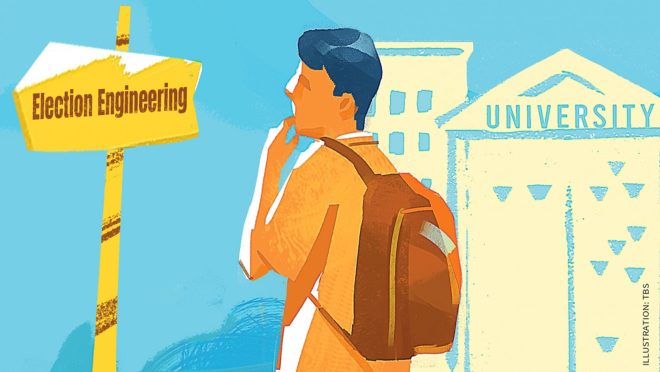
“Engineering it is then!”, a defeated Billal muttered to himself. Still, the cloud of confusion persisted. “What was to be chosen?” he wondered. The options include Mechanical, Civil, Computer, Electrical, and many more.
Little did Bipolobi Billal realise that there was one more option, an option that won’t just cover the bill, but has the potential to alter people’s lives, and that was a career in Election Engineering.
Bipolobi Billal was unaware of this subject’s existence before. On a random election day, he saw both parties complaining about this engineering, and it was obvious to Billal that if he could get a BSc degree, the possibilities would be endless.
Having made up his mind, he found the most mediocre Engineering University he could find, and quickly enrolled.
The syllabus
“Civil engineers build roads; election engineers build governments,” loudly proclaimed the director of said mediocre Engineering University.
On his orientation day, Bipolobi Billal quickly realised that he had made the right choice. The syllabus displayed a wide array of innovative courses.
Some notable courses included: Introduction to Ballot Dynamics, Principles of Vote Tempering, Media Narrative Engineering, Political Crisis Management, Introduction to Trolling and Rumour Management, Professional Ethics for Election Engineers, etc.
“With these diverse skills, our graduates will have a 100% placement rate, and this degree will act as a direct pipeline to the Jatiya Sangsad,” explained the director of the engineering university in his orientation speech.
However, as with any other engineering subjects, rigorous lab work will be an integral part and thus undergraduates like Bipolobi Billal shall be busy visiting polling stations of every other election, no matter local or national.
The first day of class was daunting for Bipolobi Billal, as he saw large classrooms full of potential engineers like him. With proper textbooks having more than 1,000 pages, the teacher entered one such room and asked our future engineers to open Chapter 1, Introduction to Ballot Dynamics, and with that the fate of Bipolobi Billal was sealed.
The career prospect
After 4 years of rigorous studying with endless quizzes and hours and hours of practical lab work, our BSc graduate Bipolobi Billal was finally at the precipice of entering the job market.
A six-month “free” internship awaited him. Bipolobi Billal quickly understood that he had made the right choice. While his CSE, EEE friends were busy toiling away in free internships at unknown companies, Bipolobi Billal was approached by multiple heavy-weight parties.
Some expressed a desire to use him for vote manipulation, some for voter intimidation; whatever major he would choose, one thing was for sure: he had made the right call.
Being an intern, he often did not contribute a whole lot, but just like any other internship, he learned enough jargon to fill up his CV. He understood the practical implementations of theoretical terms he had studied, such as Polling Station Geometry (PSG), Invisible Turnout Technique (ITT), and Statistical Creativity Quotient (SCQ).
However, he realised that, similar to all other professions, the demand for election engineers also fluctuated.
Whenever there is an autocratic government, the demand predictably drops, and jobs become scarce. This is because the government inevitably controls the outcome; therefore, there is no need for election engineers while the engineers working at the government agencies are involved heavily.
Bipolobi Billal was in luck; he graduated at a time when all other Bippolibis like him had ensured a great election environment, and the job market was booming.
Therefore, as soon as he finished his internship at the Ami Right Party, he joined one of the contesting political parties and started working tirelessly.
At first, his courses of Narrative Setting and Trolling Management came in handy. His tactics helped suppress any dissenting voice against the Ami Right Party.
As the election day approached, the labs completed in Ballot and Rumour Management helped him navigate the media to focus on irrelevant stats and inconsequential developments.
After completing his first election, he now feels proud: proud of his degree, and the hard work he put in.
The Ami Right Party comfortably won. Seeing his party and the opposition both accusing each other of engineering the election, he knew he had done a solid job,
Feeling satisfied, Bipolobi Billal has now bought a GRE (Gonotontro Recovery Examination) book. He plans to study abroad and even get a PhD if possible.
As Bipolobi Billal inked his last thumb selfie and hung his BSc degree on the wall, a gentle smile appeared on his face.
He is now ready for the MSc, and with the GRE book at hand, he plans for a lifelong career in perfectly engineered democracy.