Seven women, countless barriers: Overcoming patriarchal politics
Out of 83 women who contested in the Bangladesh election for 300 directly elected seats, only seven managed to secure a win.
Seven women, countless barriers: Overcoming patriarchal politics
Out of 83 women who contested in the Bangladesh election for 300 directly elected seats, only seven managed to secure a win.
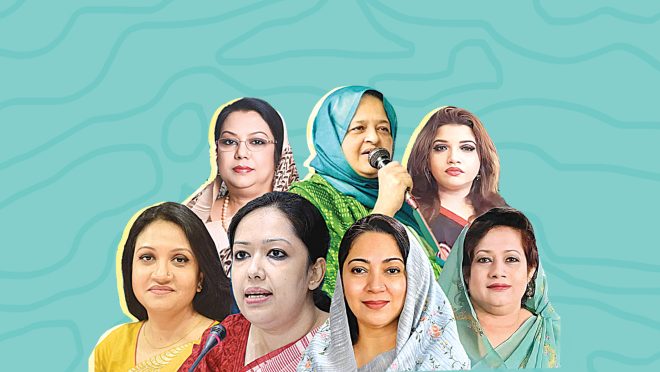
While an additional 50 seats are reserved for women to increase representation, these positions are filled by members of parliament rather than through public voting.
Even with these reserved seats, women’s presence in parliament reaches only 16.28 percent, highlighting the extreme underrepresentation in the country’s political system. Without these reserved seats, women make up a mere 0.23 percent of elected officials, a stark reminder of the gender gap that continues to persist in politics.
The seven women who succeeded in winning seats have demonstrated merit, skill, and dedication. However, media coverage has often focused on their relationships with male relatives rather than their own accomplishments and plans. This narrative minimizes their independence and reduces their work to “continuing someone else’s legacy.” For instance, many reports highlight candidates as daughters, wives, or granddaughters of prominent male politicians rather than presenting them as capable leaders in their own right. This treatment contrasts sharply with male candidates, who are portrayed solely for their achievements, leaving women continually framed by familial ties rather than professional and political capabilities.
Despite these biases, the accomplishments and contributions of these women are substantial. Afroza Khanam Rita, representing Manikganj-3, has an extensive background in business and governance, having led the Monno Group as chairwoman and previously served in the Bangladesh Textile Mills Association and Ministry of Industries. Her focus is on improving education, healthcare, employment opportunities, and infrastructure in her constituency.
Israt Sultana Elen Bhutto, elected from Jhalokati-2, brings years of political experience and leadership. She has consistently worked on issues like security for minority communities, grassroots engagement, and equitable development in her region.
Tahsina Rushdir Luna has dedicated over a decade to politics in Sylhet-2, with a strong emphasis on establishing harmonious political culture and promoting ethical, transparent governance.
Shama Obaid, as the Organizing Secretary of BNP, prioritizes strengthening democracy, protecting freedom of speech, addressing the Digital Security Act, and tackling societal issues such as child marriage and education reform.
Nayab Yusuf Kamal advocates for inclusive development in Faridpur, striving to empower women and bridge gaps across political, social, and religious divides.
Farzana Sharmin Putul, a barrister at the Supreme Court, combines legal expertise with social advocacy. She focuses on improving education, healthcare, youth employment, and public safety, demonstrating the kind of policy-driven leadership often overlooked in coverage of women MPs.
Rumeen Farhana, also a lawyer and politician, emphasizes infrastructure development, modernizing health centres, schools, and other social institutions, and ensuring accountability in governance. Her leadership style underlines independence and a commitment to reform.
The systemic challenges these women face are compounded by a rise in extremism, which has often sought to limit women’s participation in political life. Certain parties actively discourage female leadership, reinforcing patriarchal norms that continue to dominate the political landscape. This creates a misleading perception that women are unfit for governance, even though Islam and Bangladesh’s own history are full of examples of strong, capable women leaders.
These seven elected women are fully equipped with education, experience, and vision to lead. They represent more than just their constituencies—they symbolize the potential of women to contribute meaningfully to national development. Recognizing them for their individual merits, rather than their familial or marital ties, is not only fair but essential for a more equitable and progressive political system.
Bangladesh has a long way to go in terms of gender equality in politics. True progress will require media, voters, and political institutions to celebrate women for what they bring to the table, not whose names they carry. These women have already shown the capacity to lead, to govern, and to enact meaningful change. Their victories, however small in number, are proof that women’s voices matter—and that their representation must go beyond tokenism to genuine recognition and power.