Talking to the world from a rooftop in Dhaka: The story of Bangladesh’s amateur radio community
A cluttered room in Mohammadpur opens the door to a global network; inside, one of Bangladesh’s leading amateur radio operators is reconnecting the country to a borderless world powered not by the internet, but by ingenuity, physics and persistence
Talking to the world from a rooftop in Dhaka: The story of Bangladesh’s amateur radio community
A cluttered room in Mohammadpur opens the door to a global network; inside, one of Bangladesh’s leading amateur radio operators is reconnecting the country to a borderless world powered not by the internet, but by ingenuity, physics and persistence
The room looks rather unassuming from outside. On the first floor of a residential building in Mohammadpur, Dhaka, it is cluttered in the way only a certain kind of person’s room becomes cluttered — purposefully, lovingly.
Shelves sag under transceivers, coils of cable, and half-assembled circuit boards. A fluffy orange cat surveys the chaos from a workbench by the window. On a nearby laptop screen is a dense circuit schematic.
This is the home station of Fazley Rabby — callsign S21RC — and it is, in the most literal sense, a window to the world.
“The talking itself is not the main point,” Rabby says, leaning back in his chair. “It is the fact that I could make that connection — using an antenna I built myself, without the internet, without anything else. It is like angling. You might spend thousands of taka just to catch a small fish, but the joy is in the catch.”
Rabby, 45, has been chasing that joy for more than 25 years. He is now the most prominent figure in Bangladesh’s amateur radio community — a builder, experimenter, and mentor whose circuit designs have been replicated by hobbyists across Europe and Japan.
What ham radio actually is
When most people hear “radio”, they think of FM stations and jingles. Amateur radio — universally called “ham radio” — is something categorically different. It is a government-licensed hobby in which individuals use radio frequencies to communicate directly with one another across cities and continents, without any commercial infrastructure in between. No towers, no servers, no mobile network. Just a transmitter, an antenna, and the physics of electromagnetic waves bouncing off the ionosphere and returning to Earth thousands of kilometres away.
The hobby is as old as radio itself. Early 20th-century amateur experimenters were the first to discover that shortwave frequencies could travel enormous distances — a finding that reshaped global telecommunications.
Today, there are over three million licensed operators worldwide, with their own allocated frequencies, internationally recognised callsigns, and a culture of building, experimenting, and contacting the farthest corners of the planet.
In Bangladesh, an aspiring operator must pass an examination conducted by the Bangladesh Telecommunication Regulatory Commission (BTRC), clear a police background check, and receive a unique callsign.
All Bangladeshi callsigns begin with “S2” — the same international prefix on the tail fins of Biman aircraft and the hulls of naval vessels. Individual Bangladeshi ham operators carry the prefix S21; the remainder of the callsign is the operator’s own.
Rabby is S21RC. His wife, Hanium Maria Raka, who also holds a licence, is S21YLJ.
A scout camp in Sylhet, 1997
Rabby’s path began not in a lab but under canvas. In 1997, attending a scout camp in Sylhet as a college student from Rajshahi, he stumbled upon something that would quietly redirect his life: a radio station set up inside the camp, with antennas on the tent poles, talking to people in other countries.
“Until then, we thought about talking over a distance of one or two kilometres,” he recalls. “But here they were talking worldwide.”
A year later, in Dhaka for university, he tracked down a mentor — Manjurul Haque, callsign S21AM — who ran informal classes for a handful of enthusiasts from his office in Lalmatia. In 2000, Rabby passed his examination. Of the 40 or 45 who sat for it, only five or six passed. Morse code was mandatory back then.
The years that followed were interrupted by the ordinary chaos of life — jobs, apartments in which landlords would not permit a rooftop antenna. But a stint in a house in Hatirpool gave him roof access, and in 2009, he made the most memorable contact of his radio life: a brief exchange with Russian cosmonaut Yury Lonchakov aboard the International Space Station.
“Sierra 21 Romeo Charlie, from Bangladesh. Do you copy? Over.”
“I copy Bangladesh. This is the International Space Station, this is Yury.”
Fifteen seconds. The ISS, moving at 27,000 km/h, passed over Dhaka and was gone. The QSL card — a formal record of a contact — arrived weeks later. Rabby has held onto it to this day.
Then came another decade of gaps, until the pandemic locked him indoors in 2020 and he pulled his gear out of storage. By then, a geostationary satellite called QO-100 — a transponder on a Qatari government satellite, shared with amateur radio operators worldwide — offered a permanent relay station visible from Europe to South Asia. Rabby built his own ground station to access it, sourcing parts from Daraz and using a standard satellite TV dish as an antenna. It took nearly a year.
When his callsign first appeared on the satellite, European operators were startled. Bangladesh was the 28th most sought-after country on the worldwide amateur radio “most wanted” list.
“It was like a hurricane when they first heard my callsign,” Rabby says. “They were astonished that someone had built their own station from scratch and accessed the satellite with a crystal-clear signal.”
A world of contests, expeditions and awards
The hobby’s depth is staggering. Beyond simply talking to distant stations — what operators call DXing — there is an entire ecosystem of activities, each with its own culture and following.
Radiosport competitions, such as the CQ World Wide DX Contest, challenge operators to contact as many stations as possible across the globe within 24 or 48 hours. Adventure-minded operators climb peaks for SOTA (Summits on the Air) or set up portable stations in national parks for POTA (Parks on the Air), earning awards for each activation. The most technically audacious send signals to the Moon and receive the echo back on Earth — a technique called EME, or moonbounce.
Then there are the lifetime awards. The DXCC (DX Century Club), issued by the American Radio Relay League (ARRL), recognises operators who confirm contact with at least 100 different countries.
WAC (Worked All Continents) requires confirmed contacts across all six continents. WAZ (Worked All Zones) demands all 40 geographic zones into which the world is divided. Operators who earn these hang the certificates on the walls of their shacks — each one a record of thousands of hours at a microphone or a Morse key.
Confirming those contacts requires proof. For decades, hams exchanged paper QSL cards — postcard-sized confirmations mailed between operators worldwide, often months after a contact. They remain a beloved tradition.
Today, most operators also log electronically through LoTW (Logbook of the World), ARRL’s secure digital platform.
When the hobby becomes a lifeline
Amateur radio’s most powerful argument, it turns out, is not romantic but practical: it works when everything else fails.
The pattern in Bangladesh goes back to 1997, when a group of operators, including Manjurul Haque, deployed mobile radio stations with the Red Cross and CARE Bangladesh following a catastrophic cyclone in Cox’s Bazar and Chattogram. When nighttime ionospheric conditions disrupted their HF links to Dhaka, operators in India, Malaysia, and even Australia relayed their signals onward — a reminder that the amateur radio network is, at its best, borderless.
In August 2024, catastrophic floods submerged the Feni district. Mobile towers went down. Power was cut. The district administration found itself isolated. Then a group of young ham operators arrived, led by Abdullah Al Fahad (S21AF), establishing stations across a 70-kilometre radius — at the DC office, the army camp, and a medical camp — with walkie-talkie operators on every rescue boat.

An amateur radio operator is providing communication support during the army’s rescue operations during the Feni flood of 2024. Photo: COURTESY
For four days straight, they worked round the clock. More than 375 rescue operations were coordinated through their network. From Dhaka, Rabby and S21FIA assembled a directional antenna at the Scouts headquarters to relay information to the field.
“Without this network, the situation would have been far worse,” said a local official.
The hobby’s emergency value is not an accident — it is physics. A simple radio with a battery and an antenna will keep working long after every tower has fallen.
17 grids, and a year of expeditions
Now, in 2026, the community’s most ambitious project is underway. The world is divided into Maidenhead grid squares — geographic boxes of two degrees of latitude and longitude, each assigned a code. Bangladesh sits within 17 of them.
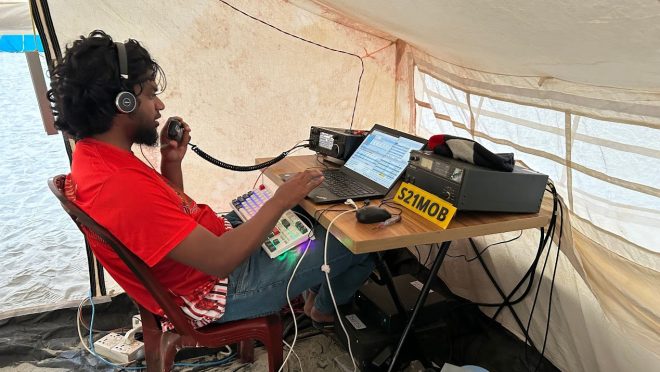
Of those, operators had only ever been active from three using the QO-100 satellite. Rabby’s S21DX team has announced that they will activate all 17 throughout 2026, setting up two stations in each grid for two to three days. Fourteen of those grids have never been activated before. Some require travelling through the Sundarbans. Six require carrying a generator in by hand.

A homebrew satellite ground station and antenna setup for the “17 Grids of Glory” event, while operating from Kuakata with the S21DX team. Photo: COURTESY
The first activation — grid NL51, near Kuakata — was completed in March 2026, producing 1,692 contacts with operators from 297 grid squares worldwide. European operators are already posting requests on the team’s website, waiting for grids they have never been able to reach.
How to become an operator
The path in is more accessible than it once was.
The BTRC examination covers electronics theory, radio propagation, operating procedures, and regulations. The Morse code requirement has been dropped. Free preparation workshops, drawing 150 to 200 participants at a time, are run by the community’s registered clubs: Bangladesh DX Club (BDXC), Bangladesh Amateur Radio League (BARL), and Amateur Radio Society of Bangladesh (ARSB).
Costs in 2025: the exam fee is Tk1,650. The three-year licence and callsign cost about Tk6,325. Police verification adds roughly Tk1,500. Renewal every three years is around Tk3,425 — bringing the total government cost to get started to between Tk8,000 and Tk9,500.
Equipment ranges from Tk10,000 for a basic handheld radio to Tk150,000 or more for a full HF transceiver. To purchase any radio, operators must obtain an NOC from the BTRC. Many build significant portions of their gear from scratch. Rabby’s own designs are published online for free — a philosophy shared across the global community. “We call this the Ham Spirit,” he says.
Small community, big story
Bangladesh’s licensed operator count has grown from 20 or 30 in 2000 to approximately 850 today. Still modest. Still mostly self-taught. No Bangladeshi university has an amateur radio club — a fact Rabby raises with evident frustration. In Japan and the United States, university clubs routinely launch satellites as hobby projects.
“They develop these things,” Rabby says. “We only use them. We have not yet reached the development stage.”
But then he glances at the shelves in his room — the transceivers, the homebrew gear, the orange cat, and the small certificate from ARISS confirming a two-way contact with the International Space Station — and it is clear that someone, at least, has been reaching.
Outside the window, the afternoon light falls across Dhaka’s rooftops. Somewhere up there, invisible and patient, a satellite waits.
For information on getting a ham radio licence, contact the BDXC, BARL, or ARSB through their social media groups. The S21DX expedition schedule is at s21dx.org.