The hidden tax on education: How the system profits while families struggle
Education, according to our constitution, is a fundamental right, a right entitled to all. Yet in reality, the lower strata of society are actively deprived of it, while the middle class struggles to keep up with its rising costs.
The hidden tax on education: How the system profits while families struggle
Education, according to our constitution, is a fundamental right, a right entitled to all. Yet in reality, the lower strata of society are actively deprived of it, while the middle class struggles to keep up with its rising costs.
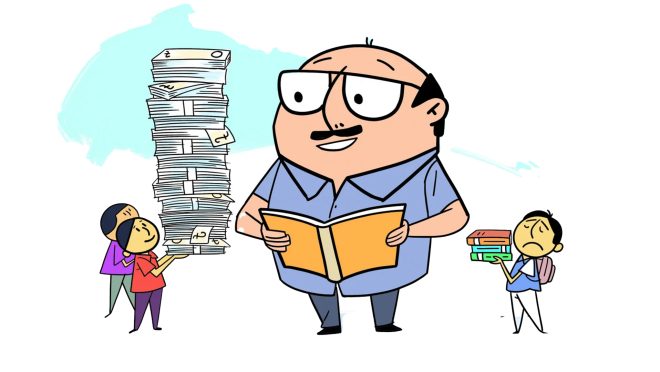
Therefore, on the International Day of Education, it is incumbent upon us to analyse the current scenario of education costs in Bangladesh and question why the government is not taking action.
In researching for this article, we decided to focus on the costs related to Bangla medium education, directly controlled by the NCTB. The reason is simple: the upper class dominates the English medium spectrum, whereas the lower spectrum linger behind in charity organisations such as the madrasas and maktabs.
The Costs
Our interviews were limited to school students from grades 3 to 10. It was remarkable to see families investing double, sometimes triple the amount on coaching centres and private tutors compared to school fees, a fact evident from the sheer number of coaching centres spread across Dhaka.
From the four families interviewed for this article, all of them spend an average of Tk2,500 monthly on school fees, not alarming in the context of a middle-income household.
However, a surprising fact emerged when we asked about coaching fees. One interviewee from South Point School and College, currently in sixth grade, spends around Tk9,000 monthly on three different coaching centres, triple the amount spent on school fees, prompting the question, what is the point of wearing a uniform and going through all that trouble?
Similarly, an interviewee studying in the tenth grade at Monipur Uchcha Vidyalaya spends Tk9,000 on private tuition plus an online platform. During the interview, the guardian expressed displeasure at teachers pressurising the students through intimidation and occasionally providing less than favourable treatment.
The godfather-esque network of teachers running multiple coaching centres using intimidation tactics is not unique in Bangladesh’s education landscape. The incentive structure seems broken. It is far more profitable for teachers to spend their evenings teaching batches than doing their actual work in the classrooms.
The competitive nature of our education system exacerbates the situation. Choosing to boycott these centres and follow an independent path would mean missing out on crucial suggestions, strategies, and subject knowledge. Therefore, the privatised monopoly appears to be on firm ground..
Even families who choose not to participate in this hierarchy face overwhelming costs. Our interviews of Mohammadpur Preparatory School and College, and Shaheed Bir Uttam Lt Anwar Girls’ School revealed that they spend around Tk6,000 monthly on private tutors. Both families employ the bare minimum, yet these costs are double the amount of their school fees.
Expenses extend beyond tuition fees. Stationery, guidebooks, and other miscellaneous costs can become burdensome as children progress through grades. In a four-member household in Dhaka, the median living cost can rise to Tk70,000. If two of those members attend school, the cost of education per child can reach Tk11,500.
One can imagine the toll on a middle-class family if Tk23,000 is extracted solely for children’s education, not accounting for rent, food, and other expenses.
The Solution
Universal literacy programmes might seem like the easiest solution, but limitations exist. Revenue streams cannot simply be fabricated to fund such programmes. Furthermore, vested interests currently dominating the education sector are unlikely to support reforms that threaten their profits.
The government, sadly, remains apathetic. Various commissions and policies have been part of the July Charter, yet the cost of educating our future generation was not addressed.
Thus, the end of this middle-class oppression is nowhere in sight. Our constitution, however vague or unambitious, still calls upon the state to ensure the education of children as a fundamental right.
Yet the state, with its long history of ignoring pressing issues, is expected to overlook this one as well. For families of limited means, education, the one aspect that could elevate their standard of living, remains elusive.
As the misfortunes of the middle class reach desperate levels, the plight of the lower strata of society is even worse.
For our own sanity, this article has focused primarily on middle-class struggles of education.