The man who refused to hate
I was in class three when one of my father’s acquaintances handed me a book. It was a collection of the greatest speeches in history. I do not recall the occasion, nor do I remember the man’s face. What I remember is sitting with that book later, flipping through pages I was probably too young to fully understand, and stopping at a headline:
I Have a Dream.
The man who refused to hate
I was in class three when one of my father’s acquaintances handed me a book. It was a collection of the greatest speeches in history. I do not recall the occasion, nor do I remember the man’s face. What I remember is sitting with that book later, flipping through pages I was probably too young to fully understand, and stopping at a headline:
I Have a Dream.
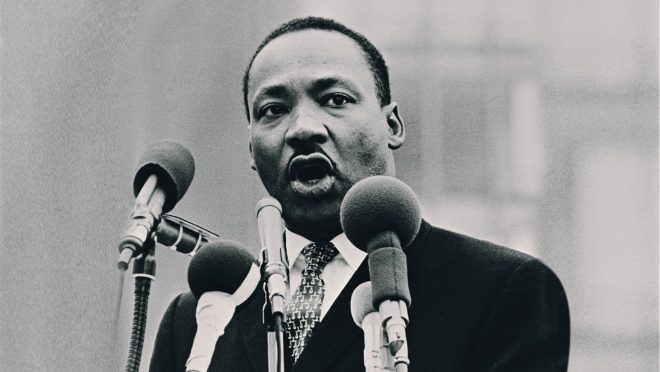
Something about those four words held me in place. I read the speech without understanding half of its references, without knowing the full weight of what Birmingham meant or what a March on Washington looked like from the ground. But I felt it. The rhythm of it, the way each sentence seemed to build toward something larger than itself, the sense that the man speaking was not merely describing a wish but insisting on a world that did not yet exist.
I did not know then that the man who delivered it would be dead in five years. I did not know he was thirty-four when he stood at that podium. I did not know that America, by the end of his life, had turned significantly against him. I only knew that the words moved me in a way that nothing had quite moved me before.
That feeling stayed. This piece is, in some ways, a reckoning with it.
There is something almost uncomfortable about how often Martin Luther King Jr. is quoted by people who would have disagreed with him while he was alive. He is safe now. Framed on walls, printed on tote bags, reduced to a sentence about dreams and little children holding hands. The discomfort has been edited out. We remember him as a man who gave a speech. We prefer not to remember what the speech cost him. He was thirty-nine when he died. Younger than most people’s ideas of a legacy. Younger than most people’s ideas of finished. He had been jailed twenty-nine times by then, had survived a stabbing in 1958 that left a letter-opener lodged so close to his aorta that a single sneeze, the surgeon said, would have killed him. He had watched his home bombed. He had read the FBI’s letters urging him to take his own life. He had been called a communist, an agitator, a troublemaker, by newspapers that would later praise him in editorials after his assassination.
America did not love Martin Luther King while Martin Luther King was alive. It is worth sitting with that for a moment. What made him genuinely threatening to the people in power was not the dream. It was the discipline. King operated inside a philosophy of nonviolent resistance that demanded something most political movements do not ask of their members: that they absorb hatred without returning it. That they look at people who wanted them erased and refuse to give those people the satisfaction of hate in response.
He had studied Gandhi, had engaged seriously with the theology of love as a political force, and had understood that a movement built on moral clarity becomes far harder to dismiss than one built on anger alone. When the cameras rolled and the batons fell, the footage of peaceful marchers being attacked did not just generate sympathy. It made the violence visible in a way that nothing else could. The cruelty was always there. King’s method forced the world to watch it.
And yet the image of him as simply patient, simply waiting for America’s better angels to arrive, misses something essential. By the mid-1960s, he was speaking about economic inequality with a directness that made Washington nervous. He called the Vietnam War a moral catastrophe. He was planning a Poor People’s Campaign that would bring thousands of the dispossessed to the capital to demand not sympathy but systemic change. The FBI surveillance intensified. The approval ratings dropped.
He was the same man. The country had simply preferred the version of him that could be contained.
That pattern did not end with him. The idea that a person can be celebrated for a sanitized version of their beliefs while the more demanding parts are quietly archived—that is not history. That is a habit.
King’s life, read fully, is not a comfortable story about progress. It is a precise and demanding argument about what moral courage actually requires. Showing up when the numbers are wrong. Speaking when the room is hostile. Holding onto something when the evidence suggests it is not working, not because the evidence is wrong, but because the alternative is to stop.
He never stopped. Even on the last night in Memphis, he spoke about having been to the mountaintop.
The dream was never the whole speech. The whole speech was a reckoning. The dream was just the part that was easier to remember. And I was in class three, sitting with a book I had received as a gift, learning, without knowing it, what it means to be moved by something true.