The unfinished sketch of being human
There are lines everywhere if one has the patience to observe them. Lines on our palms, on our foreheads, lines in our resumes, in the margins of books we once loved and no longer quote.
The unfinished sketch of being human
There are lines everywhere if one has the patience to observe them. Lines on our palms, on our foreheads, lines in our resumes, in the margins of books we once loved and no longer quote.
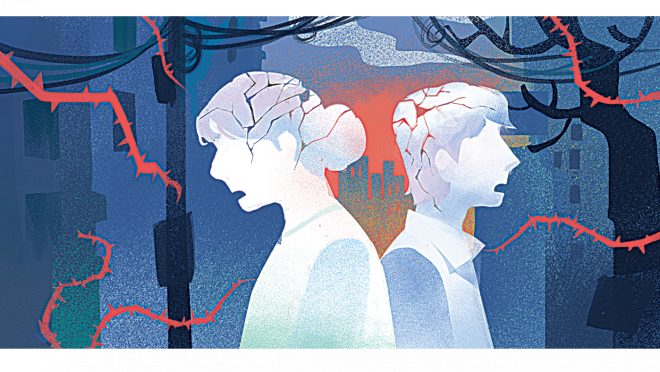
Life, it seems, is less a grand sculpture and more a disciplined drawing, an intricate sketch composed of success, struggle, gossip, appreciation, love, envy, and ambition trembling under the line of hope.
Illusion
Success is the most photographed line of life. The skyline that is shot at dusk, the framed certificate, the headline with a name spelt correctly. It is a linear line in theory, composed in clean, ascending, enviable straightness with no barriers. However, it resembles a cardiograph in mild distress.
Societal practice adores this line. It measures in promotions, wealth, followers on social media, and occasionally in the subtle shift of how relatives pronounce names at weddings. Success, when observed from a distance, appears effortless, like a well-rehearsed speech delivered with spontaneous charm, seeking all attention.
Yet those who walk on this line know its secret, know how it is paved with invisible strain. Behind every accolade is a draft discarded at 3:00 am; behind every overnight achievement lies a decade of anonymous hardship. The line of success is not drawn with a ruler; it is etched with persistence.
Satirically, we adore pretending. We dedicate it to luck when it belongs to others and to merit when it belongs to us. Thus, the line of success doubles as a mirror reflecting not just accomplishment but also our insecurities.
The backbone
If success is the headline, then struggle is the fine print. Struggle is the line we hesitate to display. It is not accompanied by hashtags. It exists in silent rejections, in the quiet resilience of those who wake up each day and try again without the thought of comfort.
Yet it fortifies the soul. Struggle is the apprenticeship of character. It is the disciplined sculptor who chisels arrogance into humility and naivety into wisdom.
We romanticise struggle only in retrospect. We narrate it dramatically once it has concluded, editing out the exhaustion and failure. Struggle feels less poetic and more administrative.
Devoid of any form of glamour, struggle gives success its legitimacy.
Gossip is the unofficial currency of society. It travels faster than truth and dresses better. It thrives in corporate corridors, neighbourhood balconies, and digital comment sections. It is democratic, sparing no individual.
At its worst, gossip corrodes reputations and fractures trust. At its mildest, it functions as social glue, binding communities in shared curiosity. Nevertheless, it is a subtle test of character.
The line between listening and participating is barely visible, like a thread. The choice not to engage is often more radical than it appears. In abstaining from gossip, one chooses integrity over inclusion.
We condemn gossip in principle and indulge in practice. We address it with concern, analyse it, or simply share it. Thus, gossip becomes a line we draw around others to feel superior, only to realise we stand within similar outlines ourselves.
A rare signature
Appreciation is perhaps the most underrated line of life. It is delicate, understated, and transformative.
Unlike success, appreciation does not demand scale. A sincere acknowledgement can redirect a life. A mentor’s faith, a friend’s gratitude, a colleague’s recognition, an end-of-day message from doers, these are small signatures that validate existence.
In professional spaces, it functions as an invisible architecture. It strengthens morale, nurtures loyalty, and humanises ambition. And yet, appreciation is often rationed. We withhold praise out of competitiveness. The fear that acknowledging another’s brilliance will diminish our own is all that it takes.
Appreciation multiplies; it is the line that extends without dividing. In offering it, we enlarge the canvas for everyone.
Comparison and envy is another form of art in society. It emerges when we measure our progress against curated glimpses of other people’s lives. It whispers that someone’s chapter 25 should have been our starting point and vice versa. It compares behind-the-scenes footage with highlight reels.
It is human, but when left unexamined, it distorts the map. It is the cycle of admiration turning into resentment and ambition into anxiety.
The professional world, especially, cultivates envy with remarkable efficiency. Metrics, rankings, titles, these become coordinates in a competitive geometry. We begin to live on someone else’s graph.
The antidote is not denial but discernment. To convert envy into inspiration is to redraw the line consciously. It is to say, “Their path is theirs. Mine remains unwritten.”
Hidden guide
Failure is the line that interrupts the narrative. It appears as a missed opportunity, a rejected proposal, a collapsed venture. It is unsentimental. Failure has little interest in our timelines. Yet it is arguably the most honest instructor.
It strips away illusions. It reveals gaps in preparation, humility, or strategy. It compels recalibration. In satire, we applaud resilience while secretly fearing embarrassment. We admire stories of failure overcome, so long as they are not our own in real time.
But failure is not the end of the drawing. It is a correction mark, not a cancellation. Those who learn to see it as such evolve with depth. They acquire a sturdier confidence that is less flamboyant, more durable.
Amid ambition and competition, care remains the binding thread. It is the line that curves gently through every other line, softening their sharpness. Some things manifest as friendship, family, partnership, and mentorship. It is the quiet assurance that one is seen beyond performance metrics. It is a refuge after public battles. Professionally, care translates to empathy. Personally, it translates to belonging.
Ultimately, every life is summarised in a few lines that are spoken at farewells, written in biographies, and remembered in anecdotes. The irony is profound. After decades of intricate drawing, we are distilled into a paragraph.
The question is, what remains? Rarely is it the number of promotions. Rarely is it the gossip we participated in. Often, it is the kindness extended, the resilience displayed, and the integrity maintained.
The lines of life converge into a singular question: did we draw generously?
Life is not about achieving the straightest line but about composing a meaningful one. A line that bends with humility, rises with courage, steadies with discipline, and softens with compassion. With trembling yet determined hands, we continue to draw, aware that the masterpiece was never perfection, but participation.
Success will glitter, struggle will test, gossip will tempt, appreciation will heal, envy will intrude, failure will instruct, and care will endure.
For life is not a race to the finish line. It is the art of tracing lines that matters.