The world was free before the elite invented passports
The world was free before the elite invented passports
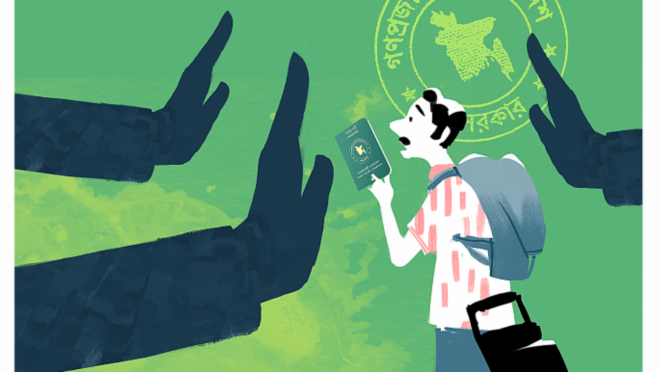
Even 100 years ago, the concept of requiring a visa to move to a different country was not common. Humanity, in its vast history, has seldom been prohibited from choosing where they live. From climate catastrophes to ravaging war, leaving one’s homeland has been a part and parcel of life for us nomadic creatures.
However, the world today is much more complicated. One cannot just live wherever he or she chooses to. There are geopolitical, financial, and various ambitions for why one might leave their birthplace; mostly it relates to finding a better life for him and his family.
Given this historical trend ingrained in humanity’s existence, it is a matter of discussion on International Migrants Day why this digitally interconnected world is so distant geographically, and how the contemporary West is now once again taking a protectionist policy against migration, be it illegal or legal.
The days before passports
Just as most of history, the restriction of movement has its roots deeply in colonial and imperialist practices.
Before the 19th century, a farmer could just decide to move on, leaving behind his land and country if he thought that land was not sustaining his needs anymore. A soldier could settle down in his newly conquered state since he might have been on the battleground for years and lost contact with his previous family, or simply a trader could choose to buy a new home in a new place and use it as a trading post to make his commute easier.
Through these basic practices, humanity intermingled throughout the six continents and cultures travelled thousands of miles, and changes in the demography of a particular land were nothing out of the ordinary.
Here came the colonialists and the need for them to control movement. Feudalism, and its forefather, colonialism, benefited greatly by restricting the free movement of peasants or “normal” people. People who were just citizens bearing no real political will.
The competing colonial nations needed an organised system in order to control the population, maintain suitable labour availability, and establish their rule and implement the so-called “rule of law” to govern the territory according to their requirements.
British India used “passes” to restrict internal movement of indentured labourers; the same happened in Africa where, under colonial rule, the enslaved population had no legal rights to move, and those of the elite who had the affordability required government-approved passes.
The passport system in its current form, standardised booklets required for crossing borders, was only introduced in the 1920s as European states sought further control over their borders and were concerned greatly with their population mixing and getting ideas of revolting from contesting agitators.
The UK, along with passports, introduced the concept of a VISA, as a conditional endorsement within a passport, granting travellers permission to enter British territories. Therefore, this restriction is a completely new phenomenon, originating out of the need to control the population, restrict their movement, and assert control.
An unfair practice
Most of history might be viewed through a class struggle, a struggle where the bulk of it was carried by the class that was being dominated. Without land or power, their restriction of movement was not something experienced by the privileged.
Much like today, greater finances and wider connections were required in order to migrate from one place to another. Although there has been widespread migration, specific examples such as the Irish potato famine, and the migration after WWII come to mind; these were anomalies where prevailing circumstances forced the inevitable. However, the power to trade and have the luxury of dual citizenships was always a trait of the elite.
Throughout history, the need for migration never really faded away. For education, work, and a better life, people needed to migrate from poorer nations to richer states. Just as in colonial times, the migration pattern for a greater life is still today limited to the elites.
The requirements of a better life still require greater capital; unless you gain something amongst a handful of scholarships, your dream of a higher education is just that, a dream. Unless generational wealth can give you the boost to bear the fees. As does work: very few corporate and international staff migrate from developing nations to the developed, and those that do go for odd jobs and lesser service requirements, meaning even if they get their footing, their only hope is that their next generation benefits from them. For the underprivileged, migration has always been and undoubtedly now is an act of self-sacrifice rather than self-actualisation.
The politics and future
Trump won the ballot largely because of fear-mongering; the Mexicans are turning things brown, the so-called “s**ithole nations” are flocking their streets and making crime unbearable, are the rhetoric that resonated. Europe is further moving along to the right, just as their big brother.
It seems just as the world became segregated through accumulating wealth and ammunition, it suddenly decided that it was enough, and the flow of population should stop in order to keep things as they are.
There are, although, feel-good anecdotes: people like Zohran Mamdani or London’s Sadiq Khan are examples of immigrant success, but evaluating their past in terms of wealth and privilege can show that there is nothing special except for the fact that a brown elite intermingled with white ones and the white ones approved wholeheartedly.
The migrants who are truly unfortunate can be forced to enter Europe and “take over”. They are the people from the war-torn Middle East, where the only chance of survival during the journey is one’s swimming skills and sheer luck. Here, no amount of scholarships or work permits acts as their validation of “whitification”. Thus, they are likely to not be welcomed.
So it is the world today, just as it was before. Accepting the privileged, ignoring the rest. Nothing changed, and the trend is not optimistic.
“The bourgeoisie, by the rapid improvement of all instruments of production… and by the immensely facilitated means of communication, draws all, even the most barbarian, nations into civilisation.”
(Karl Marx, Friedrich Engels, Communist Manifesto, 1848, Part I)
And civilisation chews up and spits out those whom it deems unfit (the bricklayer working under the desert sun in Dubai) and shows pity to those whom it knows to be barbarians (the Zohrans of the world). Such is the nature of modern nationhood.