We are all Nobita now
Some of us used to mock Nobita for continuously asking for help from Doraemon, always sharing his sad takes, and sometimes being fully dependent on Doraemon. But now, we are also becoming like him. Don’t you think?
We are all Nobita now
Some of us used to mock Nobita for continuously asking for help from Doraemon, always sharing his sad takes, and sometimes being fully dependent on Doraemon. But now, we are also becoming like him. Don’t you think?
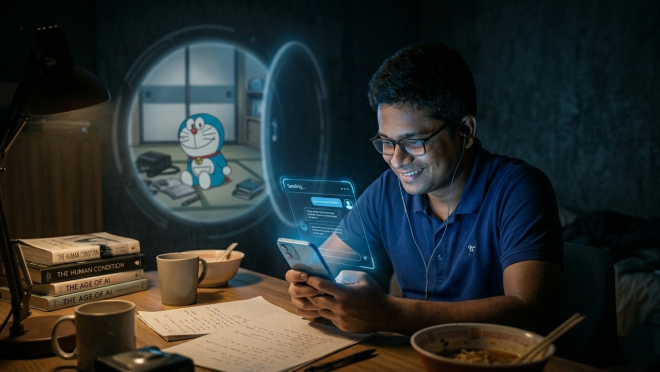
The show is named after Doraemon. But the story has always belonged to Nobita, a kid we all knew. He was not a hero by any conventional design. He fails every exam. He is terrorised by Gian, outclassed by Suneo, and academically humiliated by Dekisugi, the calm, brilliant, relentlessly pleasant boy who seems to exist specifically to show Nobita everything he is not. From the outside, Nobita’s life looks like a long, unbroken tragedy.
But it all started to shift with the arrival of a futuristic robot, Doraemon. He was sent back through time with a four-dimensional pocket and an infinite inventory of solutions. He is, by any definition, the most powerful character in the story. Afterwards, the story continues with the same boy, the same drawer, the same reflex. No matter what happens, like failing a test, he runs to Doraemon. Got bullied, ran to Doraemon. Heartbroken, confused, or overwhelmed by the ordinary difficulty of being alive, ran to Doraemon. We used to sit on our side of the screen and shake our heads at him. Look at this boy, can’t do a single thing on his own.
And yet, on 19 March 2008, this story got recognition from the Japanese Ministry of Foreign Affairs (MOFA) as its first anime cultural ambassador. They said this story conveyed something important about the relationship between human beings and the tools they build. They were right, though perhaps not in the way they intended. Because we did not know we were not watching just an animated show. We were watching a prophecy. Effort without reward. Trying without arrival. And yet, here is what took us years to understand: that “Nobita Nobi is not a caricature. He has a diagnosis.”
And this parallel is too precise to be comfortable. Nobita reached for Doraemon not because he was incapable, but because the drawer was there. And the gap between where he was and where he needed to be felt too wide to cross alone, and there was something that could close it instantly. That is not a character flaw unique to a fictional child. That is a description of what human beings do when an easier option exists. We took it. Every time, we took it reliably.
Same depth. Same resilience. Or rather, the same absence of it.
Now, look at us. We are doing the very same thing on a civilised scale. Grab your phone, take a look. How many times today did you open ChatGPT, or Claude, or Gemini, or any chatbot before you sat with the problem long enough to attempt it yourself? How many assignments have been written by AI while you watched? How many decisions about what to say, how to say it, what to do next, have been outsourced to something that runs on servers you will never see?
Though we are producing better output, cleaner essays, sharper emails, more articulate arguments, and faster decisions, nobody looking at the result would know the effort was borrowed. But we know. And more importantly, the person who needs to develop through the effort of producing it is the person who is staying exactly where they started. The fact is, we are not just using AI to do our homework. We are confessing to it. We are processing our grief inside it. We are, in the most literal sense, running to the drawer.
The world got noisier. Faster. More demanding of performance and less tolerant of the messy, uncertain, in-progress version of a person. Somewhere along the way, it became embarrassing to not know, to be confused, to need help in the visible, human way that requires admitting it to another person. We started curating ourselves for each other, presenting finished versions of lives that were still mid-construction, and the gap between what we showed and what we felt became too wide to bridge in ordinary conversation. So, we went to the drawer.
Every time Nobita chose the gadget over the struggle, something did not happen. Not a disaster. Something quieter and more consequential than that. A small piece of growth that could only exist in the gap between the problem and the solution: the confusion, the failed attempt, the figuring-it-out simply did not occur. And we became Nobita. Just dressed it up in better technology and called it productivity.
Because the drawer does not require us to be a finished version of ourselves. It does not require us to be anything. It just receives whatever we bring, processes it, and hands something useful back. No risk. No residue. No growth either. But that part is quiet, and easy to miss.
Perfection is an illusion
The only thing that changed between Nobita’s world and ours is that our drawer is more powerful, more available, more convincing, and fits inside our pocket. And more than that, more uncomfortable than that: there is a specific kind of loneliness underneath all of this that we do not talk about honestly enough.
Like, how many times have you typed something into an AI chatbot that you have never said out loud to another human being? Your fears. Your embarrassment. The secret that is too heavy for a real conversation, that you fear you cannot hand to another human because what if they look at you differently? What if they judge you? What if they do not know what to say, and it becomes awkward, and both of you live with that awkwardness?
But AI never does any of that. It responds warmly, immediately, without complication. It is, by design, the perfect listener. And that perfection is the trap. Human connection was never supposed to be frictionless. The friend who says the wrong thing but means well. The conversation that gets difficult before it gets honest. The relationship that requires you to be seen imperfectly and trusted anyway is not a design flaw in human intimacy. That is the entire mechanism by which loneliness ends.
When we replace it with something that always responds correctly, we do not solve the loneliness. We soundproof it. We make it so comfortable that we stop trying to escape it. And comfortable loneliness is the kind you stop noticing until it is all you have.
This is not an argument against AI. That argument is already lost, and it should be. These tools are extraordinary. And honestly? In a year when I have used more AI tools than I care to count, outsourced more decisions than I probably should have, and had more conversations with screens than with people, there is something quietly revolutionary about a show whose central message is that no gadget, no matter how miraculous, is a substitute for someone who genuinely shows up for you. Doraemon understood this. Nobita, slowly, episode by episode, keeps learning it. Maybe at twenty-four, so am I.