Why wars no longer end conclusively in a unipolar world
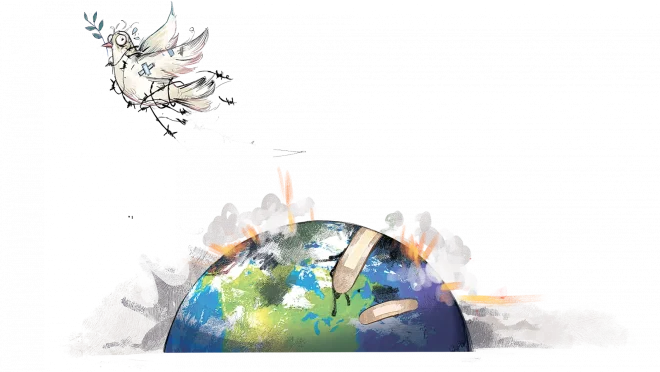
Wars are no longer defined by victory or defeat. The disappearance of a balancing force has transformed wars into something far harder to conclude than to begin.
Why wars no longer end conclusively in a unipolar world
Wars are no longer defined by victory or defeat. The disappearance of a balancing force has transformed wars into something far harder to conclude than to begin.
In 2007, at the height of the Iraq War, General David Petraeus posed a question that has since haunted American foreign policy: “Tell me how this ends.” Two decades later, that question feels less like a moment of introspection and more like a permanent condition of the global order.
There was a time when wars ended with clarity. Borders stabilised, regimes either consolidated or fell, and reconstruction followed, no matter how imperfect it might have been. That time coincided with a world divided into two.
A world of two poles
The bipolar world of the Cold War was characterised by the rivalry between the US and the Soviet Union. It was, by definition, a system in which two dominant states possessed most of the world’s economic, military, and cultural influence. The world was sharply divided, alliances rigid, and competition relentless. Yet, paradoxically, this rivalry imposed discipline.
The defining feature of this system was not just competition, but restraint. The doctrine of mutually assured destruction ensured that, while proxy wars raged, direct confrontation between the superpowers remained unthinkable. The result was a tense but structured stability.
Wars during this era followed a pattern. They were brutal and prolonged, but ultimately mediated—directly or indirectly—by the two superpowers.
Consider the Korean War (1950–1953), the first major “hot” conflict of the Cold War. North Korea, backed by the USSR and China, invaded US-supported South Korea. After three years of devastation, the war ended not in total victory but in a stalemate. The border returned to the 38th Parallel, and a demilitarised zone was established—still one of the most militarised borders today. It was not peace, but it was resolution.
The Vietnam War (1955–1975) revealed the limits of US power. Despite overwhelming military force, the US could not defeat a determined insurgency. The Paris Peace Accords in 1973 led to US withdrawal, and by 1975, Saigon had fallen. The country unified under a communist government, delivering what was widely seen as a major blow to US prestige and triggering the so-called “Vietnam Syndrome”—a reluctance to intervene abroad.
Even crises that risked global catastrophe were resolved through negotiation. The Cuban Missile Crisis (1962) brought the world to the brink of nuclear war. Yet, after 13 days of tension, a settlement was reached: the USSR withdrew its missiles from Cuba, the US pledged not to invade, and secretly removed its missiles from Turkey.
It also led to the establishment of a direct “hotline” between Washington and Moscow to prevent future miscalculations.
Perhaps most telling was the Suez Crisis of 1956. When Israel, the UK, and France invaded Egypt following the nationalisation of the Suez Canal, both the US and USSR intervened—not militarily, but diplomatically. President Eisenhower threatened to wreck the British economy, while the Soviets hinted at nuclear intervention. The result was a withdrawal and the deployment of the first UN Emergency Force. It marked the end of British and French imperial dominance and reaffirmed that even allies were subject to superpower discipline.
These conflicts were not “successful” in a moral sense. But they were contained. More importantly, they ended in ways that allowed states to rebuild. None of the countries embroiled in these wars emerged as permanently failed states.

Graphics: TBS
The unipolar moment
The collapse of the Soviet Union in 1991 ushered in what scholars call the “unipolar moment”—a world in which a single superpower dominates international affairs. The US became the sole hegemon, shaping global norms, influencing economic policies, and acting as a security guarantor.
In theory, such a system could promote peace if managed by a benign power. In practice, it concentrated authority without accountability. There was no counterweight, no balancing force, and no external mechanism to check unilateral action.
Wars in this era looked different—not just in how they were fought, but in how they ended.
The Iraq War (2003–2011/2017) was launched to “disarm” Iraq of weapons of mass destruction—which were never found—and to topple Saddam Hussein. The regime fell, but what followed was chaos.
Sectarian violence engulfed the country, and the resulting power vacuum enabled the rise of ISIS. Iraq remains a fragile state, its sovereignty compromised and stability elusive.
Afghanistan tells a similar story. Initiated after the 9/11 attacks, the war aimed to dismantle Al-Qaeda and remove the Taliban. After 20 years, billions of dollars, and extensive “nation-building”, the US withdrew in 2021.
The Afghan government collapsed almost instantly. The Taliban returned to power, and the country plunged into a humanitarian crisis. What was meant to be a transformative intervention ended in reversal.
Libya (2011) offers perhaps the clearest example of intervention without post-conflict planning. NATO’s Operation Unified Protector helped overthrow Muammar Gaddafi, but offered no blueprint for governance. The result was a “failed state”, fragmented between rival factions—a hub for human trafficking and weapons smuggling, destabilising an entire region.
Syria remains unresolved. The civil war, beginning in 2011, drew in multiple external actors—the US, Russia, Turkey, and Iran—each pursuing their own interests. The result is a “frozen” conflict. Bashar al-Assad remains in power, but over a fractured country. The war has produced the largest refugee crisis of the 21st century, with no formal peace in sight.
Unlike the Cold War’s stalemates and negotiated settlements, these conflicts have yielded what many historians describe as “unsettled” outcomes—prolonged instability, state collapse, and humanitarian crises.
No one to check the hegemon
The core issue underlying this transformation is structural. During the Cold War, the presence of two superpowers ensured mutual constraint. In today’s unipolar system, there is no equivalent check on US power.
Domestically, US institutions—Congress and the Supreme Court—are designed to limit presidential authority. Internationally, no such mechanism exists. The United States operates in a system in which it can act unilaterally, often shaping both the course and resolution of conflicts.
This absence of balance has profound consequences. As one system transitions into another, the question is no longer just who wins wars, but whether wars can end at all.
Unipolar power
The ongoing 2026 US–Israeli war against Iran, launched under “Operation Epic Fury”, demonstrates these dynamics with alarming clarity. As political scientist Dr Widyane Hamdach writes in her research titled Tell Me How This Ends, the intervention risks “transforming into a strategic overextension for the US”.
Modern wars in a unipolar system are not merely harder to win; they are harder to conclude, too. Without a balancing force, interventions risk expanding indefinitely, shaped more by shifting objectives than strategic clarity.
The operation, initiated on 28 February, targeted leadership, military installations, and missile sites, with four stated objectives: preventing Iran from acquiring a nuclear weapon, destroying missile capabilities, degrading proxy networks, and annihilating its navy.
Yet, as the study suggests, “the ultimate objective appears to be the systematic degradation of the Iranian government”.
While the strikes may have delayed a nuclear threat, they have substituted any imminent threat with immediate instability, with unknown ramifications. Those ramifications are already visible.
Domestically, Iran faces unprecedented instability. The death of Supreme Leader Ali Khamenei has disrupted the regime’s central power structure. As she notes, since 1989, “the Supreme Leader has tightened hardliner control over the management of the Shia clerical establishment”. His absence has opened the door to factional conflict.
Public sentiment is deeply divided. Some mourn; others celebrate. Reformist groups have rallied around exiled Prince Reza Pahlavi, chanting “Javid Shah!” (“Long live the Shah!”). Yet even here, uncertainty prevails. President Trump himself expressed scepticism, suggesting someone within Iran “would be more appropriate”.
The absence of a unifying figure, combined with ethnic divisions—Persians, Azeris, Arabs, Kurds, and Baloch—raises the risk of fragmentation. A collapse could trigger a refugee crisis of unprecedented scale. As the EU Agency for Asylum warns, “If just 10% of Iran’s population fled, this would rival the largest refugee flows of recent decades.”
Regionally, the war has escalated through asymmetric warfare. Iran has launched missile and drone attacks on US bases and allied infrastructure. Proxy groups—Hezbollah, Iraqi militias, and the Houthis—have expanded the conflict across multiple fronts.
The cost imbalance is stark: while Iran relies on inexpensive drones, the US depends on costly defence systems. In 2025 alone, operations against the Houthis cost $1 billion in three weeks.
Globally, the conflict is reshaping power dynamics. Russia and China have seized the opportunity. Moscow benefits from reduced Western focus on Ukraine, while Beijing—heavily reliant on Iranian oil, purchasing up to 80–90% of exports—has deepened its support.
The war is also straining global economic systems. Disruptions in the Strait of Hormuz have driven up oil prices and shipping costs, with cascading effects worldwide.
In short, what began as a targeted intervention has evolved into a multidimensional crisis—precisely the kind that Petraeus warned against.
Petraeus’s question forces policymakers to confront the absence of a clear end state.
As the Iran conflict shows, modern wars in a unipolar system are not merely harder to win; they are harder to conclude. Without a balancing force, interventions risk expanding indefinitely, shaped more by shifting objectives than strategic clarity.
The policy recommendations emerging from the Iran case are telling. They emphasise multilateral engagement, coordination with institutions such as the IAEA and OCHA, and regional frameworks like the Gulf Cooperation Council. They call for deterrence without occupation, diplomacy over escalation, and the avoidance of large-scale ground war.
These are, in essence, attempts to recreate the balance that once existed structurally.
The transition from a bipolar to a unipolar world has not simply redistributed power; it has altered the nature of war itself. Where once two superpowers enforced limits, now a single hegemon operates with fewer constraints. The result is not greater stability, but greater unpredictability.