WrestleMania: When entertainment stops loving you back
There is something heartbreaking about watching a thing you love become too expensive and not love you back. And in 2026, that sentence does not belong only to wrestling fans. It belongs to most people.
WrestleMania: When entertainment stops loving you back
There is something heartbreaking about watching a thing you love become too expensive and not love you back. And in 2026, that sentence does not belong only to wrestling fans. It belongs to most people.
We are living through a particular kind of economic exhaustion, not the dramatic, headline-grabbing collapse, but the slow, grinding kind that arrives in the form of a grocery receipt, a rent renewal, or a cost-of-living adjustment that does not quite adjust enough.
Inflation has not merely raised prices. It has quietly renegotiated what ordinary people are allowed to enjoy. Concerts, travel, sporting events, and the small ceremonies of collective joy that once felt within reach have drifted upward into a register that requires justification. You save longer. You go less. You watch from a distance that feels increasingly permanent.
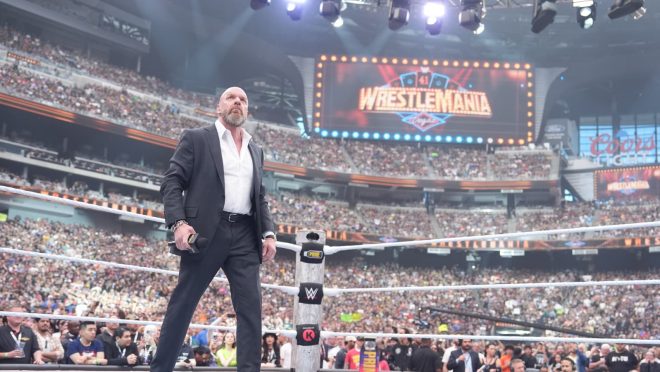
WrestleMania 42 is, on its surface, a story about a wrestling company miscalculating its market. But I keep reading it as something else, as a small, precise illustration of a much larger pattern that is reshaping who gets to be present when the lights come on.
WWE, now operating under TKO Group Holdings, moved WrestleMania 42 back to Las Vegas for a second consecutive year after the city produced a $66 million gate in 2025. The logic was clean. The city had delivered. Go back. The trouble is that what a city delivers in one year cannot always be replicated simply by returning, especially when the world that surrounds the event has quietly shifted. Ticket prices that averaged $169 three years ago now sit above $740.
The cheapest seat in the furthest row costs roughly $270 per night. And to ensure those seats were purchased rather than circumvented, WWE imposed a 50-mile blackout radius, barring every local bar, casino, and restaurant from broadcasting the event, even with a paid licence.
The mathematics were clean. The logic was cold. And the thing it quietly destroyed was harder to quantify than a gate number.
Wrestling crowds are not passive audiences. They are participants. The synchronised chants, the eruptions, the grief-stricken silence after an unexpected loss, these are not atmosphere. They are the product. The camera does not merely capture the event; it captures the people watching the event, and those two things are inseparable.
When you price out the passionate travellers who save for months, who memorise the card, and who arrive already emotional, and replace them with wealthy tourists treating it as a Thursday evening novelty, the broadcast does not look wrong. It simply looks quieter. Something is present. Something essential is not.
This is not cynicism about wealth or tourism. It is a more specific observation: that certain experiences depend on a particular kind of witness. A concert can be attended by people who do not know the lyrics, and the band still plays. But a wrestling crowd that does not know when to react changes the performance itself. Wrestlers work the audience. The audience works with the wrestlers. Remove that literacy and you do not have a different crowd. You have an absence shaped like a crowd.
By mid-March 2026, WrestleMania 42 sat roughly 10,000 tickets behind per night compared to the same point the previous year. The reasons stacked quietly on top of one another. The FIFA World Cup arrived in North America the same year, drawing the international fans who had always formed the reliable floor of WrestleMania’s attendance, fans who, in a year of stretched budgets and competing obligations, had to choose.
An unprecedented injury wave, Seth Rollins, Braun Breaker, Bronson Reed, and Bianca Belair, dismantling a card built around four pillars, leaving creative teams to revise storylines in real time. The resignation of veteran writer Road Dogg Brian James, who reportedly felt shut out by a corporate structure that no longer made room for institutional memory.
And underneath all of it, something quieter and harder to name: that the people most likely to fill those seats with genuine feeling are the same people for whom $270 is no longer a casual decision. They are navigating the same inflation, the same stagnant wages, the same sense that the world is demanding more while offering less. The core fan, the one who has been watching since childhood, who knows the grammar of a slow build, who understands which entrances warrant standing and which losses require something like grief, is not the loudest voice in any boardroom. They are the reason the camera has somewhere to point. But they are precisely the demographic that a $740 average ticket price quietly, efficiently removes.
The wealth gap does not announce itself dramatically. It simply raises the floor until certain people can no longer reach it and then looks around at the empty seats with genuine puzzlement.
Under pressure from the 10,000-ticket deficit, from a city that had paid millions in public incentives expecting a wider economic ripple, and from businesses locked out by a blackout policy that served no one, WWE reversed itself. The blackout was lifted. Ticket prices dropped from $254 to $177 for the cheapest available. Circa’s Stadium Swim confirmed watch parties. The bars reopened their screens.
Eric Bischoff framed the reversal practically: Las Vegas tourism is down. The city needed WrestleMania to generate the boom it was promised, and that boom cannot happen if the surrounding economy is excluded from it.
The maths had simply run the other direction. I find myself less interested in the reversal as business news and more interested in what the entire arc reveals, the way institutions that grow large enough begin to confuse their audience for their product rather than understanding them as its source. This is not unique to wrestling. It is the story of concert venues, of football stadiums, of cinemas, and of every communal space that once served a broad public and gradually, through a series of individually rational pricing decisions, became accessible only to those for whom the price is not a consideration.
The spectacle does not disappear. It just becomes something else. A production watched by people who can afford to be in the room, surrounded by other people who can afford to be in the room, broadcasting to everyone else through a screen. Clean. Loud. Oddly hollow.
WrestleMania 42 will happen. It will be large and visually overwhelming in the way only Las Vegas can deliver. There will be pyrotechnics and entrances and moments designed for the highlight reel. The production will not fail.
But I keep thinking about the 10,000 empty seats. About the fan who saved for months and found the price had moved again. About the bar that was told, briefly, it was not welcome at the party it had always been part of.
About all the small ceremonies of joy, not just this one, that are drifting just out of reach for the people who need them most.
There are no blackout reversals for those moments. Some distances, once opened, do not close simply because the policy changes.
The show will go on. It always does.
I just wonder, sometimes, who it is going on for.