From Ruet to Toronto: Securing a fully funded PhD abroad
In a time when higher education seems to become not only a luxury but a distant dream, some still are prevailing and making their marks.
From Ruet to Toronto: Securing a fully funded PhD abroad
In a time when higher education seems to become not only a luxury but a distant dream, some still are prevailing and making their marks.
Whatever the difficulties there might be, these individuals are steadfast in making sure that their offer letters always come back positive, and that too with full funding.
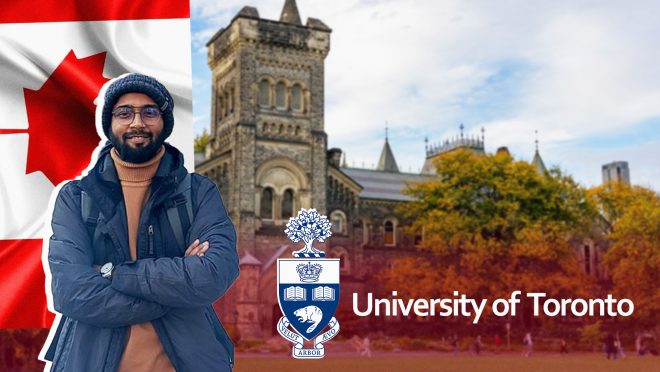
One such individual is Md. Hasibul Hasan. He, as with any other driven individual, resembled a sheer persona of perseverance and determination.
Currently pursuing a PhD in Mechanical and Industrial Engineering at the University of Toronto, we decided to have a talk with him to truly understand how someone from RUET, with his entire academic foundation built in Bangladesh, secured a post-grad position in Canada.
“I completed both my B.Sc. and M.Sc. in Materials Science and Engineering at the University of Rajshahi, Bangladesh.”
The decision to pursue a PhD didn’t come from external pressure or prestige chasing. It emerged internally during his undergraduate years while pursuing his B.Sc. in Materials Science and Engineering.
He realised quickly that research offered something deeper and more lasting than conventional career paths. He explained, “During my third year as an undergraduate, I developed a strong interest in research and realised that academic research aligned better with my long-term goals than conventional government or industrial jobs.”
In other words, this was a choice rooted in fate.
Choosing the University of Toronto was a calculated decision. He was looking for an institution where ambition would be matched by global relevance.
“The University of Toronto is Canada’s top-ranked university and consistently ranked among the world’s top 20–25, with world-class research facilities and outstanding faculty.”
His proposed research reflects that same precision. Rather than vague interests, his PhD application focused on a clearly defined, high-impact area at the intersection of materials science and applied engineering.
“My research focuses on aerogel fibre spinning from natural nanofibres to develop flexible, ultra-lightweight, and thermally insulating fibres for functional applications.”
However, the preparation towards getting a chance in such a competitively ranked university required careful planning. By the time he applied, his research profile was already mature. He said, “At the time of application, I had five journal articles published (3 as first author Q1, Q2) and four others under review in Q1 journals, also 4 conference papers.”
Several experiences strengthened his application, particularly collaborative research beyond his home department. He added, “Collaborative research work with government research institutes like BCSIR and Sonali Project Laboratory of BJMC helped me a lot.”
That level of productivity made him undeniable.
Preparation for the PhD application was not rushed or reactive. It was methodical and long-term, spanning more than a year. He said, “I prepared for over a year, focusing on publishing research, organising documents… preparing for language tests, building professional social profiles… and carefully shortlisting universities and potential supervisors.”
Finding a supervisor was approached with the same discipline. Rather than sending generic emails, he invested time in understanding faculty research and reaching out directly with intent. “I explored the university website, studied faculty research profiles, and contacted potential supervisors directly via email.”
His Statement of Purpose (SoP) was structured to tell a coherent story of the past, present, and future aligned.
“I highlighted my academic background, research alignment with the supervisor’s lab, my motivation for a PhD, future goals, how I could bring value to the university, and how my work could contribute to society.” It wasn’t just about what he wanted, but what he could give back.
Recommendation letters played a decisive role, and he chose referees strategically from people who truly knew his work. “I chose my thesis supervisor and co-supervisor, who knew my research abilities closely and provided strong, detailed recommendations.”
Financially, his PhD offer came with full funding, but even then, he approached it responsibly. “I carefully reviewed the funding details and living costs in Toronto before accepting the offer.” Planning, again, was key.
Looking outward, he identifies common mistakes future applicants make, most of them avoidable. “The common mistakes are giving up after rejections, poor document preparation, generic emails, weak CV formatting, and lack of follow-ups.” His emphasis is clear: preparation first, consistency always.
Finally, his advice mixes faith, self-belief, and realism. He doesn’t romanticise the process, but he doesn’t discourage it either. He said, “Believe in the Almighty, believe in yourself, stay patient, don’t fear rejection, and keep improving.”