Political manifestos and Bangladesh’s broken education system
It seems as with any other elections, education has taken a back seat amongst the different manifestos of respective parties.
Political manifestos and Bangladesh’s broken education system
It seems as with any other elections, education has taken a back seat amongst the different manifestos of respective parties.
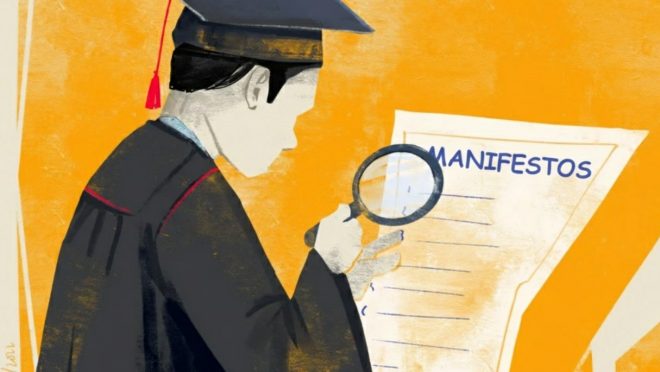
Considered as the backbone of a nation, the education sector currently is mired with a wide array of problems ranging from its lack of universality to the very curriculum currently being taught.
To be fair to the political parties, their manifestos contain calls for reforms and increased investments, but nowhere did any party provide a clear roadmap. A roadmap that actually provides the answer to the basic question, How?
How will you reform what is so intricately broken?
Scrutinising political policies is something that traditional Bengali culture is not used to. In researching this article, we have tried to get insights from multiple university professors and school teachers in order to know what the lacunae at the root stages are.
To our utter disappointment, not one teacher was willing to contribute their thoughts regarding the education related manifestos, further highlighting the immense sensitivity which the current political climate possesses in discussing real issues.
We did, however, contact a respected faculty member of the University of Rajshahi who wished to remain anonymous, and a development researcher currently teaching as a lecturer at Barishal University
With more inputs from current students studying both at home and abroad, this article hopes to dissect election manifestos of NCP, Jamaat and the BNP, not to stir up controversy but to truly understand why their steps are still not enough to fix the all-encompassing broken system.
National Citizens Party
Out of the three manifestos, objectively the NCP’s was the shallowest. With 36 points just mentioned in a PDF, it was hard for us to comprehend how these promises would come to fruition and what steps were needed.
Only three points, numbered 17, 18 and 19, are concerned with education.
- An Education Reform Commission will be formed to rationally coordinate all existing forms and systems of education. A separate salary structure for teachers will be implemented, and 75% of MPO-registered educational institutions will be nationalised within five years.
- To link higher education with careers, a six-month full-time internship or thesis research will be made mandatory at the undergraduate level.
- A reverse brain drain project will attract expatriate researchers through seniority and one-time funding for their labs. A national computing server will be established to give special emphasis to computational research.
Number 17, before mentioning anything else, calls for forming a reform commission.
Avoiding the need to write anything substantive for reform by calling for a commission itself was a clever bypassing of hiding their indifference.
However, according to our interviewee from RU, the mandatory internship or thesis work is possible. “At Rajshahi University, the teacher-student ratio varies across departments and institutes. But as a whole, there are enough faculty members to do the job,” explained our source.
When it comes to brain drain concerns, according to the RU teacher, “Political stability, better job opportunities, higher salary, and recognition of research” are key.
“A high-paying salary can offset opportunity costs and make return financially feasible for mid-career and senior researchers. This can be seen in a small number of universities that offer competitive pay and have successfully recruited faculty returning from prestigious overseas institutions,” shared Nafees Chowdhury, a former student of Dhaka University currently completing his MSc at Oxford University.
Perhaps a potential brain who might have to decide on the pitiful decision of staying abroad or coming back, opinions of people like Nafees are crucial. Moreover, according to him, money alone is not the issue here.
“Salary alone cannot substitute for weak research infrastructure with limited funding. Nor can an elite-only approach generate the scale needed to meaningfully reverse brain drain. For academic return to be sustained, competitive pay must be embedded within a broader framework that includes research funding, transparent career progression, and institutional support that allows scholars to remain globally relevant,” added Nafees.
Bangladesh Jamaat-e-Islami
Among the three parties, Jamaat’s manifesto may be the most high-reaching. With promises of investing 6% of GDP, Jamaat surely wants to indicate that it is emphasising education heavily.
However, here also lie issues of sustainability and feasibility. Bangladesh’s nominal GDP in 2025 is estimated to be approximately USD 459.6 billion to USD 467.2 billion. Six per cent of it is close to USD 27.576 billion.
From where this money will be collected? Especially considering Bangladesh’s tax-to-GDP ratio being embarrassingly low, and two-thirds of our revenue being generated through additional value-added taxes or VAT.
If USD 27 billion is to be invested, will it require citizens to pay more in VAT? Or will it solely be taken from corporate taxes? Both ways, the effect will be fully felt by the consumer, and more importantly, the most vulnerable poor.
Jamaat has also introduced another ambitious proposal. According to its manifesto, Bangla, Science, Maths and English will remain constant and identical subjects across all the different educational sectors, be it General (NCTB), English Medium, Ebtedaye, Alia or Qoumi.
A policy such as this may help in reducing inequality in teaching standards and may even help elevate standards in the NCTB curriculum. However, there is yet again no framework given as to why this policy will be viable and accepted by all stakeholders involved. And who, more importantly, will be in charge of deciding such a curriculum? Will the Oxford or Cambridge curriculum take precedence? Or are NCTB’s current books sufficiently resourceful?
There are further promises of scholarships and stipends in lieu of the 6% investment promise.
The fact that these questions were not deemed important enough to be answered is a clear indication that feasibility was not a concern while putting pen to paper.
Bangladesh Nationalist Party
In an age where the internet is far-reaching and, besides some rural areas, almost everywhere the current infrastructure supports mobile networks and Wi-Fi, why should there be such a policy of One Tab, One Teacher?
Precisely the question raised by Asim Abrar, a researcher and lecturer at the Department of Coastal Studies and Disaster Management, Barishal University.
Teachers’ training programmes in the past were often limited to teaching PowerPoint slide presentations, as little improvement was seen in classrooms when it came to teaching methods.
The creative question structure was such a failure that instead of forcing children to write answers in their own words, the questions became more predictable and thus PowerPoint slides and lecture notes became the staple of classrooms all over Bangladesh.
BNP’s feasibility questions also arise when it comes to introducing a third language. With English, according to many experts, acting as a barrier rather than a helping hand in ensuring proper education, why then is a third language going to make learning and utilising it any different?
The logistical challenges of ensuring properly trained third-language teachers are another issue. Some elite private schools may be able to afford it, but without universal implementation, this may prove another barrier and cause of inequality amongst different strata of society.
English as a subject has proven to be effective only in urbanised population centres, while the countryside still suffers from inadequate and poor-quality learning opportunities. Why this new third-language policy will not suffer the same fate is not something the BNP thought to mention in its manifesto.
The same concerns can be raised when it comes to the plan for implementing vocational education and training.
Unless thorough universality of education is ensured, and the cost mechanism concerning the thousands of coaching centres and inadequate teaching staff is met with effective policymaking, BNP’s plans may not prove to be implementable at all.
Throughout the three manifestos, Bangladesh’s political attitude towards the education sector has been fully exposed. Sadly, the brass seem not to care about policies backed by rigorous research and historical precedents. Rather, the promises made are often far-reaching goals mentioned which, as history proves, may end up under the cabinets of bureaucratic obscurity.
Such improper planning and lack of sustainable proposals are the misfortunes from which the Bangladeshi education system can never rise above.