Vinícius and the legacy of racism in football
“People did fight, way before my time, for us to be able to perform and entertain people. And to still be in 2026 dealing with the same thing, it’s tiring. Obviously, I can relate not only because of the colour of my skin, but because I’ve been there. I’ve been lonely.”
Vinícius and the legacy of racism in football
“People did fight, way before my time, for us to be able to perform and entertain people. And to still be in 2026 dealing with the same thing, it’s tiring. Obviously, I can relate not only because of the colour of my skin, but because I’ve been there. I’ve been lonely.”
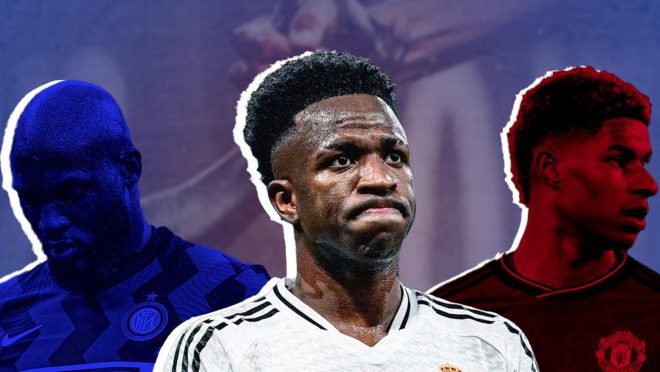
Thierry Henry uttered this statement in the wake of the racial abuse directed at Vinícius Júnior by a player of Benfica in a Champions League match.
It did not feel like a reaction to one incident; his words stretch across generations.
His words connect the terraces of the 1990s to the ultra-modern stadiums of 2026, yet here we are. Racism remains an uncomfortable and persistent issue that has cursed the sport for decades.
Vinícius’s experience, some might label it as a matter of “attitude” or “dramatic”, but one thing is clear: it is not an anomaly. In his case alone, there have been a total of 20 cases of racial abuse in his eight years at Real Madrid.
Football calls itself the “beautiful game”. The phrase captures its artistry and passion. But football also reflects society. And sometimes what it reflects is ugly.
A History That Never Really Ended
Such racial profiling in football is not a new phenomenon. It goes back much further.
The 1970s and 80s were characterised by relentless racism on the football terraces in England. Black footballers were a rare sight.
The frost had to be broken by a wave of brave first- and second-generation West Indian migrants.
Cyrille Regis, Laurie Cunningham, and Viv Anderson are some of the players of that time. Anderson, England’s first black footballer, said ‘racist abuse formed an ugly backdrop to some of his football career’, in a BBC interview.
Spain, Italy, England. Different settings, same pattern
Incidents involving Vinícius and several others in La Liga have made Spain reflect on the ongoing problem of racism in football.
The defining moment came in 2023, when Vinícius Júnior was racially abused by fans at Valencia’s Mestalla Stadium. The Real Madrid forward reacted, confronted the individual responsible, and criticised Spanish football’s failure to deal with the issue; he said “racism is normal in LaLiga”.
In 2006, Samuel Eto’o nearly walked off the pitch after monkey chants during a match whenever he touched the ball while playing for Barcelona.
In 2014, during a match between FC Barcelona and Villarreal CF, a fan threw a banana at Dani Alves. He calmly ate it and carried on playing. It sparked the #WeAreAllMonkeys campaign. It felt powerful.
But symbolism alone cannot dismantle a system that keeps reproducing the same behaviour. Alves, like Vinícius, was a regular target of racial abuse during his 12 years in Spain.
Racism is also a deep-rooted problem in Italian football. In 2019, Moïse Kean was subjected to monkey chants during a match against Cagliari. Instead of immediate solidarity, there was debate about his goal celebration.
Even his team-mate Leonardo Bonucci said his (Kean’s) celebration was partly to blame. That response revealed how normalised the issue had become. World Cup winners like Samuel Umtiti have also faced racist attacks from fans.
These are common episodes, unparalleled in Western Europe, suffered by players of African descent in the Italian football league and, more generally, by Black sportsmen, whether foreign or Italian, playing in the country.
Romelu Lukaku was also subjected to racial abuse in Italy by Cagliari fans, which was dismissed as part of the game.
Mario Balotelli’s situation has received more attention due to his polarising antics. He has endured repeated racist incidents throughout his career.
During a match for Brescia in 2019, an ultras leader of Verona made racist comments about Balotelli, after which he was banned.
England is no different. Players like Bukayo Saka, Marcus Rashford, and Jadon Sancho were targeted with racist abuse online after missing penalties in the Euro 2020 final.
Antonio Rüdiger, Raheem Sterling, Danny Welbeck, and several others have faced severe racial abuse, slurs, and monkey chants in the Premier League. Paul Pogba also faced the same online after missing a penalty.
Why does it still persist?
These attitudes mirror broader social tensions about immigration, labour markets, and national identity.
Across societies, racism often grows out of inequalities in employment and education, sometimes tolerated through media and organisations.
Despite years of campaigns like UEFA’s “No to Racism” and FIFA’s anti-discrimination codes, abuse continues.
According to Kick It Out, the anti-discrimination and inclusion charity, during the 2023–24 season there was a 47% increase in racism across all levels of the game.
The role of football’s governing bodies
So what can actually be done to tackle this issue? There is no quick fix.
Chelsea manager Liam Rosenior has called for lifetime bans for anyone guilty of racism in football.
Governing bodies cannot rely only on match bans or fines. They need to take more decisive action to uproot this problem completely.
The NBA showed how this can work. In 2018, Donald Sterling, owner of the Los Angeles Clippers, was fined $2.5 million and forced to sell the club after making racist remarks. Sometimes only a sledgehammer is necessary to send a clear message.
In football, these kinds of firm actions will make it easy for clubs, players, and fans to remember: tolerate racism and there will be consequences.
It might not erase the problem completely, but it could curb the behaviour. Similarly, it is also necessary to ensure that nobody takes advantage of this issue.
Ultimately, the sport cannot sit back and wait for society to fix itself. Turning a blind eye to such incidents only perpetuates the cycle. Football must start hammering down on racism.
If the sport truly wants to call itself the “beautiful game”, it has to show that beauty in its actions, not just in its play.