The death of the panjabi market
Remember the times when you could roam the market during Eid and be gently brushed in the face by a wide and vivid range of panjabis, kurtas and kablis?
The death of the panjabi market
Remember the times when you could roam the market during Eid and be gently brushed in the face by a wide and vivid range of panjabis, kurtas and kablis?
I remember the prices being affordable and accessible for students, job holders and people looking to give their loved ones something nice.
The clothes were colourful, with intricate designs that felt intentional, not copies of last year’s trend.
There was personality in the stitching and courage in the colours. You could tell when something was handmade or, at the very least, made with care. You bought a panjabi because it spoke to you, not because an Instagram post told you what Eid was supposed to look like.
Then the luxury panjabi brands arrived and smacked us in the face with their so-called premium pricing, which they cannot justify.
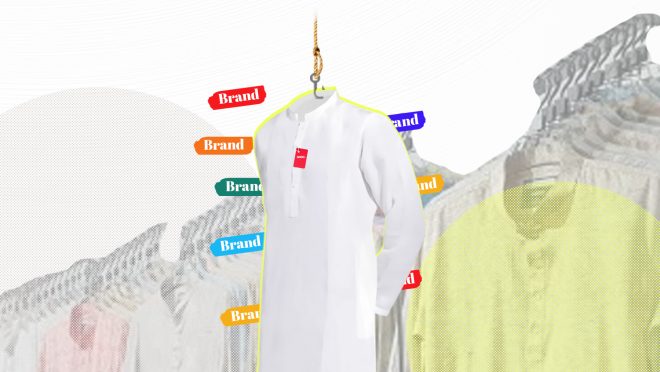
These brands focused on simplicity, but the type of simplicity that just seems lazy. Plain front and back, with perhaps a coloured cuff and collar. Panjabis like these have been trending because, apparently, according to designers, menswear must be simple. Too simple. Yet somehow we are expected to think of it as gorgeous. It feels like a scam, to be honest.
Somewhere along the way, luxury stopped meaning quality and started meaning absurd price tags inflated by English names, beige aesthetics and aggressively minimal Instagram feeds.
The colour drained first. Every rack began to look the same. Every panjabi became a variation of one tired silhouette, stamped with the same embroidery placed in the same predictable spot, justified with words like heritage, timeless and curated.
And the prices? Astronomical. Not because the fabric was rare or the craftsmanship revolutionary, but because exclusivity had to be manufactured somehow. Suddenly, a student could not afford Eid clothes without planning three months ahead. A middle-class job holder had to “invest” in a panjabi as if it were real estate. Gifting clothes, once an act of joy, became a financial decision weighed down by guilt.
Local designers, small shops and even brands that built their reputation on affordability were forced to increase prices just to stay relevant. Not because their costs suddenly tripled. Not because their craftsmanship magically evolved overnight. But because charging less began to look “cheap” in a market intoxicated by the idea of premium.
A panjabi that once cost a student a manageable amount now comes with a price tag that demands justification.
What is worse is that the vibe died with it.
Going to the market used to be chaotic in the best way. Loud bargaining. Friends hyping each other up. Shopkeepers pulling out “one last design” from under the counter as if it were contraband. You walked for hours, touched everything and tried things on for fun. You laughed. You argued. You discovered unexpected hidden gems. Shopping was not a transaction but an experience, a ritual, part of the build-up to Eid itself.
Now the market feels tense, calculated and joyless.
People walk in already defeated, doing mental arithmetic before they even touch a hanger. Shopkeepers look apologetic when they state the price. Bargaining feels embarrassing, almost insulting, because of the “fixed premium rate”. The thrill of discovery has been replaced with anxiety. The colours are muted, the racks are predictable and everything feels designed to be photographed rather than worn.
And somehow, this trend has convinced everyone that more money equals more taste. That if it is loud, it is tacky. If it is detailed, it is “too much”. So designers play it safe. Markets lose character. Individual style gets erased in favour of looking like every other man scrolling through the same Instagram feed.
It has forced everyone to chase an illusion and, in doing so, stripped Eid shopping of its soul. What we lost was not just affordability. We lost spontaneity. We lost fun. We lost that electric feeling of stepping into a crowded market knowing you would walk out with something that felt uniquely yours.
Now you walk out with a receipt, a hole in your wallet and the quiet suspicion that you have been played.